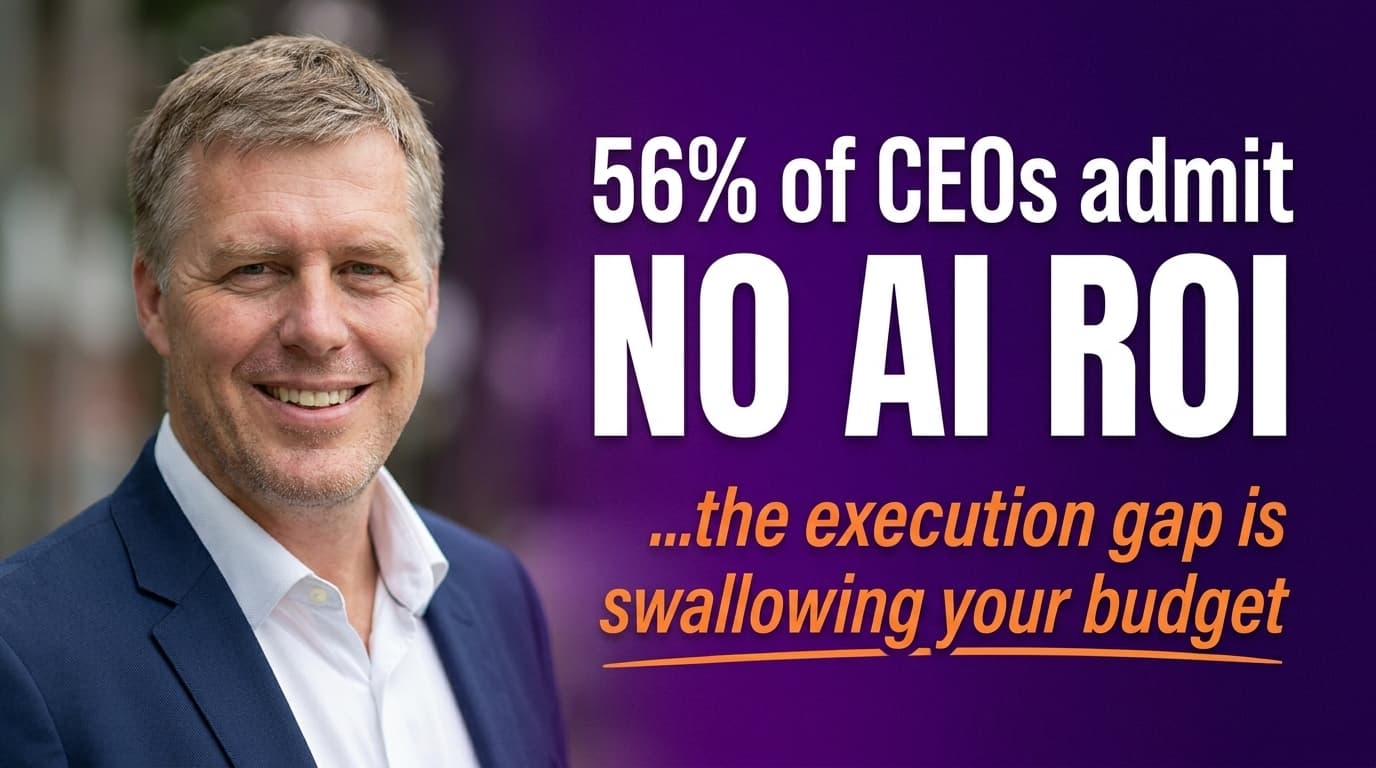
56% of CEOs report no ROI on AI, the execution gap explained
TL;DR
A PwC survey found that 56% of CEOs admit to seeing no return on their AI investment. Gartner's data is equally stark: 70% of IT leaders claim an AI strategy, but only 34% can execute it. The AI execution gap, the Grand Canyon between having a tool and using it to make money, is swallowing businesses whole. The answer isn't more spending; it's strategy-first, ruthlessly ROI-focused implementation.
Why are more than half of CEOs getting nothing back from AI?
The numbers deserve to be stated plainly.
- PwC survey: 56% of CEOs report zero measurable return on their AI investment
- Gartner report: 70% of IT leaders claim an AI strategy; only 34% can actually execute it
- That execution gap (more than half of leaders with a detailed map but no car, no petrol, and no driver's licence) is not a technology problem. It is a fundamental business failure.
The root cause is the same in boardrooms across the UK, Australia, and Singapore: businesses are treating AI like a lottery ticket. Dazzled by the jackpot, they are buying tickets with money they cannot afford to lose, without understanding how to play the game. They lack strategy, deep business integration, and the relentless focus on execution required to turn potential into profit.
What is the AI execution gap, and why does it matter?
The AI execution gap is the distance between a press release announcing your "AI-powered future" and actually delivering a better product or a more efficient service. It is the reason companies are pouring money into tools with fancy acronyms and expensive consultants, then sitting back waiting for a revolution that never arrives.
The bubble is stretching, getting thinner and more fragile by the day. When it bursts, companies that have spent fortunes with nothing to show for it will be exposed.
Businesses are buying complex enterprise solutions without a clear problem to solve, implementing tools without a defined use case, and then sitting back expecting a miracle. The AI spending bubble is fuelled by a toxic cocktail of hype and FOMO, and the fallout when it bursts will set back genuine innovation for years.
If Microsoft can stumble, what does that mean for you?
Microsoft went all-in on Copilot, weaving it into every corner of Windows 11. The promise was a seamless, AI-powered future. The reality was clunky, intrusive, and in many cases completely unnecessary: a solution in search of a problem.
The result: Microsoft is now actively scaling back Copilot integrations, pulling it from core applications including Notepad and Photos. A company with virtually unlimited resources, world-class talent, and enormous market power made a fundamental, public misstep because it prioritised hype over execution.
If Microsoft can get it that wrong, the question every business owner needs to sit with is uncomfortable: what chance do you have if you are doing the same thing at a fraction of the budget?
The Microsoft stumble is not a failure of AI. It is a textbook failure of execution, a multi-billion-dollar lesson that you get to learn for free.
See where AI fits in your business. Free.
A 45-minute audit. We map the highest-value automations and what they're worth in time and money. No pitch, no pressure.
What legal risks are most businesses sleepwalking into?
The financial waste is painful. The legal exposure could be existential.
- The City of Baltimore has taken the unprecedented step of suing Elon Musk's xAI over deepfake proliferation, arguing the technology constitutes a public nuisance causing real-world, tangible harm.
- Anthropic is in a legal battle with the Pentagon over the use, misuse, and control of AI models.
These are not edge cases. They are early signals of a new frontier of litigation where lines of responsibility are hopelessly blurred and potential damages are astronomical. Most businesses have given zero thought to defensible policies on data usage, algorithmic bias, or the ethical implications of AI-driven decisions. You are not just risking your initial investment; you are risking your brand's reputation, your legal standing, and potentially the existence of your company.
What is Singapore doing differently, and why does it work?
Singapore's approach is a masterclass in everything the rest of the world is getting wrong.
Rather than throwing money at the problem and hoping for the best, Singapore built an entire ecosystem:
- National AI Council: a unified body drawing on government, industry, and academia to provide a single national vision, not competing silos
- 400% tax deduction for SMEs investing in AI and training: a surgically targeted incentive focused on skills development, not vanity projects
- A dedicated AI park, a physical hub designed to foster innovation, serendipity, and collaboration
The critical difference is focus on execution over announcement. Singapore treats AI as a fundamental economic and social driver requiring careful, strategic, long-term planning, not as a marketing buzzword or a magical black box. It is a masterclass in strategy, and a lesson the rest of the world desperately needs to learn.
How should you approach AI investment instead?
Stop buying tools and start building a strategy. A real one.
A genuine AI strategy starts with the business problems you need to solve, not the technology you want to buy:
- Identify a real pain point, a process too slow, a cost too high, a customer experience falling short
- Work backwards from that problem to the solution
- Build or assign a team with the skills and the authority to execute
- Track, measure, and justify every pound spent on AI against tangible, measurable ROI
- Cut ruthlessly anything that is not delivering measurable value, have the courage to kill it
The "spray and pray" approach, buying a bit of this, subscribing to that, hoping something sticks, is a strategy for burning money. That approach is doomed. Every single pound, dollar, or yen you spend on AI must be tracked and justified. If it is not delivering, cut it.
What to do this week
- Audit your current AI spend. List every AI tool, subscription, and project active in your business. Next to each one, write the measurable business outcome it is delivering. If you cannot write one, that is your answer.
- Identify your single biggest operational pain point. Not the flashiest, not the one your board is excited about, the one that, if solved, would move the needle most on revenue or cost.
- Define one AI use case tied to that problem. One. Not five, not a roadmap. Define what success looks like in numbers before you spend a single pound.
- Assign a named owner for execution. A strategy without accountability is a wish list. Someone needs to own the result.
- Ask yourself the Microsoft question. If a company with virtually unlimited resources and world-class talent was forced into a public retreat, what does your current implementation look like under that same scrutiny?
Where to from here
Book a free 60-minute AI audit, we'll explore exactly what workflows are worth augmenting with AI.
Live with passion & AI,
Brett
Running an event? Put practical AI on your stage.
Keynotes and workshops that send business owners home with a plan they can use Monday morning. No hype.
Frequently asked questions
Why are so many CEOs seeing no return on AI investment?
+
According to PwC, 56% of CEOs admit they are seeing no measurable return on their AI investment. The core reason is a lack of execution strategy, businesses are buying tools without a defined problem to solve or a plan to measure results.
What is the AI execution gap?
+
The AI execution gap is the distance between claiming an AI strategy and actually implementing it. Gartner found that while 70% of IT leaders say they have an AI strategy, only 34% can actually execute it, a failure rate of more than half.
Why did Microsoft scale back Copilot?
+
Microsoft over-promised on Copilot's integration across Windows 11, and users found the experience clunky, intrusive, and unnecessary. Microsoft has since pulled Copilot from core applications including Notepad and Photos, a public retreat driven by execution failure, not AI failure.
What legal risks does AI create for businesses?
+
Legal exposure from AI is growing rapidly. The City of Baltimore is suing xAI over deepfake proliferation, and Anthropic is in litigation with the Pentagon over AI model use and control. Businesses without clear policies on data usage, algorithmic bias, and ethical AI decision-making face significant legal and reputational risk.
What is Singapore's AI strategy and why is it working?
+
Singapore established a National AI Council unifying government, industry, and academia, offers a 400% tax deduction for SMEs investing in AI and training, and built a dedicated AI park to foster collaboration. The strategy works because it prioritises long-term execution over short-term hype.
What should a business AI strategy actually look like?
+
A real AI strategy starts with a specific business problem, a process too slow, a cost too high, a customer experience falling short, and works backwards to the solution. Every pound spent must be tracked against measurable ROI, and anything not delivering tangible value should be cut.
Is the AI spending bubble going to burst?
+
The conditions for a correction are in place: massive spending, poor execution, and widespread inability to demonstrate measurable returns. When companies that have spent fortunes with nothing to show for it are exposed, the fallout could set back genuine innovation for years.

Brett is a four-time founder (Darra Tyres, Gladfish, EzyTrac, Anaboo) and the operator behind AIOS, Anaboo's AI Operating System. He writes from inside the build, installing AI in his own businesses first and reporting back what actually moves the numbers. Based between Singapore, the UK and Australia.