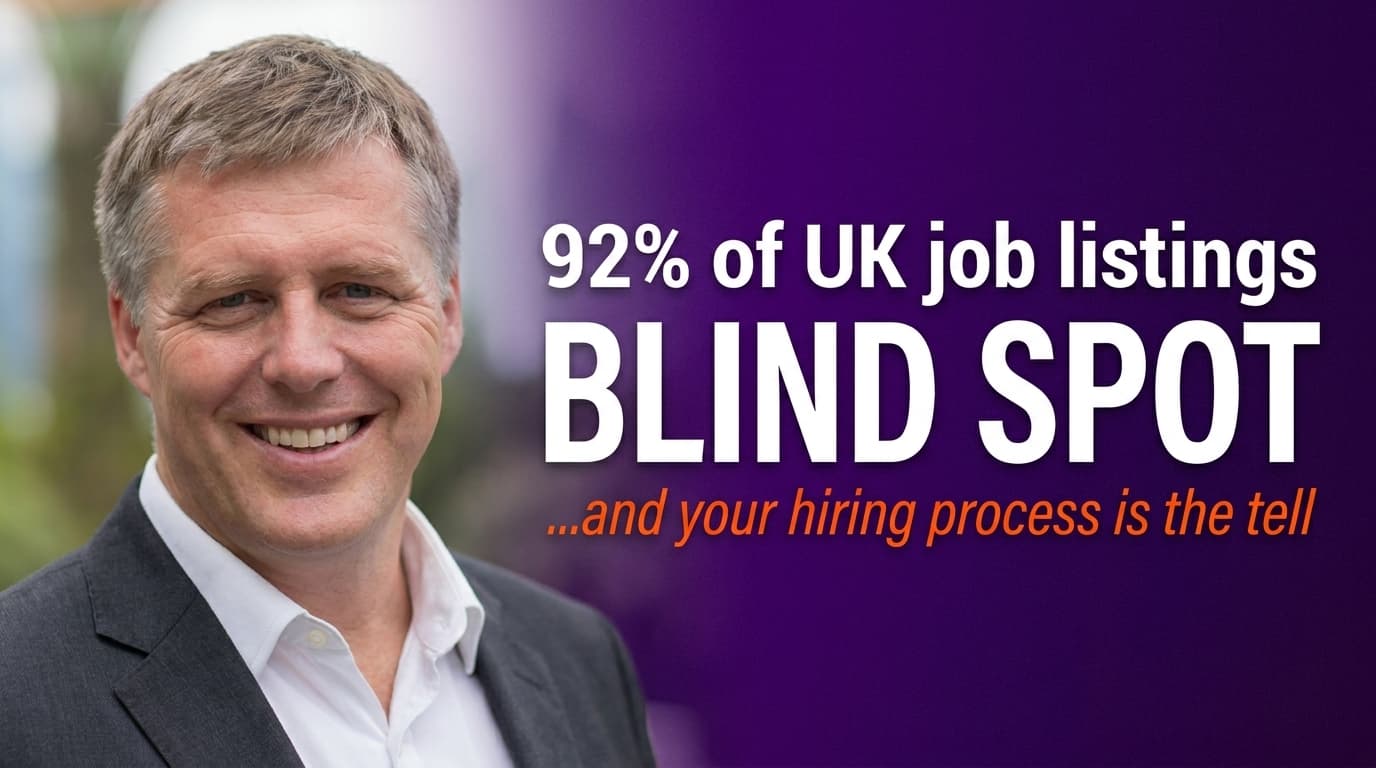
92% of UK job listings don't mention AI skills, and that's a crisis
TL;DR
A Prince AI Training study of over 1,000 UK office job listings found 92% contain zero mention of AI skills. Only 2.6% of non-technical roles, marketing, HR, finance, list AI skills as a genuine requirement. Meanwhile, Singapore is offering SMEs a 400% tax deduction on AI expenses and running a national adoption programme, while Australia's legal sector sits at 16% daily AI adoption against a global average of 49%. The UK is not just behind; it is actively constructing a skills debt that compounds with every hiring cycle.
What does the data actually show?
The Prince AI Training study put over 1,000 UK job listings for office roles under the microscope. The headline number is 92%: the share of listings that mention AI skills not at all. Dig deeper and it worsens.
- 92% of UK office job listings make no mention of AI skills
- Only 2.6% of non-technical roles list AI skills as a genuine requirement
- 72% of civil servants say they want access to AI tools to do their jobs better
- Only 29% have even been consulted about it
The silence in these job descriptions is not neutral. It is a diagnostic. It tells you that the majority of UK businesses have not yet accepted that the nature of work has fundamentally changed, and that their hiring process is the clearest evidence.
Why is this a leadership failure, not an IT problem?
Most business owners treat AI as a line item for the IT department: complex algorithms, servers humming in a dark room. That framing is entirely wrong, and it is costing them.
AI is a core business strategy problem. It shapes how you market, how you sell, how you manage your finances, and how you serve your customers. Hiring people who cannot operate in that context is not cautious, it is self-defeating.
The gap between what is possible with AI and what your team can actually do with it is widening every single day you choose to ignore it. This isn't just a skills gap; it's a leadership failure.
Your employees are already ahead of you on this. Seventy-two per cent of civil servants want AI tools. Only 29% have been asked. The appetite for transformation exists at every level of the organisation. The blockage is at the top.
How does Singapore make UK inaction look negligent?
Singapore's response to the AI era is worth studying not because it is aspirational, but because it makes inaction look reckless by comparison.
For SMEs, Singapore has introduced a 400% tax deduction on AI-related expenses. The government is not nudging businesses towards adoption; it is making it financially irrational not to adopt. Alongside this, the "Champions of AI" programme identifies and resources companies leading the charge, providing mentorship, visibility, and a platform to become global competitors.
This is a comprehensive national strategy: education, infrastructure, investment, and incentives working in concert. Singapore is building a generation of AI-native businesses and workers. The UK is still debating whether to get in the pool.
See where AI fits in your business. Free.
A 45-minute audit. We map the highest-value automations and what they're worth in time and money. No pitch, no pressure.
What does Australia's legal sector tell us?
Australia's legal industry is a useful case study because it should be an obvious early adopter: mountains of documents, volumes of precedent, high-value billable hours at stake.
The daily AI adoption rate in Australian legal firms sits at 16%. Globally, that figure is 49%. Australian firms are running at roughly one-third the pace of their international competitors, not because the technology is unavailable, but because the industry is hesitant, risk-averse, and unprepared.
The focus on what AI might do wrong is paralysing businesses from embracing what it can do right, right now. That hesitation produces a vicious cycle: businesses do not invest in AI because the workforce is not skilled, and the workforce does not get skilled because businesses are not investing. Only bold leadership breaks that loop. And both the UK and Australia are waiting for someone else to go first.
What is the skills debt you are building right now?
Every hire you make without considering AI capability adds to a skills debt inside your business. Every time you skip the upskilling conversation with your existing team, that debt compounds. It is invisible on a balance sheet today. It will show up as missed opportunities, lost market share, and competitors who operate faster, smarter, and cheaper.
You cannot outsource this to government. You cannot wait for the education system to catch up. The pace of change is too fast. The shift required is from passive consumer of talent to active creator of it, a culture of learning and adaptation built deliberately, inside your own walls.
This is not about replacing your team with data scientists. It is about looking at your marketing manager and asking: "How can AI help you identify new customer segments?" It is about asking your finance team: "What insights can AI surface from our cash flow data?" It is about giving the people who already know your business the tools to operate at a higher level.
What to do this week
- Audit your last five job descriptions. Count how many mention AI skills or AI literacy. If the answer is zero, rewrite at least one this week, including for roles in marketing, finance, or operations.
- Ask your team. Find out who is already using AI tools on their own initiative. They are your internal champions. Resource them rather than ignore them.
- Pick one bottleneck. Choose one repetitive, time-consuming task draining your team's energy. Spend one hour researching whether an AI tool addresses it. It almost certainly does.
- Run one pilot. You do not need a company-wide rollout. You need one project, one team, one measurable outcome. Learn from it, then expand.
- Change your hiring brief. From your next hire onwards, include AI literacy as a stated criterion, for every role, not just technical ones.
The compounding effect of starting now versus waiting another quarter is significant. The compounding effect of another year of inaction may be irreversible.
Where to from here
Book a free 60-minute AI audit, we'll explore exactly what workflows are worth augmenting with AI.
Live with passion & AI,
Brett
Need an AI operator inside your team?
Place a Chief AI Officer, an AI Officer, or embed an Anaboo Forward Deployed Engineer for 3–6 months.
Frequently asked questions
What percentage of UK job listings mention AI skills?
+
According to a Prince AI Training study of over 1,000 UK office job listings, 92% make no mention of AI skills at all. Only 2.6% of non-technical roles, including marketing, HR, and finance, list AI skills as a genuine requirement.
What is the Prince AI Training study?
+
The Prince AI Training study analysed over 1,000 UK job listings for office roles to measure how frequently AI skills appear as a stated requirement. Its findings revealed a near-total absence of AI literacy expectations across non-technical hiring.
How is Singapore supporting AI adoption for small businesses?
+
Singapore has introduced a 400% tax deduction on AI-related expenses for SMEs, making AI adoption financially compelling rather than optional. The government has also launched a 'Champions of AI' programme to identify, resource, and mentor businesses leading AI adoption nationally.
What is the daily AI adoption rate in Australia's legal sector?
+
Daily AI adoption in Australian legal firms sits at just 16%, compared to a global average of approximately 49%. Australian firms are operating at roughly one-third the pace of their international competitors, despite the legal sector being an obvious candidate for AI-driven efficiency.
What is a skills debt and how does it affect my business?
+
A skills debt accumulates every time you hire without considering AI capability and every time you skip investing in upskilling your existing team. It does not appear on a balance sheet today, but it will materialise as missed opportunities, lost market share, and slower operations compared to AI-enabled competitors.
Should I only hire data scientists to address the AI skills gap?
+
No. The AI skills gap is not an IT problem, it is a business strategy problem. The priority is equipping existing roles in marketing, finance, operations, and HR with the ability to leverage AI tools relevant to their function, not replacing teams with specialists.
What is the fastest way to start addressing AI skills in my business?
+
Start with one bottleneck, a repetitive, time-consuming task, and research whether an AI tool exists to address it. Run a single pilot project, measure the outcome, and expand from there. Simultaneously, update your hiring briefs to include AI literacy as a criterion for every role, not just technical ones.

Brett is a four-time founder (Darra Tyres, Gladfish, EzyTrac, Anaboo) and the operator behind AIOS, Anaboo's AI Operating System. He writes from inside the build, installing AI in his own businesses first and reporting back what actually moves the numbers. Based between Singapore, the UK and Australia.