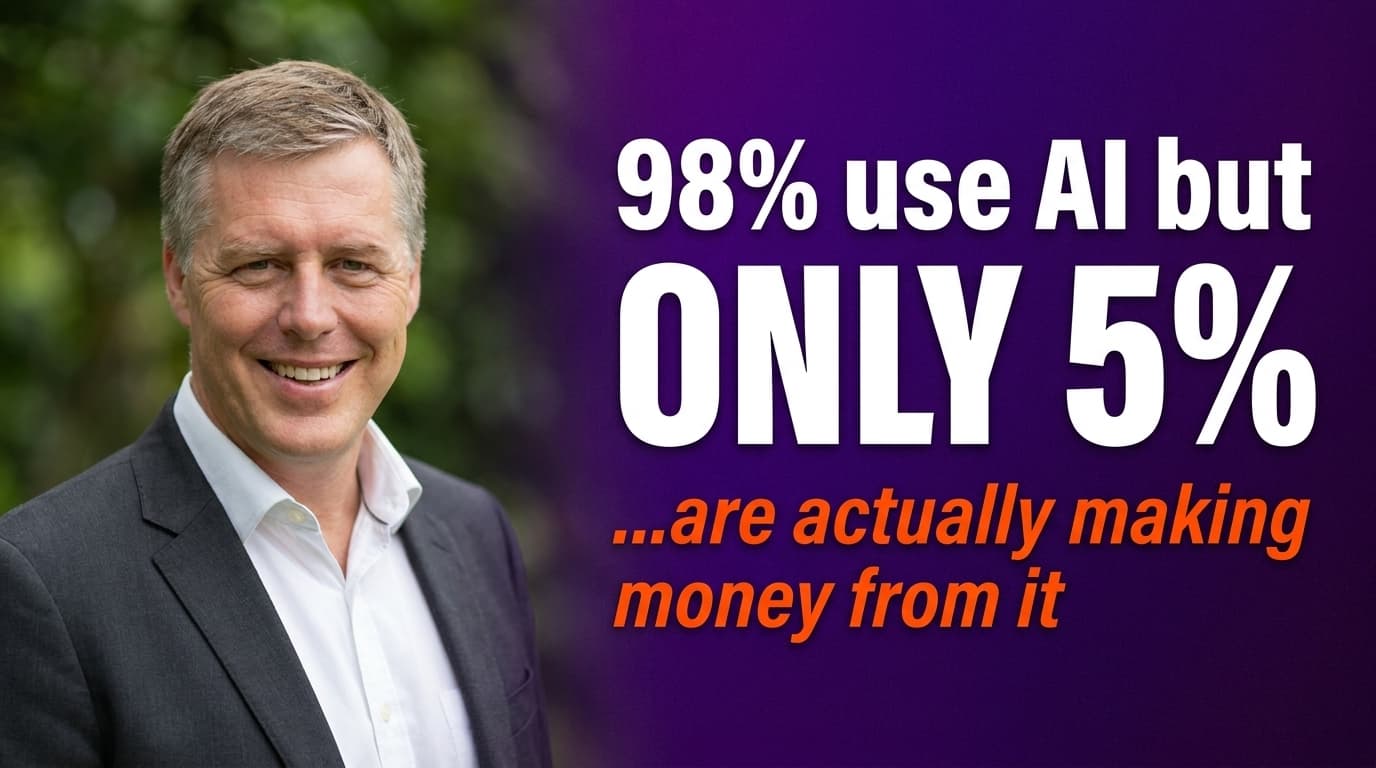
98% of companies use AI, only 5% are making money from it
TL;DR
A recent report found 98% of organisations are now deploying generative AI, yet only 5% have seen a million-dollar impact. Businesses are spending fortunes on tools without redesigning the processes underneath them. The companies actually winning, Atlassian, WiseTech, aren't layering AI on top of existing operations; they're rebuilding their businesses around AI entirely. A Lloyds Bank study shows that when implementation is done right, 70% of businesses see significant productivity gains and 42% see profit increases.
Why are 95% of businesses getting no return from AI?
The biggest untold story in AI right now is the return on investment crisis. Founders and CEOs are spending fortunes on tools and their P&L hasn't moved. For many, it's actually getting worse.
Here's the data:
- 98% of organisations are deploying generative AI
- Only 5% have seen a million-dollar impact
- That's 95 out of every 100 companies on the AI bandwagon burning cash
This is innovation theatre. Businesses are ticking the AI box, buying software, running workshops, hiring consultants, without anything changing in the results column. The software vendors are winning. Everyone else is digging up dirt.
What does the typical AI failure actually look like?
Picture a founder in logistics who spent the better part of a year and a couple of hundred grand on an AI-powered demand forecasting system. The dashboard looked impressive. The graphs were slick. But when asked how it had changed the way the team worked, there was no answer.
The team was still using their old spreadsheets to "double-check" the AI's predictions. They didn't trust it. The expensive AI system was just a glorified, and very costly, calculator.
They'd bolted a Ferrari engine onto a horse-drawn cart. The process was still human-centric. The AI was just a passenger.
This is the core problem. Businesses treat AI like another piece of software, bolt it onto broken, inefficient, human-centric processes, and expect a miracle. The problem isn't the technology. It's the thinking. Until the thinking changes, the 95% failure rate isn't going anywhere.
Who are the 5% getting it right, and what are they doing differently?
Look at the outliers: Atlassian and WiseTech. These companies aren't tinkering with AI at the edges.
- Atlassian recently restructured, removing 1,600 roles
- WiseTech is cutting 2,000 positions
This isn't cost-cutting. It's a radical restructuring, a signal that these businesses are rebuilding their entire operations around AI. They're not asking how to make an existing process slightly faster. They're asking how an AI can own an entire workflow from start to finish.
They've accepted the uncomfortable truth: real AI transformation isn't a software subscription. It means looking at every single process and asking how an AI can execute it end to end. It means redesigning workflows to be event-driven and AI-first. It means moving from a model where humans are the actors and AI is the assistant, to one where AI is the actor and humans are the exception handlers.
That's a tough pill for most leaders. It means admitting that the way things have been done for years, sometimes decades, is no longer fit for purpose. Not a popular message. But the reality is that the companies willing to have those conversations are the ones that are going to win.
See where AI fits in your business. Free.
A 45-minute audit. We map the highest-value automations and what they're worth in time and money. No pitch, no pressure.
What is agentic AI, and why does it change everything?
The shift from the 95% to the 5% comes down to one idea: moving from AI as a productivity tool to building agentic AI.
As CIO.com has reported, agentic AI isn't another chatbot. It's autonomous systems that execute end-to-end processes, reasoning, making decisions, and taking action with minimal human intervention. These aren't dumb bots following a script. They're intelligent agents that understand context, learn from mistakes, and adapt to new situations.
For the last 50 years, software has been built to help humans do their jobs better. Calculators, spreadsheets, AI co-pilots, the human has always been at the centre. Agentic AI flips that entirely:
- The AI becomes the worker
- The human becomes the manager, the strategist, the exception handler
- The human's job shifts from doing the work to designing the work, setting goals, defining rules, handling the edge cases the AI can't
This is the fundamental difference between the 5% who are winning and the 95% who aren't. The winners aren't just automating tasks, they're automating entire workflows. They're not augmenting a human workforce; they're building a new, digital one. And that's why they're seeing results the rest of the market can only dream of.
What do the numbers say when AI is done right?
A Lloyds Bank study of businesses properly implementing AI found:
- 70% saw significant productivity gains
- 42% reported profit increases
These aren't marginal improvements. A 42% profit increase is the kind of step-change that moves a business from struggling to market leader. This is the prize on offer for businesses willing to do the hard work, the difference between being a disruptor and being disrupted.
A client in the recruitment space shows what this looks like in practice. Their team was spending all day sifting through CVs, soul-destroying, repetitive work costing a fortune in lost productivity. An AI-first workflow was built to read every CV, match candidates to the job description, and automatically schedule interviews with the top applicants. The result: an 80% reduction in time-to-hire, with more placements than ever before.
Their recruiters weren't replaced. They were freed to focus on relationship-building and closing deals, the work only humans do well. They didn't bolt AI onto the old process. They built a new process around AI. That's the distinction.
Why isn't everyone making this shift?
The barrier isn't technology. The tools are accessible. The knowledge is there.
The barrier is leadership. It's far easier to buy a new tool and tell everyone you're "doing AI" than to look your team in the eye and say the way they've worked for the last 20 years is now obsolete. Most businesses are clinging to existing processes, hoping this whole AI thing will blow over.
This is a fundamental shift in the way the world works. The companies that don't adapt won't catch up later, they'll be left behind.
The businesses willing to have the hard conversations are the ones building durable competitive advantage. The rest are rearranging deck chairs. It's a brutal, unforgiving landscape, but it's also a massive opportunity for those brave enough to move.
How do you start if you're not a tech giant?
You don't need to be Atlassian. You don't need a thousand engineers. The tools are accessible to businesses of every size. The only missing ingredient is the willingness to rethink how work gets done.
If you're in the 98%, you've bought the tools, encouraged your team to use them, but the P&L hasn't moved, the answer isn't more tools. It's a different operating model. Stop bolting AI onto old, broken processes. Start redesigning workflows to be event-driven and AI-first. Stop asking how to make your people more efficient. Start asking how to make your processes more autonomous.
This isn't about replacing your team. It's about elevating them, freeing them from the mundane, repetitive tasks that drain energy and creativity, and allowing them to focus on the high-value work that only humans can do. Turning a group of doers into a team of thinkers, strategists, and relationship-builders.
What to do this week
Pick one bottleneck. Choose one process in your business that is painful, repetitive, and time-consuming, lead generation, customer support, scheduling. One thing, not everything.
Change the question. Don't ask: "How can my team do this faster?" Ask instead: "How could an AI do this entire process from start to finish?" That question unlocks the real value.
Map it out. Write down the inputs, the outputs, and every decision point in between. That's your agentic workflow blueprint.
Find the tools. For each step in the process, research what AI tools can automate it. You'll be surprised how much is already possible.
Run a pilot. Automate one step first. Measure the result. Build from there. Don't try to boil the ocean.
The 70% productivity gains and 42% profit increases in the Lloyds Bank data aren't reserved for tech giants. They're available to any business that stops treating AI as a feature and starts treating it as an operating model.
Where to from here
Book a free 60-minute AI audit, we'll explore exactly what workflows are worth augmenting with AI.
Live with passion & AI,
Brett
Want this installed in your business?
Bespoke AI implementation across your operations: strategy, build, rollout, and ongoing drift maintenance.
Frequently asked questions
What percentage of companies are seeing a return on their AI investment?
+
According to a recent report, 98% of organisations are now deploying generative AI, but only 5% have seen a million-dollar impact from it.
Why are most businesses failing to get ROI from AI?
+
The core problem is bolting AI onto existing, human-centric processes without redesigning how work gets done. Businesses accumulate AI expense without structural gain because the process remains human-centric and the AI ends up as a passenger.
What is agentic AI?
+
Agentic AI refers to autonomous systems that execute end-to-end processes, reasoning, making decisions, and taking action with minimal human intervention. Instead of assisting humans, AI agents become the worker while humans shift to managing, strategising, and handling exceptions.
Which companies are successfully restructuring around AI?
+
Atlassian and WiseTech are cited as examples. Atlassian removed 1,600 roles and WiseTech is cutting 2,000 positions, not as cost-cutting measures, but as a radical restructuring to rebuild their entire operations around AI.
What productivity and profit gains do businesses see when AI is properly implemented?
+
A Lloyds Bank study found that businesses properly implementing AI saw 70% experiencing significant productivity gains and 42% reporting profit increases.
What does a real-world agentic AI success look like?
+
A recruitment business built an AI-first workflow to read every CV, match candidates to job descriptions, and automatically schedule interviews with top candidates. The result was an 80% reduction in time-to-hire with more placements than before.
How do you start moving toward an AI-first business model?
+
Pick one bottleneck process, then ask not how your team can do it faster, but how an AI could handle it end to end. Map the inputs, outputs, and decision points, then find tools to automate each step, start with one workflow and build from there.

Brett is a four-time founder (Darra Tyres, Gladfish, EzyTrac, Anaboo) and the operator behind AIOS, Anaboo's AI Operating System. He writes from inside the build, installing AI in his own businesses first and reporting back what actually moves the numbers. Based between Singapore, the UK and Australia.