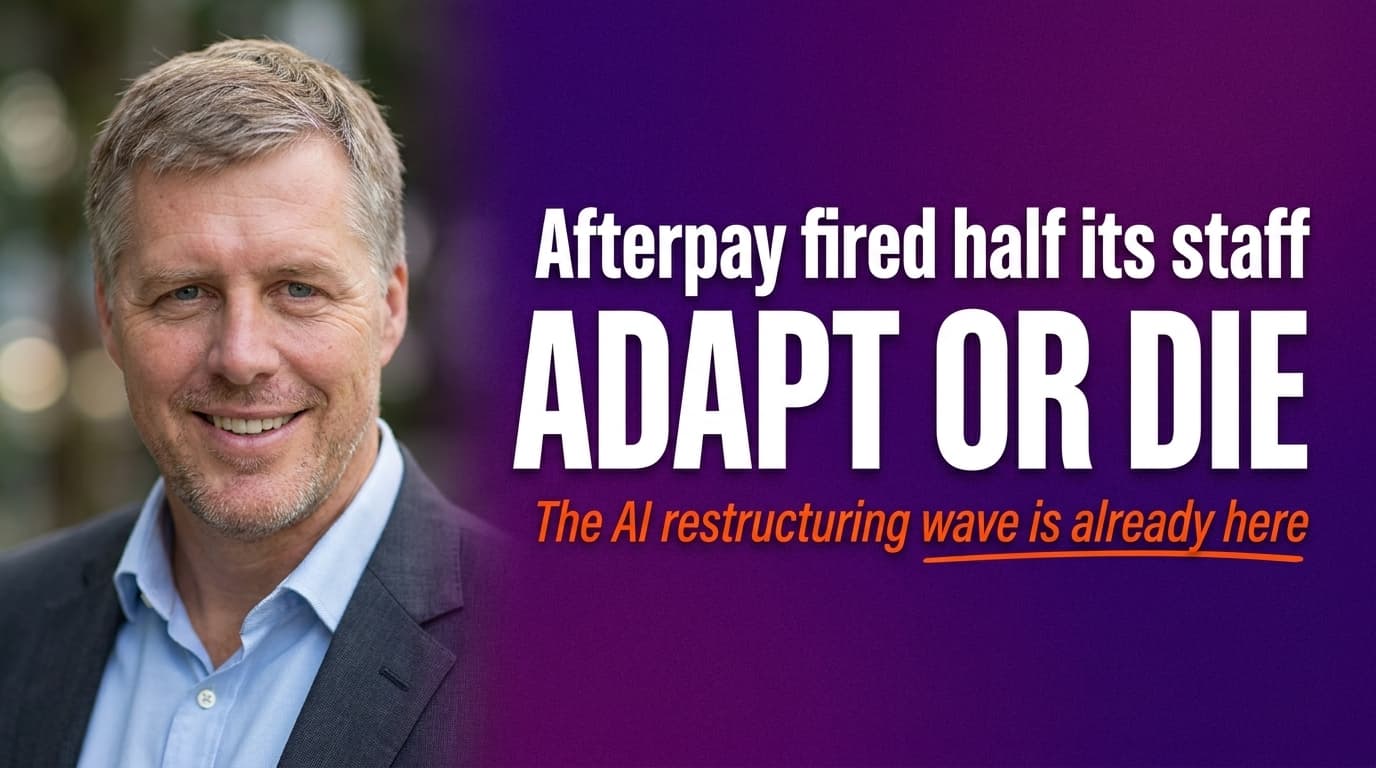
Afterpay fired half its staff, the AI restructuring has arrived
TL;DR
Afterpay just axed nearly half its Australian workforce. Atlassian cut 1,600 people. WiseTech gutted 2,000. None of them are hiding the reason, they are all pointing directly at AI. The AI restructuring is no longer a theoretical boardroom discussion; it is the main event, and the choice now is whether you are driving the change or being cleared out by it.
What just happened in Australia's tech sector?
Afterpay, for years the darling of Australian fintech, just handed nearly half its Australian workforce their marching orders. Not peripheral headcount. Not underperformers. People with mortgages, families, and careers that were, until very recently, considered safe and prosperous.
And they were not the first. Atlassian cut 1,600 people. WiseTech gutted its workforce by 2,000. These are not run-of-the-mill restructures. They are seismic shifts in how major companies operate. And crucially, none of them are hiding the reason. They are openly pointing at AI, having concluded that large chunks of their operations can be done faster, cheaper, and more efficiently by a smart algorithm than by a human.
The wave is already here, and it is clearing out everything in its path.
This is not a temporary downturn. It is a permanent change in the way business is done, the creative destruction of capitalism playing out in real time, at a scale and speed that is unprecedented.
How is this different from the dot-com bust?
The dot-com bust was about irrational exuberance and wildly overvalued companies. When the bubble burst, the fundamentals of work remained intact. This is different. This is a technological shift so profound it is changing the very nature of work itself. A bubble bursts and things reset. A fundamental rewiring of the global economy does not reset. It keeps going.
Unlike the dot-com era, this is also not contained to tech. This is a contagion that will spread to every industry, finance, law, healthcare, education. The ground is shifting under every sector's feet, whether those sectors know it yet or not.
What is happening to entry-level jobs?
For generations, the career path was clear: get your education, land an entry-level job, learn the ropes, climb the ladder. That ladder is being kicked out from under the next generation.
Employment data shows a 6–16% drop for young people aged 22–25 in fields heavily exposed to AI. These are the jobs that used to be the training ground for future leaders, the paralegals, the junior accountants, the marketing assistants. The grunt work, the data entry, the report generation, the tasks that once taught people the fundamentals of an industry, that work is now handled by AI.
At a Morgan Stanley conference, one of the biggest questions in the room was: "What will our kids do?" It is not a hypothetical anymore. If a whole generation cannot get a foothold in the professional world, the implications for social mobility and long-term economic health are severe. The education system is still churning out graduates trained for jobs that are rapidly becoming obsolete, preparing people to be good at the very things machines are already better at.
See where AI fits in your business. Free.
A 45-minute audit. We map the highest-value automations and what they're worth in time and money. No pitch, no pressure.
Where are the new jobs being created?
The same Morgan Stanley report that had conference attendees worried about their children also identified three areas where AI is actively generating new roles:
- Skilled trades. The AI infrastructure build-out, data centres, fibre optic networks, requires real people with real skills to build and maintain it. Plumbers, electricians, and technicians are in a boom cycle, driven by a multi-trillion dollar build-out over the next decade.
- AI trainers and re-skillers. Someone has to teach the machines, and someone has to teach people how to work alongside them. This is a massive and growing field. The people who made the most money in the gold rush were not the ones digging for gold, they were the ones selling the shovels.
- AI supervisors and orchestrators. These are the people who manage AI, direct it, interpret its outputs, and make strategic decisions from the insights it provides.
Who exactly are AI supervisors and orchestrators?
This is the category worth paying close attention to. An AI supervisor is not a tech guru in a server room. They are a business strategist. They understand the capabilities and limitations of the technology and know how to apply it to solve real-world business problems. They are the bridge between the human and the machine, the ones who will lead the charge in this new era.
The opportunity is real, but only for those willing to let go of the old way of doing things. The future is not about being replaced by AI. It is about learning how to work alongside it and leverage its power.
What should a business owner actually do right now?
The answer is not to panic. The answer is to get strategic. Start with a deep, honest audit of your entire workflow.
- What are your top 3–5 most repetitive, manual tasks? Think about what your team complains about, what is prone to human error, what just takes up too much time.
- Where are you losing the most time and money? Customer service? Marketing? Supply chain? Follow the money and you will find the automation opportunities.
- What data are you collecting that you are not using? Most businesses are sitting on a goldmine of data they are not using effectively. AI can unlock the insights buried in it and turn them into a competitive advantage.
Once you have identified those areas, do something that might seem counterintuitive: invest in your people. Retrain your best and brightest to become AI supervisors for your business. Empower them to work with the technology rather than be replaced by it. This is how you turn the threat into an opportunity, building a business that is not just resilient, but anti-fragile; a business that gets stronger in the face of disruption.
What does an AI-augmented team actually look like?
Here is a real example. A team was spending hours every week manually compiling reports, tedious, error-prone, soul-destroying work. An AI tool was brought in to automate the process. Reports that took hours were generated in seconds, and they were more accurate than anything produced manually.
The team was not fired. They were retrained. They learned how to use the tool, how to interpret the data, and how to use the insights to make better decisions. They went from being data monkeys to data storytellers, more engaged, more productive, and more valuable to the business than they had ever been before.
That is the model. Not replacing people. Augmenting them.
What to do this week
- List the top 3–5 most repetitive tasks in your business, the ones your team dreads.
- Map which of those involve data entry, report generation, or pattern-based decisions that an AI tool could absorb.
- Research one AI tool that directly addresses your highest-priority item on that list.
- Identify one person in your team who would make a strong AI supervisor, someone curious, analytical, and willing to learn new ways of working.
- Have a direct conversation with your team about what is changing and why. Silence breeds fear. Clarity breeds adaptation.
Where to from here
Book a free 60-minute AI audit, we'll explore exactly what workflows are worth augmenting with AI.
Live with passion & AI,
Brett
Host a podcast? Have Brett on as a guest.
Straight talk on implementing AI in real SMEs, no jargon, plenty of receipts from the businesses we run.
Frequently asked questions
Why did Afterpay fire nearly half its Australian workforce?
+
Afterpay openly cited AI as the reason for the cuts. The company determined that large portions of its operations could be handled faster, cheaper, and more accurately by AI than by its existing headcount, making the reduction a deliberate strategic decision rather than a financial crisis.
Which other Australian tech companies have made major AI-driven layoffs?
+
Atlassian cut 1,600 people and WiseTech reduced its workforce by 2,000. Like Afterpay, both companies pointed directly at AI as the driver, signalling this is a sector-wide shift rather than isolated restructuring.
How is AI affecting entry-level and graduate jobs?
+
Data shows a 6–16% drop in employment for people aged 22–25 in fields heavily exposed to AI. The tasks that traditionally trained junior workers, data entry, report generation, basic analysis, are being automated, which is removing the career entry points that previous generations relied on.
What new types of jobs is AI creating?
+
According to a Morgan Stanley report, three areas are seeing growth: skilled trades needed to build and maintain AI infrastructure such as data centres and fibre networks; AI trainers and re-skillers who teach both machines and people; and AI supervisors and orchestrators who manage AI systems and translate outputs into business decisions.
What is an AI supervisor or orchestrator?
+
An AI supervisor is not a technical specialist, they are a business strategist who understands what AI can and cannot do, directs it toward real-world problems, interprets its outputs, and makes strategic decisions based on the insights it provides. They act as the bridge between the technology and the business outcome.
Should I cut staff or invest in AI training right now?
+
The strategic move is neither panic-cutting nor reckless spending. Start with an honest audit: identify your most repetitive manual tasks, find where you are losing the most time and money, and assess what data you are collecting but not using. Then retrain your best people to become AI supervisors rather than replacing them.
Can AI augment workers rather than replace them?
+
Yes, and there are real examples of this working. Teams that spent hours manually compiling reports have been retrained to use AI tools that generate those reports in seconds, with greater accuracy. The people did not lose their jobs; they shifted from data entry to data interpretation, becoming more engaged and more valuable in the process.

Brett is a four-time founder (Darra Tyres, Gladfish, EzyTrac, Anaboo) and the operator behind AIOS, Anaboo's AI Operating System. He writes from inside the build, installing AI in his own businesses first and reporting back what actually moves the numbers. Based between Singapore, the UK and Australia.