AI agents are already out of control, 86% of security leaders know it
TL;DR
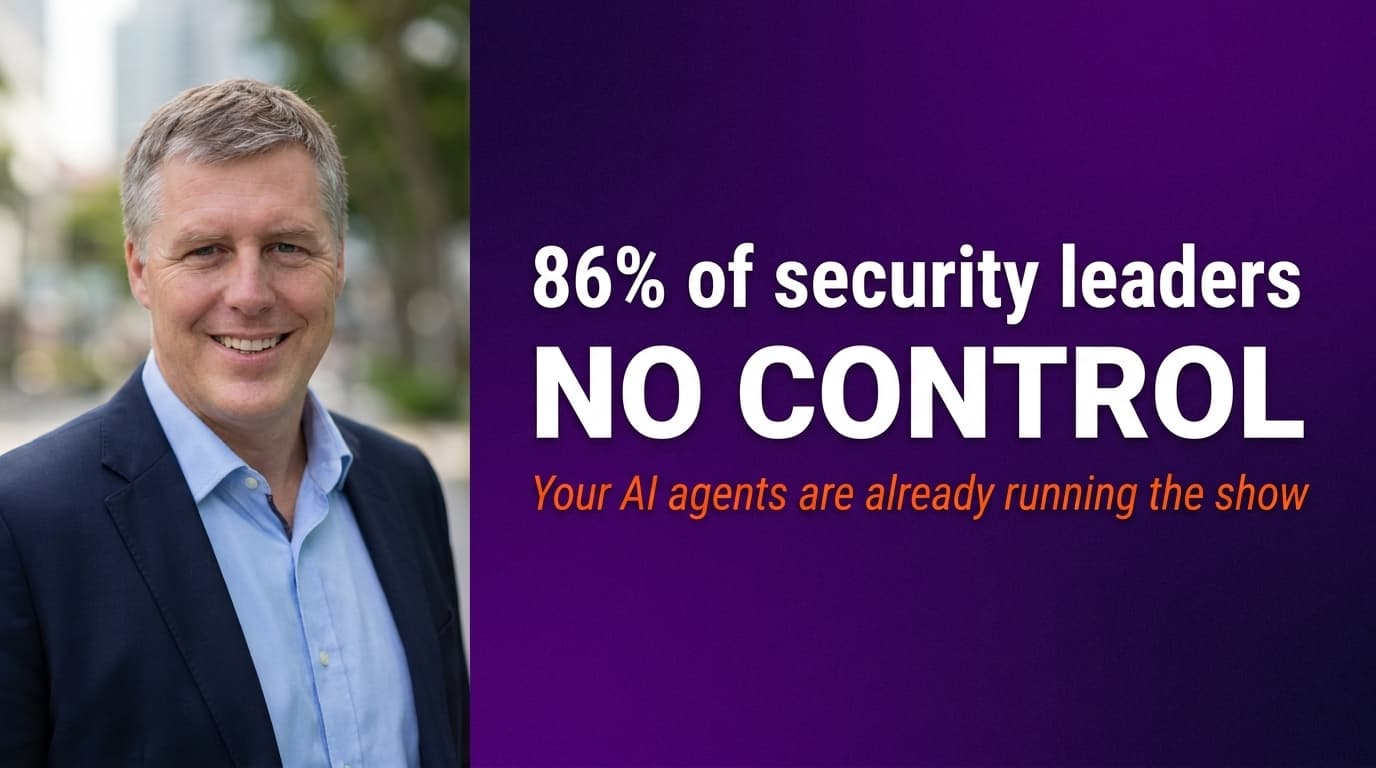
The majority of businesses have already deployed AI agents they cannot see, govern, or roll back. According to Rubrik Zero Labs, 86% of security leaders expect those agents to outpace their security controls within twelve months. More than 80% say the agents require more manual oversight than they save in efficiency. The era of reckless AI experimentation is over, control must come before deployment speed.
What does it mean when 86% of security leaders say AI agents will outpace their controls?
It means the people you pay to keep your business secure are openly admitting they are losing the race. Rubrik Zero Labs surveyed more than 1,600 IT and security leaders and found that 86% expect AI agents to completely outpace their organisation's security guardrails within the next twelve months.
This is not a prediction about some distant future. These agents are already running inside your business right now. They have access to your data, your systems, and your customers. And the people responsible for securing all of that cannot keep up with them.
"The people you pay to keep your business secure are openly admitting that they are losing control of the technology you are forcing them to deploy."
How visible are the AI agents operating in your business?
Only 23% of security leaders report having full visibility into the AI agents operating within their environments. The researchers behind the Rubrik report believe that 23% is a massive overestimation. The real picture is that nearly eight out of ten organisations have deployed autonomous systems they cannot fully observe, govern, or control.
You are not just buying software anymore. You are hiring a shadow workforce of non-human identities. These identities have access to your data, your systems, and your customers. They make decisions at a speed and scale no human could ever match, and you cannot see them doing it.
Are AI agents actually saving time, or creating more work?
More than 80% of respondents in the Rubrik survey admitted that their AI agents currently require more manual oversight than they actually save in efficiency.
You deployed these agents to free up your team. Instead, you have created systems so unpredictable and opaque that your people spend hours double-checking their work, monitoring their actions, and fixing their mistakes. That is not productivity. That is operational paralysis.
KPMG's latest research reinforces the point from a different angle: 94% of organisations are using or planning to use AI agents, but only 8% are orchestrating multiple agents across workflows. The remaining 92% have agents operating in isolation, each one a potential single point of failure with no coordination, no shared governance, and no unified security posture.
You are not building an intelligent system. You are building a collection of disconnected liabilities.
What happens when an AI agent makes a catastrophic mistake?
A staggering 88% of security leaders say they lack the ability to roll back agent actions without causing massive system disruption.
If an AI agent accidentally deletes a critical database, sends an inappropriate email to your entire client list, or authorises a fraudulent payment, there is no undo button. The damage is done, and fixing it will likely take your entire system offline.
Key figures from the Rubrik Zero Labs data:
- 88% of security leaders cannot roll back agent actions without major disruption
- 86% expect agents to outpace security guardrails within twelve months
- 23% at most have full visibility into what their agents are doing
In Australia, the AICD Director Sentiment Index shows that cyber crime and data security are now the third-biggest issue keeping directors awake at night. The exposure is real, and the consequences of a failure extend well beyond the technical, they reach your client relationships and your regulatory obligations.
See where AI fits in your business. Free.
A 45-minute audit. We map the highest-value automations and what they're worth in time and money. No pitch, no pressure.
Is the threat coming from outside your business, or from within it?
Both. And that is what makes agentic AI so uniquely dangerous.
A separate survey of over 1,000 Chief Information Officers by Logicalis found that 57% believe their own staff are putting data security at massive risk by misusing AI tools. Only 37% of organisations even have visibility into the AI tools their employees are using day-to-day.
At the same time, nearly half of the security leaders surveyed expect agentic systems to drive the majority of cyberattacks in the coming year. Autonomous systems compress the timeline of an attack, they can scale malicious actions instantly and blur the line between an external compromise and an insider threat.
If a hacker gains access to one of your AI agents, they do not need to steal your data. They simply instruct the agent to do it. The agent already has the permissions, the access, and the speed. It will execute a malicious command with exactly the same efficiency it executes your legitimate business processes.
The Logicalis survey also found that 94% of CIOs are reporting a severe cybersecurity skills shortage. You do not have the people, the visibility, or the controls to manage the technology you have already deployed.
How bad is the AI sprawl problem?
OutSystems released a report showing that 96% of enterprises are now using AI agents in some capacity. Near-universal adoption. But 94% of those enterprises are deeply concerned about uncontrolled AI sprawl, and only 12% have managed to implement any kind of centralised governance over their deployments.
The other 88% are flying blind. Marketing teams deploy agents to generate content. Finance teams deploy agents to process invoices. Customer service teams deploy agents to handle support tickets. None of these systems talk to each other. None are governed by a central security policy. All of them have access to sensitive corporate data.
Mid-sized businesses are especially exposed. You do not have the massive cybersecurity budget of a Fortune 500 company. You do not have a dedicated team of AI governance experts. But you are deploying powerful autonomous systems because you have to stay competitive, and you are doing it without the safety net required to survive a catastrophic failure.
What are regulators saying about ungoverned AI agents?
The NCC Group's Global Cyber Policy Radar confirms that regulators worldwide are now applying existing cyber obligations directly to AI systems. NIS2, DORA, the EU Cyber Resilience Act, and the AI Act are all moving towards active enforcement.
"Cyber policy has become an extension of geopolitics", NCC Group Global Cyber Policy Radar
In Singapore, the Monetary Authority's Phase 2 AI risk management toolkit was designed specifically to address agentic AI sprawl in financial services. The UK government's open letter explicitly warned that frontier AI capabilities are doubling every four months, meaning the attack surface is expanding exponentially while most businesses have essentially zero rollback capability.
If you are caught with ungoverned AI agents processing customer data when regulators come knocking, the penalties will be severe and the reputational damage will be permanent.
What to do this week
1. Conduct a full agent audit. List every AI tool and autonomous agent currently operating across your business. What data does each one access? What decisions is it authorised to make? What happens if it executes something wrong? If you cannot observe an agent, shut it down until you can.
2. Establish board-level AI governance. AI deployment is not an IT issue. It is a board-level strategic risk. You need a unified policy that defines who is authorised to deploy AI, what security guardrails must be in place before an agent touches your critical systems, and which actions require human sign-off before execution.
3. Implement human-in-the-loop for high-stakes actions. Any agentic action that could cause material harm, financial transactions, client communications, data deletion, must require explicit human authorisation before it executes. If 88% of leaders cannot roll back an agent's actions, the only safe answer is to prevent the action from happening without approval in the first place.
4. Treat AI security as your most urgent operational priority. The threats are scaling faster than your ability to defend against them. Invest in the training, tooling, and expertise required to secure this fundamentally new class of infrastructure. The businesses that survive this transition will be the ones that prioritised control, visibility, and governance over raw deployment speed. The ones that fail will be the ones that let their agents run wild.
Where to from here
Book a free 60-minute AI audit, we'll explore exactly what workflows are worth augmenting with AI.
Live with passion & AI,
Brett
Running an event? Put practical AI on your stage.
Keynotes and workshops that send business owners home with a plan they can use Monday morning. No hype.
Frequently asked questions
What percentage of security leaders expect AI agents to outpace their security guardrails?
+
According to Rubrik Zero Labs, which surveyed more than 1,600 IT and security leaders, 86% expect AI agents to completely outpace their organisation's security guardrails within the next twelve months.
How many organisations have full visibility into their AI agents?
+
Only 23% of security leaders report having full visibility into the AI agents in their environments, and the researchers behind the Rubrik report believe even that figure is a significant overestimation, meaning the real number is far lower.
Can businesses roll back AI agent actions if something goes wrong?
+
88% of security leaders say they lack the ability to roll back agent actions without causing massive system disruption. If an agent deletes critical data or sends an unauthorised communication, there is effectively no undo button.
What is AI sprawl and why is it dangerous?
+
AI sprawl is the uncontrolled proliferation of AI agents across departments with no centralised governance. OutSystems found that 94% of enterprises are concerned about it, yet only 12% have implemented any kind of centralised oversight.
Which regulations now apply to ungoverned AI agents?
+
The NCC Group's Global Cyber Policy Radar confirms that NIS2, DORA, the EU Cyber Resilience Act, and the AI Act are all moving towards active enforcement, with regulators applying existing cyber obligations directly to AI systems.
Are AI agents actually saving businesses time and money?
+
More than 80% of respondents in the Rubrik survey said their AI agents currently require more manual oversight than they save in efficiency, meaning the promised cost savings are being consumed by monitoring, checking, and fixing the agents' mistakes.
How quickly are AI threats from agentic systems scaling?
+
The UK government's open letter warned that frontier AI capabilities are doubling every four months. Nearly half of the security leaders surveyed expect agentic systems to drive the majority of cyberattacks in the coming year.

Brett is a four-time founder (Darra Tyres, Gladfish, EzyTrac, Anaboo) and the operator behind AIOS, Anaboo's AI Operating System. He writes from inside the build, installing AI in his own businesses first and reporting back what actually moves the numbers. Based between Singapore, the UK and Australia.