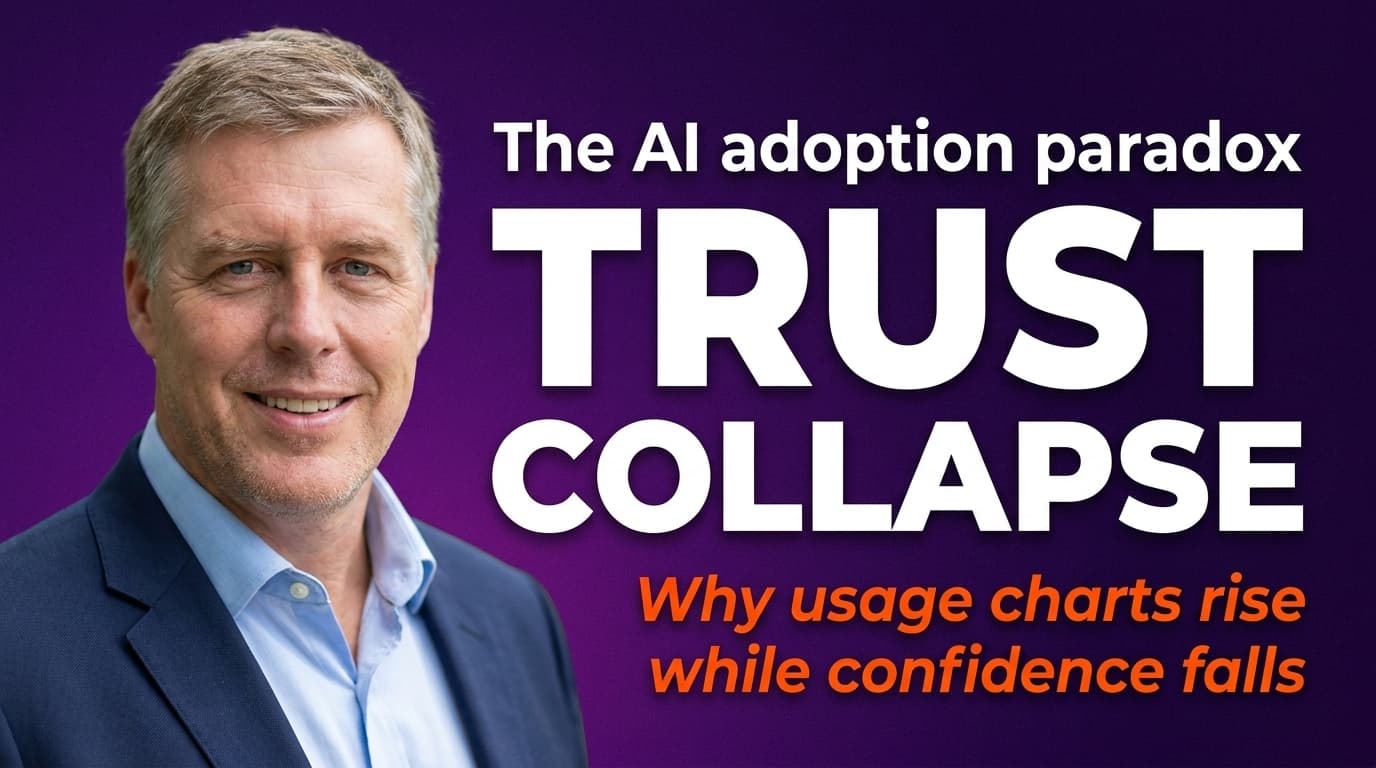
AI confidence crisis: your team uses AI more but trusts it less
TL;DR
- ManpowerGroup's 2026 Global Talent Barometer: AI usage jumped 13% in a year to 45% of the global workforce
- In that same period, worker confidence in AI fell 18%, a staggering contradiction
- ADP's survey of 39,000 workers: daily AI users are 4x more likely to feel less productive than non-users
- Only 22% of employees feel secure in their roles; fewer than 1 in 5 are fully engaged
- 64% of workers are staying with their employer out of fear, not loyalty. Researchers call this 'job hugging'
- Singapore: 64% of firms use AI daily, but only 18% have deployed autonomous AI agents
- The fix requires transparency, visible skills investment, and workflow redesign. Not another software mandate.
Why are workers using AI more but trusting it less?
ManpowerGroup's 2026 Global Talent Barometer, drawing on data from tens of thousands of workers across multiple countries, found that AI usage jumped 13% over the last year, reaching 45% of the global workforce. In that exact same period, confidence in using the technology fell 18%.
That is not a minor inconsistency. It is a systemic failure baked into how most businesses are deploying AI. Employees are using the tools because they feel they have to, not because they trust the output. They are adopting AI defensively, terrified of being seen as laggards or, worse, expendable. They prompt, they generate, and then they spend the next hour fact-checking and rewriting because they do not trust a single word the AI produced.
Are daily AI users actually more productive?
No, and this is the finding that every business leader needs to sit with. ADP's survey of 39,000 workers globally found that daily AI users, the people theoretically most fluent in the technology, were four times more likely than non-users to say they felt less productive than they could be.
The people using the tools the most are the ones who feel the most bogged down. They are wrestling with prompts, chasing hallucinations, and trying to force AI output to meet professional standards. They are using the technology, but they are not gaining any leverage from it. In many cases, it is actively slowing them down.
What is 'job hugging' and why does it matter for your business?
'Job hugging' is the term researchers are using to describe workers staying put not because they are thriving, but because they are frightened. ADP's data found that 64% of workers intend to stay with their current employer, not out of loyalty or opportunity, but because they are seeking stability in uncertain times.
This matters because your retention figures are lying to you. Low turnover feels like success, but a workforce staying out of fear is not engaged, it is paralysed. Fewer than one in five employees are fully engaged at work, and only 22% feel secure in their roles. A frightened, disengaged workforce does not drive the innovation, creativity, or productivity gains you need to survive in a competitive market.
How worried are employees about AI ethics and safety risks?
Seriously worried, and the number is growing. MetLife's 24th Annual Employee Benefit Trends Study found that 61% of employees are worried about the ethical implications of AI, bias, misinformation, hallucinations, and a lack of accountability. That figure is up five percentage points from just a year ago, and it is still climbing.
Your employees see the flaws in the technology every single day. When leadership blindly pushes for more AI adoption without acknowledging these risks, it does not build confidence, it destroys trust in management. It signals to your team that you are forcing them to use broken tools without understanding the reality of their daily work.
See where AI fits in your business. Free.
A 45-minute audit. We map the highest-value automations and what they're worth in time and money. No pitch, no pressure.
What does Singapore's AI adoption gap reveal about the global picture?
Singapore is one of the most digitally advanced markets in the world, world-class infrastructure, a highly educated workforce, aggressive government promotion of AI across every sector. And yet a HubSpot study of over 700 Singapore business leaders found the same fault line running through its economy.
Sixty-four percent of Singapore firms use AI consistently across daily workflows, impressive by any global benchmark. But only 18% have implemented fully autonomous AI agents capable of making decisions and executing tasks end-to-end. That is a 46-percentage-point gap between basic usage and advanced deployment. Almost everyone is dabbling. Almost no one is going deep.
The primary reason: 43% of respondents cited trust and reliability concerns as their top barrier to scaling AI, followed by data quality and integration challenges at 37%. Only 28% of Singapore firms are currently investing in AI agents, despite 43% expecting them to become highly important within the next 12 to 24 months. Everyone can see the future. Almost no one is willing to bet on it yet.
What separates companies actually winning with AI from the rest?
Workflow redesign, not more software. PwC identified the top 20% of companies as capturing 74% of all AI economic value. What sets them apart is not the tools they use; it is that they have rebuilt their workflows around AI rather than layering it on top of broken processes.
These are not companies using AI to speed up the creation of low-quality output that someone else fixes. They are identifying where AI genuinely removes friction and redesigning the work around that. That is a fundamentally different strategic posture from the shallow, defensive adoption that characterises the other 80%.
How does visible skills investment change employee confidence?
Dramatically. ADP's research found that employees whose employers actively invested in their development were over five times more likely to feel secure in their roles. That single statistic should justify any reskilling programme you are considering.
But the investment alone is not enough. You need to communicate it actively. Every person in your organisation needs to know you are investing in their ability to master this technology, and that their human judgement, expertise, and critical thinking are the most valuable assets your business has. AI is there to amplify those qualities, not replace them.
What to do this week
1. Audit your adoption metrics honestly. Usage rates are vanity metrics if confidence is falling. Ask your team directly: do they trust the AI output they are using? How much time are they spending fact-checking? Get a real picture before your next leadership meeting.
2. Go public about the limitations. Hold a team session this week where you openly acknowledge the flaws in your AI tools, hallucinations, bias risks, output quality issues. Transparency here builds more trust than any upbeat internal communications campaign ever will.
3. Make your skills investment visible. If you have any reskilling or AI training budget, announce it publicly inside your business this week. Tell people what it is, who it is for, and how they access it. A five-times improvement in employee security is sitting on the table waiting for you to pick it up.
4. Identify one workflow to redesign, not just automate. Pick one process where AI is currently layered on top of existing work without changing the underlying flow. Map out what that workflow would look like if it were rebuilt from scratch around AI capabilities. That is your pilot.
5. Close the agent gap deliberately. If you are among the 82% of businesses not yet running autonomous AI agents, set a 12-month target to pilot one. Start with a low-stakes, high-repetition task. Trust has to be built through experience, not aspiration.
Where to from here
Book a free 60-minute AI audit, we'll explore exactly what workflows are worth augmenting with AI.
Live with passion & AI,
Brett
Need an AI operator inside your team?
Place a Chief AI Officer, an AI Officer, or embed an Anaboo Forward Deployed Engineer for 3–6 months.
Frequently asked questions
Why are AI usage rates rising while worker confidence is falling?
+
Employees are adopting AI defensively. They use the tools because they feel mandated to, not because they trust the output. ManpowerGroup's 2026 Global Talent Barometer found usage up 13% to 45% of the workforce while confidence fell 18% in the same period. Workers prompt, generate, and then spend hours fact-checking because they do not trust a single word the AI produced.
Are daily AI users more productive than non-users?
+
No. ADP's survey of 39,000 workers found that daily AI users were four times more likely than non-users to say they felt less productive than they could be. They spend significant time wrestling with prompts, chasing hallucinations, and rewriting output to meet professional standards, gaining usage without gaining leverage.
What is 'job hugging' and why should business owners care?
+
Job hugging is when workers stay with an employer out of fear rather than fulfilment. ADP data found 64% of workers intend to stay with their current employer primarily for stability, not because they are thriving. With only 22% feeling secure in their roles and fewer than one in five fully engaged, low turnover is masking a paralysed, disengaged workforce.
How worried are employees about AI ethics and safety?
+
MetLife's 24th Annual Employee Benefit Trends Study found 61% of employees are worried about the ethical implications of AI (including bias, misinformation, hallucinations, and accountability gaps). That figure is up five percentage points in a single year and still climbing.
What does Singapore's AI adoption data reveal about the global picture?
+
A HubSpot study of over 700 Singapore business leaders found 64% use AI consistently in daily workflows, but only 18% have deployed fully autonomous AI agents. That 46-percentage-point gap between basic usage and advanced deployment mirrors a global pattern. The primary barrier: 43% cited trust and reliability concerns.
What separates companies capturing most of the AI economic value?
+
PwC found the top 20% of companies are capturing 74% of all AI economic value. What distinguishes them is workflow redesign. They rebuilt how work gets done around AI capabilities rather than layering AI on top of broken processes. They are not speeding up the creation of low-quality output; they are removing friction at its source.
How much does visible skills investment affect employee security?
+
Substantially. ADP's research found employees whose employers actively invested in their development were over five times more likely to feel secure in their roles. The investment alone is not enough. It must be actively communicated so every person in the organisation knows they are being equipped, not replaced.

Brett is a four-time founder (Darra Tyres, Gladfish, EzyTrac, Anaboo) and the operator behind AIOS, Anaboo's AI Operating System. He writes from inside the build, installing AI in his own businesses first and reporting back what actually moves the numbers. Based between Singapore, the UK and Australia.