AI is now driving 26% of all corporate layoffs, UBS data shows
TL;DR
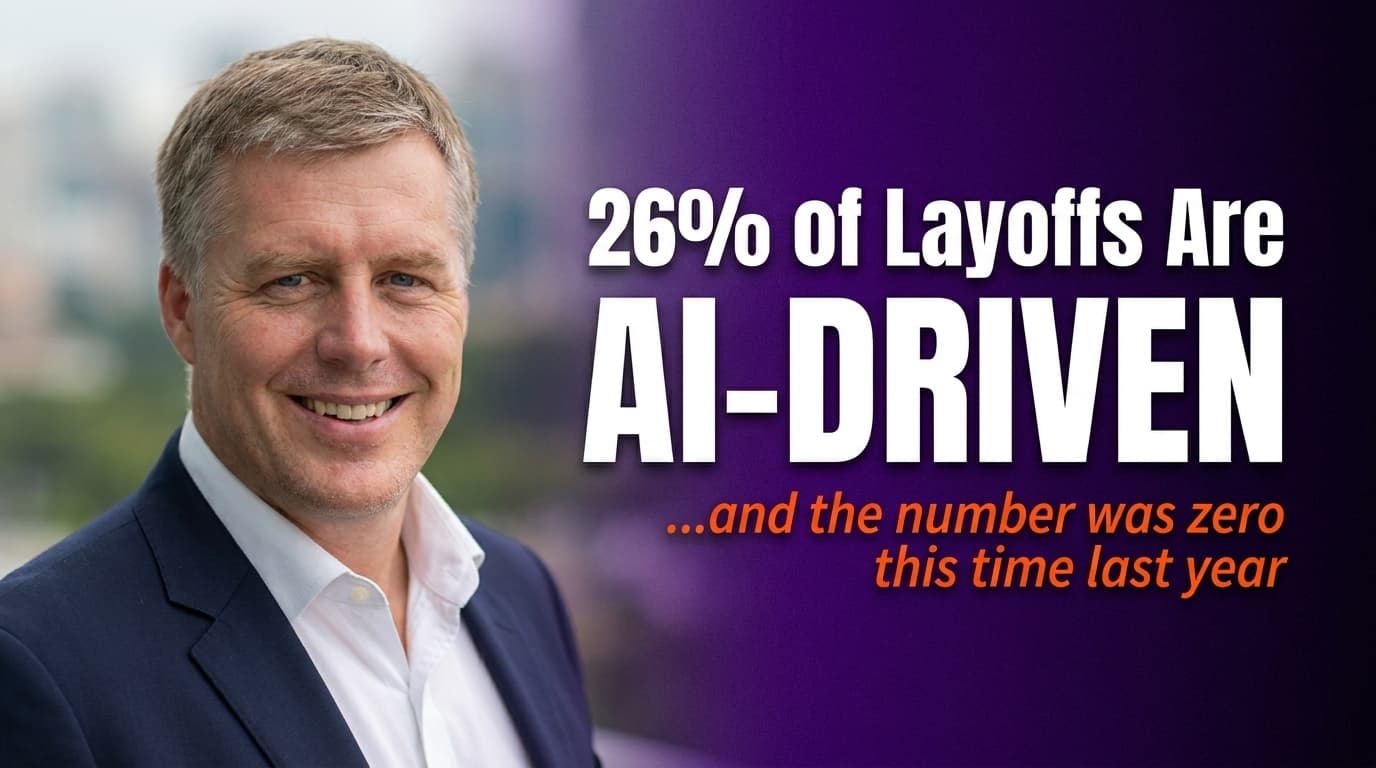
UBS Global Research has confirmed what many suspected but few wanted to say plainly: 26% of all announced corporate layoffs in the most recent measured month were directly attributed to AI initiatives, up from zero per cent at the same point last year. Forty-two per cent of corporate leaders now expect AI to significantly reduce their long-term hiring pipelines. This is not a projection for 2030. It is current operating reality, and it is moving toward SMEs faster than most business owners are prepared for. The businesses that treat it as a big-company problem are the ones most at risk.
What exactly did the UBS report find?
The UBS Global Research report does not hedge. Twenty-six per cent of all announced corporate layoffs in the most recent measured month were explicitly attributed to AI initiatives, not to market downturns, not to restructuring, not to underperformance. AI. And the year-over-year jump is the most alarming part: at this same point last year, the figure was zero per cent.
The report also found that 42% of corporate leaders now expect AI to significantly reduce their long-term hiring pipelines. That is not a one-off restructure. That is a permanent strategic recalibration of how businesses intend to scale, and how much human labour they believe they will need to do it.
Is this just a big-tech problem?
No. That is the comfortable story, and it is wrong.
Large enterprises move first because they have the capital and the scale to absorb transition costs. But the strategies, the tools, and the economic pressure that drive AI adoption at the top of the market flow downward to SMEs. If you run a business with 20 to 500 employees and you are watching this as a spectator sport, you are misreading the timeline.
What starts in the giants inevitably reaches the small and medium business sector, the question is whether you are ready when it arrives.
If your larger competitors are aggressively using AI to reduce labour costs and streamline operations, they are building a structural cost advantage. If you do not respond strategically, you risk being outpriced and outmanoeuvred by businesses operating on leaner economics.
What does the 42% hiring pipeline figure actually mean?
It means the intention is structural, not cyclical. When 42% of corporate leaders say AI will significantly reduce their long-term hiring pipelines, they are describing a permanent change to the shape of their organisations, fewer roles needed to operate at scale, not a temporary dip followed by rehiring.
For SMEs, the implication is direct: the businesses that build genuine AI competency into their existing workforce now will need to hire less to scale later, and will compete more effectively on unit economics against both larger incumbents and leaner AI-native startups entering their markets.
See where AI fits in your business. Free.
A 45-minute audit. We map the highest-value automations and what they're worth in time and money. No pitch, no pressure.
What is the real cost of using AI purely as a headcount cutter?
The short-term numbers look clean. Fewer salaries, lower overheads, margin improvement on a spreadsheet. The long-term cost is harder to quantify and far more damaging.
- Loss of institutional knowledge. Experienced employees carry accumulated client relationships, process nuance, and contextual judgement. When they leave, that knowledge leaves with them, and it is extraordinarily difficult to rebuild.
- Employer brand erosion. Companies perceived as running AI-driven layoffs without transparency or support will find talent acquisition significantly harder. Candidates have options, and reputation travels fast.
- Reduced adaptability. A workforce in fear of its own replacement does not experiment, does not surface problems early, and does not take the creative risks that keep a business competitive. Defensiveness and resistance are the predictable outputs.
- Ethical and reputational exposure. Customers and the public are increasingly attentive to how businesses treat their people. An opaque AI-driven redundancy programme carries real reputational risk, and in some markets, regulatory scrutiny.
A purely cost-cutting AI strategy is a short-sighted path to long-term decline. You save on salaries in the short term and sacrifice the human capital, institutional trust, and innovation capacity that sustain a business over time.
What does a human-first AI strategy actually look like?
It starts with a different question. Instead of asking "which roles can AI replace?", the question is "how does AI make my existing team more effective, more capable, and more valuable?"
Augmentation before automation. Identify the repetitive, low-judgement tasks consuming your team's time, data entry, routine reporting, first-pass document review, and automate those. Protect and invest in the roles requiring empathy, strategic thinking, and client relationships, where AI is a tool, not a replacement.
Reskilling as a business investment. Develop structured training that teaches employees how to work with AI tools, interpret AI outputs, and apply AI to sharper decision-making. This converts fear into competency and protects your investment in human capital. Employees who know how to leverage AI become more valuable, not less.
Transparency as a retention strategy. Be direct with your team about your AI plans, what will change, what will not, and what support you are providing. Uncertainty breeds attrition. Clarity builds trust, and trust is your most durable competitive asset.
Proactive role evolution. New roles are emerging as AI absorbs lower-judgement tasks: AI trainers, prompt specialists, data curators, AI output reviewers. Map these against your current team and identify who is best positioned to grow into them. This is transition planning, not redundancy planning.
Foster AI literacy across the organisation. The more comfortable and proficient your employees become with AI tools, the more indispensable they become to your business. Create a safe environment for experimentation, learning, and identifying where AI genuinely adds value in your specific workflows.
Why does the jump from 0% to 26% matter so much?
Because the speed of the shift is as significant as the scale. A figure that was essentially zero twelve months ago accounting for more than a quarter of all announced layoffs today is not a gradual trend, it is a step change. It reflects AI moving from proof-of-concept and pilot phase inside large organisations into operational deployment at scale.
Businesses that are still in the "exploring AI" phase while large competitors are in the "deploying AI at headcount-replacement scale" phase are not twelve months behind. They are at a strategic inflection point that requires a deliberate response, not continued observation.
What to do this week
- Bring the UBS data into your next leadership conversation. Twenty-six per cent of corporate layoffs attributed to AI is a board-level strategic data point. It belongs in your planning discussions, not just your reading list.
- Audit your highest-volume repetitive tasks. Identify the five to ten tasks in your business that are high in volume and low in judgement. These are your first AI implementation targets, automating them frees your team for higher-value work rather than threatening their roles.
- Have an honest conversation with your team about AI. Do not wait for your employees to read these headlines and draw their own conclusions. Frame your AI strategy, explain what it means for their roles, and invite their input on where AI could make their work better.
- Map emerging AI roles against your existing team. You likely do not need to hire an AI specialist if someone already on your team has the aptitude and the interest. Identify and invest in them now.
- Set a reskilling budget. Even a modest commitment to structured AI literacy training sends a clear signal: your people are your competitive strategy, not your cost centre to be optimised away.
Where to from here
Book a free 60-minute AI audit, we'll explore exactly what workflows are worth augmenting with AI.
Live with passion & AI,
Brett
Want this installed in your business?
Bespoke AI implementation across your operations: strategy, build, rollout, and ongoing drift maintenance.
Frequently asked questions
What percentage of corporate layoffs are being attributed to AI?
+
According to UBS Global Research, 26% of all announced corporate layoffs in the most recent measured month were explicitly attributed to AI initiatives, up from zero per cent at the same point the previous year.
How many corporate leaders expect AI to reduce their long-term hiring pipelines?
+
The UBS Global Research report found that 42% of corporate leaders now expect AI to significantly reduce their long-term hiring pipelines. This signals AI is shifting from a productivity tool to a structural labour replacement strategy.
Will AI-driven layoffs in large corporations affect small and medium businesses?
+
Yes. Strategies and economic pressures that emerge at enterprise scale typically filter down to SMEs within years. Businesses treating current AI-driven layoffs as a big-tech problem are likely misreading how quickly these shifts reach the broader market.
What is a human-first AI strategy?
+
A human-first AI strategy prioritises using AI to augment employee capability rather than replace headcount. It involves automating repetitive low-judgement tasks, reskilling employees to work alongside AI tools, and maintaining transparency about how AI will affect roles.
What are the risks of using AI purely to cut headcount?
+
Cutting headcount through AI without a transition plan risks losing institutional knowledge, damaging employer brand, reducing workforce adaptability, and triggering reputational backlash from customers and the public.
What new roles are emerging as AI displaces traditional tasks?
+
As AI automates lower-judgement work, roles such as AI trainers, prompt specialists, data curators, and AI output reviewers are emerging. Businesses that identify and develop these roles internally are better positioned than those treating AI transition as a pure reduction exercise.
How should SME owners respond to the UBS AI layoffs report?
+
SME owners should audit their highest-volume repetitive tasks as first AI implementation targets, have honest conversations with their teams about their AI strategy, and invest in reskilling programmes that convert employee fear into AI competency.

Brett is a four-time founder (Darra Tyres, Gladfish, EzyTrac, Anaboo) and the operator behind AIOS, Anaboo's AI Operating System. He writes from inside the build, installing AI in his own businesses first and reporting back what actually moves the numbers. Based between Singapore, the UK and Australia.