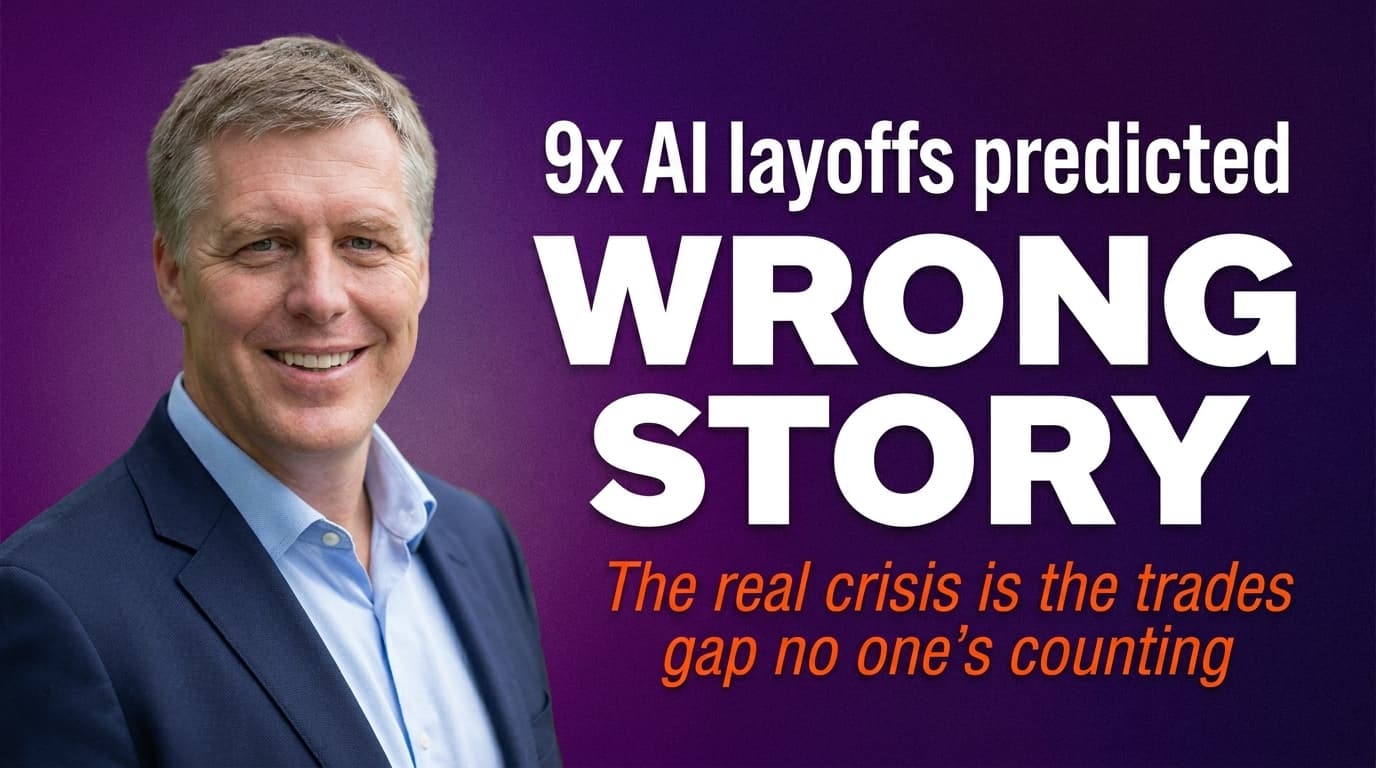
CFOs predict 9x more AI layoffs, but the real crisis is the trades shortage
TL;DR
The nine-fold increase in AI layoffs that 750 CFOs are predicting still represents just 0.4% of the total workforce, a rounding error dressed up as a catastrophe. The real workforce crisis runs in the opposite direction: a surge in blue-collar demand the AI economy has created and almost no business is staffing for. Robotics technician demand is up 107%, HVAC engineers up 67%, construction up 30%, all since late 2022. The businesses that grasp this now will win. The ones fixated on white-collar redundancy will be left with a beautiful AI strategy and a warehouse full of stationary robots.
Is the AI jobs apocalypse actually happening?
No, and the numbers prove it. The fear stems from a survey of 750 Chief Financial Officers predicting AI-related layoffs will be nine times higher this year. Nine times sounds terrifying. But that nine-fold increase represents just 0.4% of the total workforce. That is not a jobs apocalypse. That is a minor reshuffle being sold as a disaster movie.
The narrative is one of mass extinction. The reality is a quiet, fundamental rewiring of the economic engine.
The fear-mongering has real costs. It pushes talented people away from valuable careers before they have started. It distracts business leaders from the genuine, urgent opportunity sitting in front of them. Every headline about white-collar redundancy is a headline not being written about the acute shortage of the people actually building the AI economy.
What is the 'labour flip' and why does it matter?
For the first time in recent memory, it now takes longer to hire a skilled trade worker than a knowledge worker. The script has flipped completely. While tech companies were shedding software engineers, demand for the people who build and maintain the physical world accelerated dramatically.
The numbers since late 2022:
- Robotics technicians: demand up 107%
- HVAC engineers: demand up 67%
- Construction jobs: demand up 30%
These are not minor fluctuations. This is a seismic shift. The AI economy is a physical economy. It needs data centres, warehouses, fibre-optic networks, charging infrastructure, and power grids. Every server farm needs cooling. Every robot needs commissioning. Every EV charging station needs wiring. And right now, we do not have nearly enough people with the skills to do any of it.
What is the Atlassian Paradox?
Atlassian laid off 1,600 people as part of a major pivot toward AI. The headlines wrote themselves. Nobody reported the other side.
It now takes, on average, 56 days to hire an HVAC engineer, fifty-six days to find someone qualified to design and maintain the cooling systems for the massive, power-hungry data centres that Atlassian's AI strategy depends on entirely. They can hire a PhD in machine learning in a fortnight. The person who stops the servers from catching fire is nearly impossible to find.
We're celebrating the architects of the digital cathedral while completely ignoring the fact that we've run out of stonemasons.
The public story is shedding knowledge workers to embrace the future. The private, operational reality is a desperate scramble for skilled tradespeople to build the very foundation that future runs on. It is like boasting about the engine you have built for your race car while forgetting that nobody on the team knows how to change a tyre.
See where AI fits in your business. Free.
A 45-minute audit. We map the highest-value automations and what they're worth in time and money. No pitch, no pressure.
What actually kills a multi-million-dollar AI investment?
Not bad code. Not poor data science. Not a competitor's algorithm.
A faulty air conditioner.
Consider a business that invested heavily in AI, hired excellent data scientists, and built an elegant algorithm to revolutionise its industry. It failed, not because the code was bad, but because the data centre overheated on a hot day and crashed the entire system, wiping a week's worth of data. They had a dozen people who could write Python. Nobody on staff genuinely understood the thermodynamics of a server room. A qualified HVAC technician could have prevented the entire catastrophe for a few hundred dollars.
This is the new reality of operational risk. Plan for the digital and ignore the physical, and the physical will shut you down.
Who is the most critical person on your team in the next decade?
It might not be the person with a master's degree in computer science. It might be the person with a TAFE certificate and a toolbox.
Imagine a logistics CEO who invests tens of millions in an AI-powered robotics system, the consultants have promised a 40% efficiency gain, the software is live, the algorithms are humming. The entire project sits idle for six weeks because there is no qualified robotics technician available to commission it. The one technician found is booked solid for two months and charging a rate that makes a senior software developer look underpaid. This is not hypothetical. This is happening across the country right now.
The value equation has been rewritten. Businesses that recognise this early will build real competitive advantage. Businesses that do not will be perpetually held hostage by a trades pipeline they never thought to build.
What should business owners actually be asking?
Not: "Who do I need to fire?"
The real question is: "Who do I desperately need to hire?"
Most AI strategies map out the technology, the data pipelines, the automation workflows. Almost none include a plan for sourcing the technicians, electricians, engineers, and builders needed to turn that strategy into a physical reality. It is a massive strategic blind spot, and it is costing businesses real money right now. While attention is locked on the white-collar workforce, the blue-collar skills the entire operation will soon depend on go completely unplanned for.
This is also a cultural shift. The person who can diagnose and fix a complex piece of machinery is just as valuable, if not more so, than the person who can write a line of code. The toolbox deserves the same respect as the laptop. The businesses that build their pipeline of skilled trades now are the ones that will win the next decade. The ones that do not will be left with a fantastic AI strategy and a warehouse full of very expensive, very stationary robots.
What to do this week
- Audit your physical dependencies. Map every piece of infrastructure your AI strategy requires, data centre capacity, cooling, power, networking. Identify who maintains it and what happens if that person is unavailable.
- Add trades to your talent pipeline. Build a relationship with at least one trade school or TAFE this month. These relationships take time to develop. Start now.
- Review your hiring priorities. If your AI strategy includes physical infrastructure, robotics, or data centres, a robotics technician or HVAC engineer may be your most urgent hire, not another data scientist.
- Create an apprenticeship programme. Even a single apprentice in a critical trades area builds pipeline for the next two to five years. The cost is minimal compared to six weeks of an idle, multi-million-dollar robotics system.
- Treat physical infrastructure like your digital stack. Document it, budget for it, and make someone accountable for it. The businesses winning in the AI economy respect the whole system, not just the software layer.
Where to from here
Book a free 60-minute AI audit, we'll explore exactly what workflows are worth augmenting with AI.
Live with passion & AI,
Brett
Running an event? Put practical AI on your stage.
Keynotes and workshops that send business owners home with a plan they can use Monday morning. No hype.
Frequently asked questions
How much higher will AI layoffs be this year according to CFOs?
+
A survey of 750 CFOs predicts AI-related layoffs will be nine times higher this year. However, that nine-fold increase still represents just 0.4% of the total workforce, a rounding error, not the mass-extinction event the headlines suggest.
Which jobs are actually in demand because of the AI economy?
+
Skilled trades are surging. Since late 2022, demand for robotics technicians is up 107%, HVAC engineers up 67%, and construction jobs up 30%. Electricians, welders, and mechanics servicing increasingly complex AI-driven machinery are also in acute shortage.
What is the Atlassian Paradox?
+
Atlassian made headlines laying off 1,600 workers as part of an AI pivot, but the untold story is that it now takes an average of 56 days to hire an HVAC engineer, the people who keep the AI data centres their strategy entirely depends on from overheating.
What is the labour flip?
+
For the first time in recent memory, it now takes longer to hire a skilled trade worker than a knowledge worker. The long-held assumption that physical trades were in secular decline has been inverted by the physical demands of the AI economy.
Can a shortage of tradespeople actually kill an AI project?
+
Yes. In one example, a multi-million-dollar AI system failed not because of bad code but because a data centre overheated and crashed, wiping a week's worth of data. The business had no one on staff who understood the thermodynamics of a server room, a problem a qualified HVAC technician could have solved for a few hundred dollars.
What do most AI strategies overlook?
+
A plan for sourcing the tradespeople, technicians, electricians, engineers, builders, who will turn a digital AI strategy into a physical reality. Most strategies map the technology and data pipelines but completely ignore the physical infrastructure that underpins them.
How should recruitment strategy change for the AI economy?
+
Build relationships with trade schools and TAFEs, create apprenticeship programmes, and offer competitive packages for welders, robotics technicians, and HVAC engineers, not just software developers. The definition of 'tech talent' has expanded to include the people who build and maintain the physical AI economy.

Brett is a four-time founder (Darra Tyres, Gladfish, EzyTrac, Anaboo) and the operator behind AIOS, Anaboo's AI Operating System. He writes from inside the build, installing AI in his own businesses first and reporting back what actually moves the numbers. Based between Singapore, the UK and Australia.