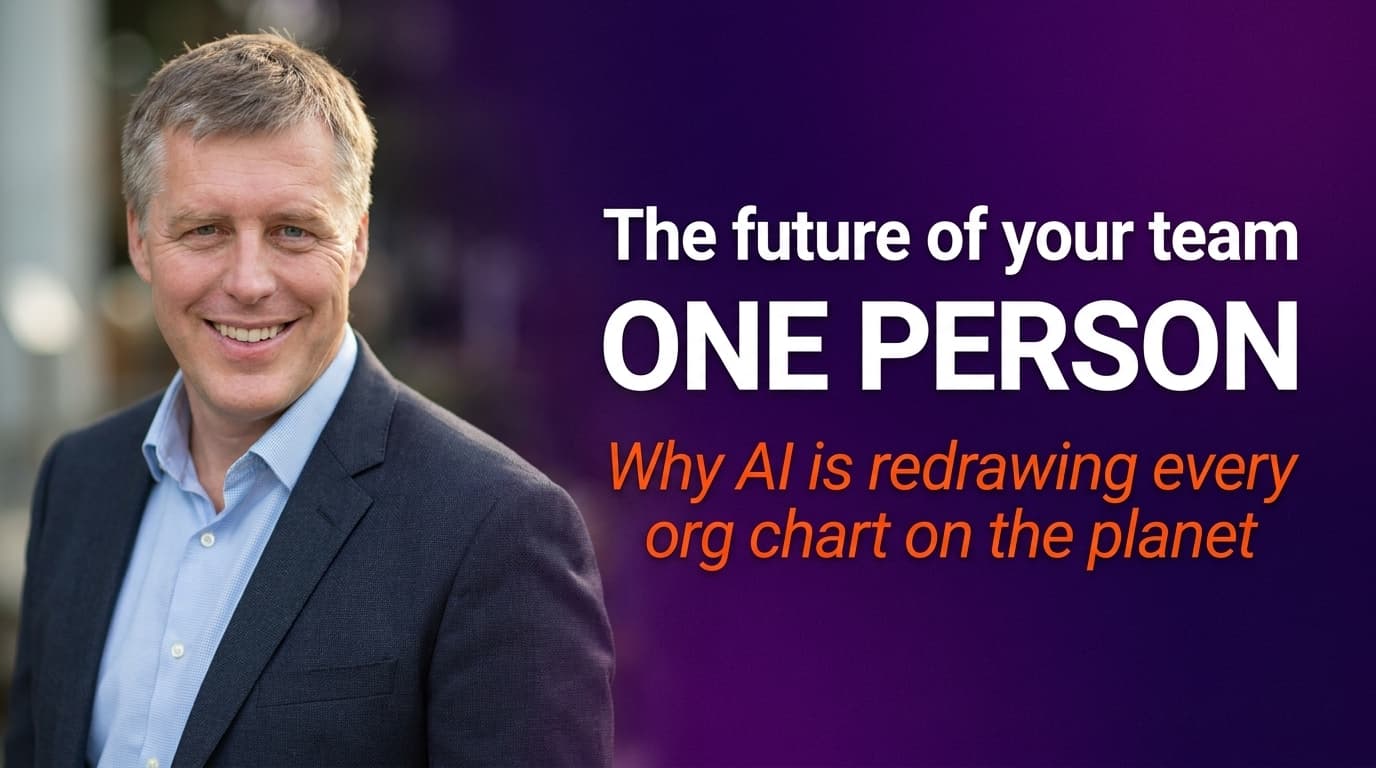
One-person AI teams are here, what Zuckerberg's prediction means for your business
TL;DR
Mark Zuckerberg has publicly stated that work once requiring big teams can now be done by one talented person. Meta is cutting nearly 16,000 jobs to prove it. Sam Altman envisions companies run by one to five people. In Australia, Atlassian, Afterpay, and WiseTech are all following the same playbook. The shift is structural, not cyclical, and the businesses that survive it are building AI orchestrators, not bigger headcounts.
What did Zuckerberg actually say?
The statement is direct: “projects that used to require big teams can now be accomplished by a single, very talented person.” Meta is not just talking, it is cutting nearly 16,000 jobs to back it up. This is a deliberate strategic move, not a cost-cutting panic. The logic is simple: talent amplified by AI outperforms a large, bureaucratic team. Zuckerberg is treating the old model of scaling by adding headcount as a liability, not an asset. The post-war industrial playbook, throw more people at the problem, is being retired in real time.
Is this just Silicon Valley hype, or is it actually happening?
Sam Altman, CEO of OpenAI, has articulated the same position: a future where a company could be run by one to five people. Both Zuckerberg and Altman are building companies that operate on this principle today, not in some hypothetical future. When the two most prominent AI executives in the world make the same prediction and then immediately act on it, that is not hype. It is an operational manual. The old industrial model, scale by adding headcount, is being retired, and the people running the world's most influential companies are the first to say it out loud.
What is happening to Australian businesses right now?
Australia is not insulated. Atlassian cut 1,600 jobs, not because the business is failing, but because it is succeeding with AI and reallocating resources accordingly. Afterpay followed with its own significant workforce reductions. WiseTech announced plans to cut roughly one-third of its global workforce, approximately 2,000 jobs, as it pivots to an AI-first approach. These are not isolated incidents. This is a coordinated trend across some of Australia's most successful technology companies. The message is consistent: manual processes and large, cumbersome team structures are no longer commercially viable.
What three new career paths did Morgan Stanley identify?
Morgan Stanley pointed to three roles in surging demand. First, skilled trades, the data centres powering the AI revolution require electricians, construction workers, and engineers to build and maintain physical infrastructure. Demand for these skills will grow as the AI arms race accelerates. Second, AI trainers, people with deep domain expertise who can teach models what they need to know. This is not a coding role; it is a role for experienced practitioners who understand their industry inside out, using hard-won knowledge to shape the next generation of AI systems. Third, and most strategically significant, AI supervisors and orchestrators, the new management layer, directing a digital workforce rather than a human one.
See where AI fits in your business. Free.
A 45-minute audit. We map the highest-value automations and what they're worth in time and money. No pitch, no pressure.
What does an AI orchestrator actually do day to day?
An AI orchestrator manages a team of AI agents rather than a team of humans. The shift is from doing to directing, setting goals, evaluating outputs, course-correcting, and combining tools to solve complex problems. It is the conductor role, not the instrument role. For experienced professionals who understand their industry deeply, this is the highest-leverage position available right now. It is the escape hatch from being displaced, the difference between being the master of the machines and being replaced by them.
Which roles inside your own business are most exposed?
Look at your org chart honestly. Any role centred on managing information, coordinating tasks, or executing repetitive processes is vulnerable. That covers the majority of middle-management and administrative functions in most organisations. The roles that are durable are those requiring genuine judgement, deep customer relationships, and the ability to direct AI towards a specific outcome. The question is not whether this trend affects your business, it is which roles it restructures first and how fast.
How do you actually make the transition inside your business?
The move is not mass redundancy, it is transformation. Your most valuable people, those with hard-won industry knowledge and strong customer understanding, are almost certainly spending the majority of their week on low-value coordination and administrative work. The goal is to strip that layer away and rebuild their roles around AI leverage. Give them the tools and the training to orchestrate AI agents. That is how one person becomes a team. The org chart does not simply shrink; the output per person multiplies. That is the sustainable competitive advantage, and it is available to any business willing to make the shift deliberately.
What to do this week
- Audit your org chart. Identify every role that is primarily about managing information or coordinating tasks, these are the first to be restructured as AI tooling matures.
- Map your top performers. Estimate honestly what percentage of their week goes to low-value admin versus high-value, judgement-intensive work. Most businesses are confronted by the ratio.
- Pick one workflow to automate end-to-end. Choose a repeatable internal process, run it through an AI tool, and measure the time and quality difference against the manual baseline.
- Research the orchestrator skill set. Understand what tools exist to automate the coordination layer and identify which of your people have the aptitude and domain depth to lead that transition.
- Have the honest conversation with your leadership team. The Zuckerberg and Altman positions are not predictions, they are current operating realities at the world's most successful companies. The question is not whether AI will affect your headcount. It is whether you will shape that transition deliberately or be shaped by it.
Where to from here
Book a free 60-minute AI audit, we'll explore exactly what workflows are worth augmenting with AI.
Live with passion & AI,
Brett
Want this installed in your business?
Bespoke AI implementation across your operations: strategy, build, rollout, and ongoing drift maintenance.
Frequently asked questions
What did Zuckerberg actually say about AI and team size?
+
Zuckerberg stated that projects once requiring big teams can now be accomplished by a single, very talented person. Meta is backing that statement with nearly 16,000 job cuts, a deliberate strategic move, not a cost-cutting panic.
Is this shift only happening in Silicon Valley?
+
No. Australian companies including Atlassian, Afterpay, and WiseTech have all made significant workforce reductions as part of a deliberate pivot to AI-augmented, smaller teams. This is a global structural trend.
What is an AI orchestrator?
+
An AI orchestrator manages a team of AI agents rather than human staff. The role involves setting goals, evaluating outputs, and directing digital tools towards business outcomes, the conductor, not the instrument.
What three new career paths did Morgan Stanley identify?
+
Morgan Stanley identified skilled trades (building AI data centre infrastructure), AI trainers (teaching models using deep domain expertise), and AI supervisors and orchestrators (managing a digital workforce rather than a human one).
Which roles inside a business are most at risk from this shift?
+
Any role centred on managing information, coordinating tasks, or executing repetitive processes is exposed. Middle-management and administrative functions face the most immediate restructuring pressure.
How should a business respond to the one-person team shift?
+
The move is transformation, not mass redundancy. Identify top performers, strip away the low-value coordination work consuming their week, and rebuild their roles around AI leverage, giving them the tools to orchestrate AI agents.
What is Sam Altman's vision for company size in the AI era?
+
Sam Altman, CEO of OpenAI, has stated that he envisions companies run by one to five people, not as a distant prediction but as the operational direction the world's most innovative companies are already moving towards today.
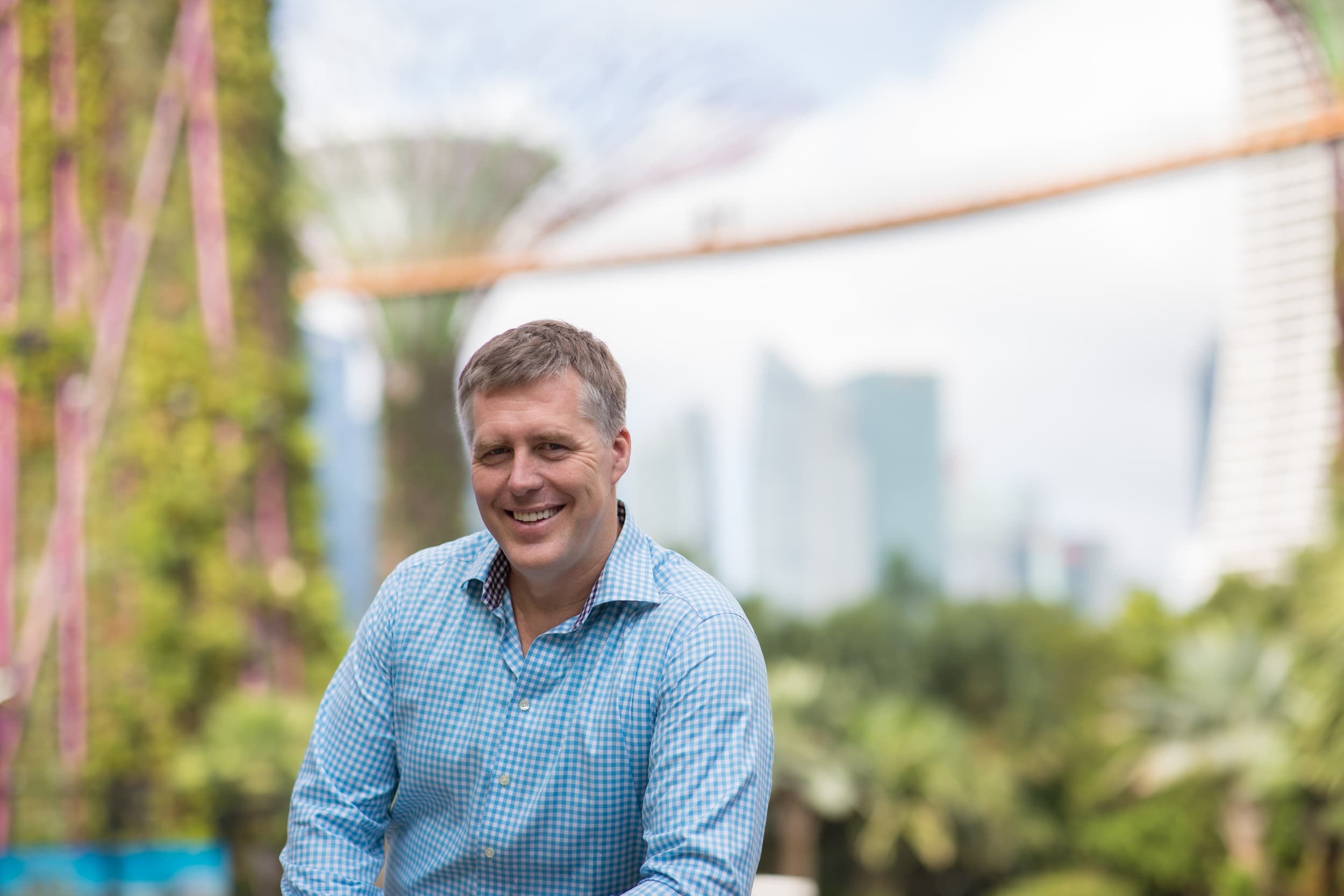
Brett is a four-time founder (Darra Tyres, Gladfish, EzyTrac, Anaboo) and the operator behind AIOS, Anaboo's AI Operating System. He writes from inside the build, installing AI in his own businesses first and reporting back what actually moves the numbers. Based between Singapore, the UK and Australia.