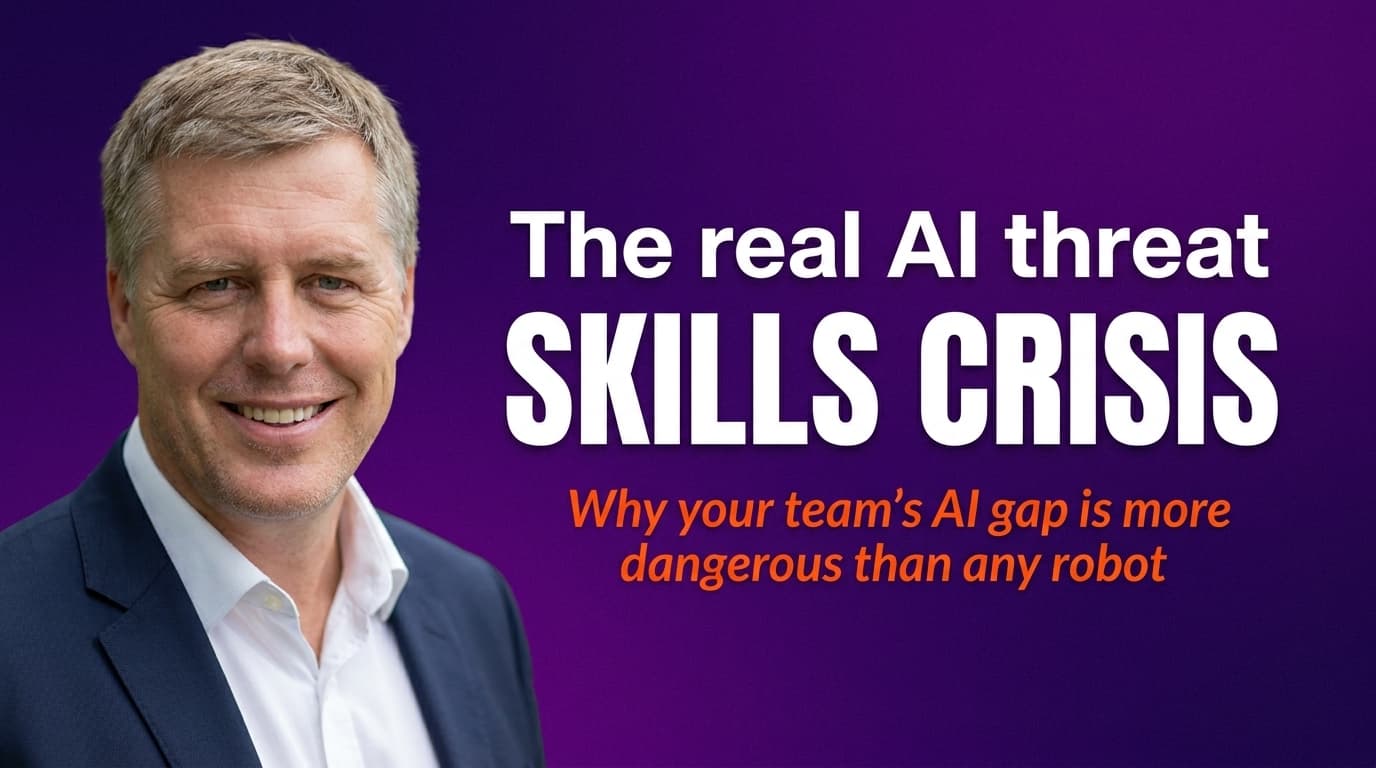
AI skills crisis: the real threat already crippling your business
TL;DR
The biggest threat to your business right now isn't robots. It's the gaping hole in your team's AI skills. Sixty percent of UK businesses admit their staff lack the AI capabilities they need. The talent pool is a puddle, the government response is a water pistol aimed at a forest fire, and your best people are quietly updating their CVs. The answer isn't hiring, it's building from within.
Is the AI jobs apocalypse story actually a distraction?
Yes. The Terminator narrative is convenient, dramatic, and wrong. AI isn't a single switch that flips one day and makes humans obsolete, it's a tool. A profoundly powerful one, but a tool nonetheless. And like any tool, its value depends entirely on the skill of the person wielding it.
We're handing the most powerful business tool ever created to people who have absolutely no idea how to use it. The result isn't a sci-fi movie; it's a slow-motion car crash of inefficiency, risk, and missed opportunity.
How bad is the UK's AI skills gap right now?
Catastrophically bad. A study from SAP laid it bare: 60% of UK businesses admit their staff lack the necessary AI skills. Six out of ten. This isn't some far-off prediction, this is the reality on the ground today. The majority of your team are operating in the dark.
What is shadow AI, and is it already happening inside your business?
Shadow AI is what happens when your people, given no guidance, start using AI tools on their own initiative. They're not being malicious; they're trying to be productive. But the consequences can be devastating.
Picture your marketing manager, we'll call her Sarah, under pressure to produce a competitor analysis report. She opens ChatGPT and pastes in your entire confidential sales strategy, your client list, and your pricing structure. She gets a plausible-looking report back in minutes. She's thrilled. What she doesn't realise is she's just fed your company's crown jewels into a third-party system with no security guarantees. That data is now out there, potentially being used to train the model for your competitors to query.
Or consider your finance team. A junior analyst, let's call him Tom, uses an AI tool to forecast cash flow. The AI hallucinates a few large, incoming payments. It looks completely legitimate, formatted perfectly, fitting the pattern of previous months. Tom, lacking the expertise to critically evaluate the output, incorporates it into his forecast. Your business then makes a major investment decision based on money that simply doesn't exist. The fallout can be catastrophic: failed payments, damaged supplier relationships, and in a worst-case scenario, insolvency.
This is the active, daily damage being done to businesses right now, not through robot takeovers, but through untrained people using powerful tools without guardrails.
Why can't you just hire your way out of this?
Because the talent simply doesn't exist in the numbers required. Singapore is, by almost any measure, one of the most forward-thinking and prepared nations on the planet when it comes to technology and education. They saw this coming years ago. Yet a ManpowerGroup report found that 71% of employers in Singapore are struggling to find the AI talent they need. It is the single hardest-to-fill role in the country.
If Singapore is struggling that badly, what chance does a medium-sized business in Manchester or Melbourne have?
The handful of genuinely skilled AI practitioners that do exist are being treated like Premier League footballers. Bidding wars where candidates receive offers 50% or 100% above their already-inflated asking price. Headhunters circling, poaching normalised. And then OpenAI announced a major office in London, fantastic for the UK's reputation, and a disaster for every other company trying to hire AI talent. They will vacuum up the available experts and pay whatever it takes.
Relying on external hiring to solve your AI skills gap is like relying on winning the lottery to fund your retirement. It's a fantasy.
See where AI fits in your business. Free.
A 45-minute audit. We map the highest-value automations and what they're worth in time and money. No pitch, no pressure.
What happened at WiseTech Global, and what does it mean for you?
WiseTech Global is a massive, successful Australian logistics software firm. They didn't announce a retraining programme. They didn't build an internal academy to upskill their workforce. They announced a 2,000-person layoff.
This wasn't a company in trouble. It was a cold, hard strategic calculation: the skills their current workforce had didn't match what they needed to compete in an AI-driven world. It was cheaper, faster, and more efficient to cut the people who didn't fit and replace them with a smaller number who did, or with AI itself.
When quarterly results are on the line and the board is demanding action, most large companies will not choose the long, expensive, difficult path of retraining. They'll choose the brutal but simple path of redundancy. The assumption that companies will patiently and benevolently retrain their loyal staff for the AI age is a comforting fantasy. Your job as a leader is to make sure your people are on the right side of that equation.
Is the government doing enough to close the gap?
No. The UK government is offering free training courses and skills bootcamps. It's a positive step. It's also like trying to put out a raging forest fire with a water pistol.
The scale of this problem is almost beyond comprehension. The “2028 Global Intelligence Crisis” report predicts that the catastrophic mismatch between the skills people have and the skills the economy actually needs could push unemployment rates above 10%. Meanwhile, Singapore is offering businesses 400% tax deductions for investing in AI training and automation, and funding AI coaches to go directly into small and medium-sized businesses. They are in full wartime-mobilisation mode.
While the UK is dipping its toes in the water, Singapore is building an ark. The government response, while well-meaning, is destined to be too little, too late. The cavalry isn't coming in time. Waiting for a policy programme to fix your skills gap is like waiting for a lifeboat while your ship is sinking.
What is the fear inside your team actually costing you?
More than you think. Recent data showed that 41% of UK employees are actively worried about the impact of AI on their jobs. That's nearly half your workforce lying awake at night wondering whether an algorithm is about to make them redundant. When people are scared, they don't do their best work. They become risk-averse, stop innovating, and focus on just getting through the day without making a mistake. Your productivity doesn't just dip, it nosedives.
And who acts on this fear first? Your best people. Your top performers are not going to sit around waiting to become obsolete. They want to work for a leader who has a plan. While you're procrastinating, your biggest competitor is telling your best salesperson: “We have a comprehensive AI upskilling programme. We will make you a master of these tools. We will invest in your growth.” Who do you think they're going to choose?
By failing to address the skills crisis, you send a clear message to your team: you are disposable. You breed a culture of fear and mistrust. And that's a loss from which many businesses will never recover.
What is the actual solution, and why is it already inside your building?
Stop buying and start building. Your existing team is the answer. You need a systematic, structured, and comprehensive programme to upskill your entire workforce, from the receptionist to the CEO. Not a one-off lunch-and-learn on ChatGPT. AI literacy as a core competency for every single person in your organisation.
Think of it like the dawn of the internet. The companies that won weren't the ones who hired a couple of “internet guys” and left them in a dark room. They were the ones who taught everyone how to use email, how to browse the web, how to integrate this new tool into every aspect of their work. This is no different.
Your marketing team needs AI for content generation and analysis. Your sales team needs it for lead scoring and personalisation. Your finance team needs it for forecasting and fraud detection. Everyone needs to understand the capabilities, the limitations, and the ethical considerations of these powerful new tools.
The companies that do this will have a massive, almost unfair, competitive advantage, more efficient, more innovative, more agile, making better decisions and retaining the best talent. The ones that don't will be the ones putting out press releases about “restructuring” and “synergies” in two years' time. We all know what that means.
What to do this week
- Run an honest audit. Ask: could any member of your team tell you the difference between an AI hallucination and a factual output right now? If the answer is no, you already have a shadow AI problem.
- Block the bleeding first. Write a one-page AI usage policy this week, what tools staff can use, what data they cannot paste in, and when to escalate. One page. Done.
- Name an AI champion. Pick one person in your team who is already curious about AI. Give them dedicated time to explore tools and report back. You don't need a six-figure hire to start building internal momentum.
- Map the skills gap. List the five most time-consuming tasks in your business. Ask whether AI could assist with any of them. Then ask whether your team currently knows how to use it for those tasks. The gap between those two answers is your training roadmap.
- Start building, not buying. Budget for internal upskilling before your next external hire. A trained, loyal team member delivers better returns than a mercenary contractor every time.
Where to from here
Book a free 60-minute AI audit, we'll explore exactly what workflows are worth augmenting with AI.
Live with passion & AI,
Brett
Want this installed in your business?
Bespoke AI implementation across your operations: strategy, build, rollout, and ongoing drift maintenance.
Frequently asked questions
What is the AI skills crisis?
+
The AI skills crisis is the widening gap between the AI capabilities businesses urgently need and the skills their teams actually possess. A SAP study found 60% of UK businesses admit their staff lack the necessary AI skills, making it one of the most immediate business risks today.
What is shadow AI and why is it dangerous?
+
Shadow AI is when employees use AI tools without formal guidance or oversight. Well-meaning staff can inadvertently expose confidential business data to third-party systems, or make critical decisions based on AI outputs that contain errors or hallucinations, both of which can cause serious financial and reputational damage.
Why can't businesses just hire their way out of the AI skills gap?
+
Because the talent pool is critically shallow. A ManpowerGroup report found that 71% of employers in Singapore, one of the world's most tech-forward nations, cannot find the AI talent they need. The few experts who exist command inflated salaries and have little loyalty to any single employer.
What did WiseTech Global do that every business leader should know about?
+
WiseTech Global, a major Australian logistics software company, announced a 2,000-person layoff, not because the business was struggling, but as a cold strategic decision to replace roles lacking AI skills with a smaller number of people who had them. It is a warning that companies will cut rather than retrain when forced to act quickly.
What is the 2028 Global Intelligence Crisis report?
+
It is a report predicting that the mismatch between the skills workers currently have and the skills the economy actually needs could drive unemployment rates above 10% by 2028.
How is Singapore responding to the AI skills crisis differently from the UK?
+
Singapore is offering businesses 400% tax deductions for investing in AI training and automation, and funding AI coaches to work directly inside small and medium-sized businesses. The UK is offering free basic training courses, a far smaller intervention relative to the scale of the problem.
What percentage of UK employees are worried about AI taking their jobs?
+
Recent data showed 41% of UK employees are actively worried about the impact of AI on their jobs, nearly half the workforce. This fear drives disengagement, risk-aversion, and accelerated turnover among top performers.

Brett is a four-time founder (Darra Tyres, Gladfish, EzyTrac, Anaboo) and the operator behind AIOS, Anaboo's AI Operating System. He writes from inside the build, installing AI in his own businesses first and reporting back what actually moves the numbers. Based between Singapore, the UK and Australia.