Australian businesses are getting 15% AI ROI, and leaving far more on the table
TL;DR
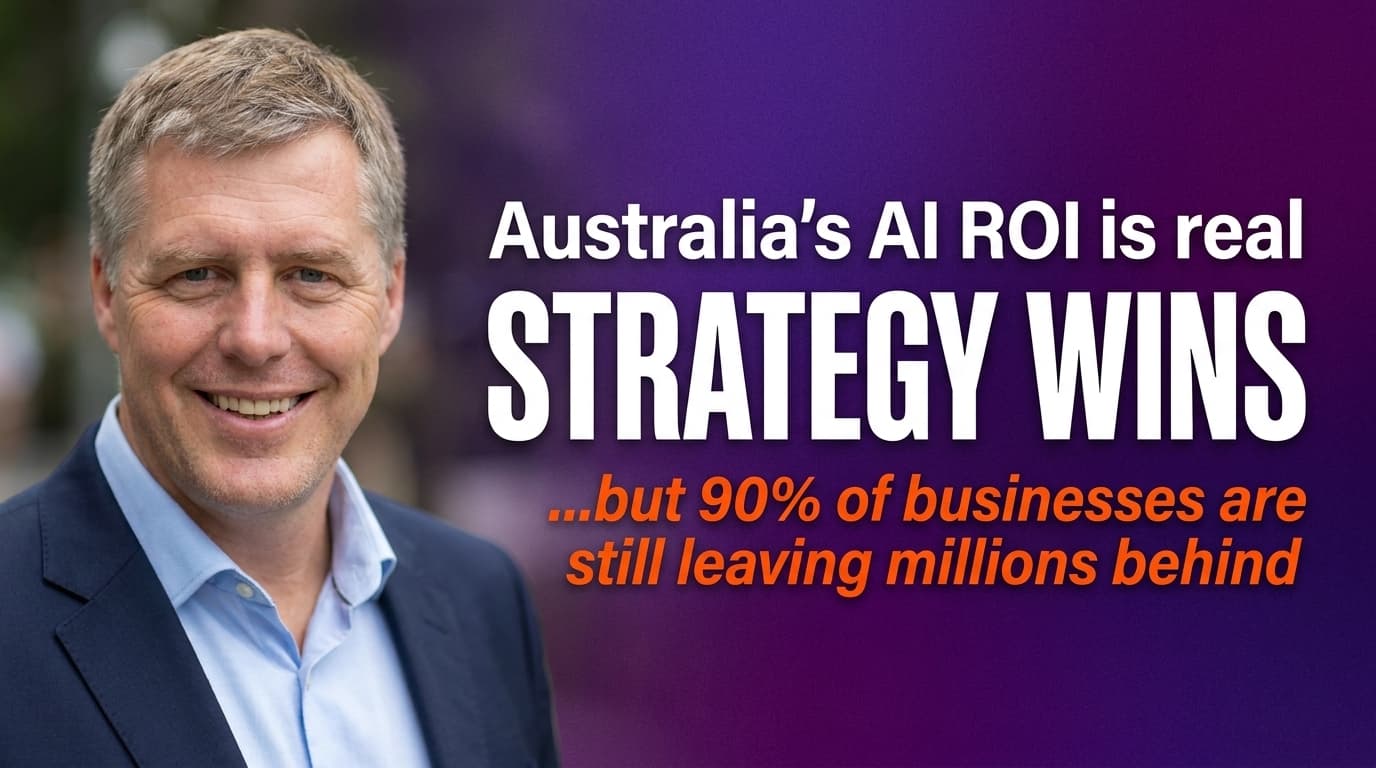
A SAP and Oxford Economics survey of 200 Australian executives shows AI is already delivering a 15% ROI, around $4.5 million on a $26.7 million spend. By 2028 that figure is projected to nearly double to 29%. The problem: 75% of businesses recognise the potential of agentic AI, but only 10% are pursuing it with a coherent strategy. The gap between those two numbers is where millions are being lost.
What does the data actually say?
The SAP and Oxford Economics report surveyed 200 Australian executives and put hard numbers on something that has been treated as theoretical for too long. Australian businesses are averaging a 15% return on AI investment, translating to roughly $4.5 million ROI on a typical spend of $26.7 million.
That is not a rounding error. That is real money hitting real balance sheets right now.
And it gets better. By 2028, that ROI is expected to almost double to 29% for businesses that are investing with intent. The question is not whether AI delivers returns. That debate is settled. The question is whether your business is positioned to capture them.
Why are 90% of businesses still underperforming?
Here is the number that should bother you: only 10% of businesses are investing in AI in a strategic, holistic manner.
The other 90%? Piecemeal. A chatbot here. An automation there. A pilot that never scaled. Individual tools that don't talk to each other and don't connect to any coherent business objective.
The report calls this the strategy gap, and it is costing Australian businesses millions in unrealised returns. You can be getting 15% ROI and still be significantly underperforming, because the ceiling for strategic adopters is nearly twice as high.
What is agentic AI and why is it the real prize?
75% of businesses in the report recognise the transformative potential of agentic AI, autonomous AI systems that can iteratively plan, act, reflect, and collaborate to achieve a goal end-to-end.
That recognition is not the problem. The problem is the 65-point gap between awareness and action.
Agentic AI is not about automating a single task. It is about automating entire workflows. Think AI agents handling customer inquiries end-to-end, managing inventory, qualifying leads, and feeding insights back into strategy, without a human touching each step. This is where the step-change in ROI lives, and the majority of businesses are watching it from the sideline.
See where AI fits in your business. Free.
A 45-minute audit. We map the highest-value automations and what they're worth in time and money. No pitch, no pressure.
What does a strategic approach actually look like?
Building a purposeful AI strategy is not complicated in principle, but it does require deliberate decisions:
1. Define what AI is supposed to achieve for your business Not "implement AI." Specific outcomes: cost reduction, faster customer response, new revenue streams, reduced headcount dependency. A vague vision produces vague ROI.
2. Map agentic AI opportunities across your workflows Stop looking at individual tasks and start looking at entire processes. Where does information pass between people, systems, and decisions? Those handoff points are where agentic AI delivers outsized returns.
3. Fix the data foundation first AI is only as good as the data it is fed. Clean, accessible, well-governed data is not optional infrastructure, it is the prerequisite. Businesses that skip this step discover it expensively later.
4. Build AI literacy into the team The return on AI investment compounds when your people know how to work with it. Invest in training that focuses on interpreting outputs, validating decisions, and redirecting human attention to high-value work. This is not about replacing roles, it is about changing what those roles spend time on.
5. Pilot small, but with scale in mind from day one Choose a high-impact, lower-risk area for the first deployment. Measure the ROI rigorously. Use those results to build internal confidence and justify the next phase. Iterative does not mean indefinite, set a timeline for each stage.
What separates the 10% from everyone else?
The businesses hitting the highest AI returns are not buying better tools. They are operating with a different orientation:
- They are not automating tasks, they are transforming departments
- They are not experimenting, they have a roadmap with defined milestones
- They are not hoping AI will integrate, they have invested in data infrastructure that makes integration possible
- They are not waiting for staff to figure it out, they have active AI literacy programmes
The competitive gap this creates is not incremental. Fundamentally lower cost structures, faster market response, and deeper customer personalisation at scale are structural advantages. They widen every quarter.
What does the 29% ROI trajectory mean in practice?
If you are currently spending $26.7 million on AI and achieving the average 15% return, you are generating $4.5 million. A 29% return on the same spend is $7.7 million. That is a $3.2 million annual difference, not from spending more, but from spending more strategically.
For smaller businesses operating at a fraction of that investment, the proportional logic is identical. The strategy gap costs you the same percentage regardless of scale.
The days of questioning AI's financial viability are over. The data is clear. What is not clear, for 90% of businesses, is the path from dabbling to deliberate.
The three things this report confirms
- AI is a proven revenue driver. The 15% ROI figure from 200 Australian executives is not an outlier, it is an average. The floor has been established.
- Strategy is the differentiator. The difference between current returns and 2028 projected returns is not technology access, every business has access to the same tools. It is strategic coherence.
- Agentic AI is the next inflection point. The businesses building autonomous, end-to-end AI workflows now are constructing advantages that will be very difficult to close in two to three years.
What to do this week
- Pull the SAP and Oxford Economics report. Read the sections on agentic AI and the strategy gap with your leadership team. Use it as a mirror against your current AI activity.
- Audit your current AI spend. List every AI tool, subscription, and project. Map each one to a specific business outcome and a measurable ROI target. If you cannot do that mapping, that is your diagnosis.
- Identify one end-to-end workflow that currently involves significant human handoffs and assess whether an agentic AI approach is viable. That is your pilot candidate.
- Rate your data readiness. Before expanding any AI initiative, honestly assess whether your data is clean, centralised, and accessible enough to support it. If not, that is the first investment to make.
- Set a strategy review date. If your business does not have a documented AI strategy with measurable milestones, put a 90-day deadline on building one. The 2028 ROI window is already narrowing.
Where to from here
Book a free 60-minute AI audit, we'll explore exactly what workflows are worth augmenting with AI.
Live with passion & AI,
Brett
Running an event? Put practical AI on your stage.
Keynotes and workshops that send business owners home with a plan they can use Monday morning. No hype.
Frequently asked questions
What ROI are Australian businesses currently getting from AI?
+
According to a SAP and Oxford Economics report surveying 200 Australian executives, businesses are averaging a 15% return on AI investment, roughly $4.5 million on a typical spend of $26.7 million.
What is the projected AI ROI for Australian businesses by 2028?
+
The same SAP and Oxford Economics report projects that AI ROI for Australian businesses will nearly double to 29% by 2028 for those investing strategically.
What is the AI strategy gap?
+
The strategy gap refers to the disconnect between awareness and action: 75% of Australian businesses recognise the transformative potential of agentic AI, yet only 10% are investing in a strategic, holistic manner. The rest are taking a piecemeal approach.
What is agentic AI and why does it matter for ROI?
+
Agentic AI refers to autonomous AI systems that can iteratively plan, act, reflect, and collaborate to achieve an objective. The SAP and Oxford Economics report highlights it as the next frontier, where entire workflows, not just individual tasks, can be automated, which is where the largest ROI gains are found.
How should a business start building an AI strategy?
+
Start by defining a clear AI vision tied to specific business outcomes, productivity, cost reduction, customer experience, or new revenue. Then identify a high-impact, low-risk pilot area, prove the ROI, and scale iteratively rather than attempting a full transformation all at once.
Why do most AI investments underperform?
+
The primary reason is a lack of holistic strategy. Most businesses adopt AI in isolated pockets, one tool here, one automation there, without integrating initiatives into a coherent roadmap aligned to business objectives. This piecemeal approach limits returns significantly.
What role does data infrastructure play in AI ROI?
+
AI is only as good as the data it is fed. Without clean, accessible, well-governed data and the infrastructure to support it, AI systems cannot perform reliably, making data investment a prerequisite for any serious AI strategy.

Brett is a four-time founder (Darra Tyres, Gladfish, EzyTrac, Anaboo) and the operator behind AIOS, Anaboo's AI Operating System. He writes from inside the build, installing AI in his own businesses first and reporting back what actually moves the numbers. Based between Singapore, the UK and Australia.