Australian SMEs using AI grow 2.8x faster, why 46% still won't act
TL;DR
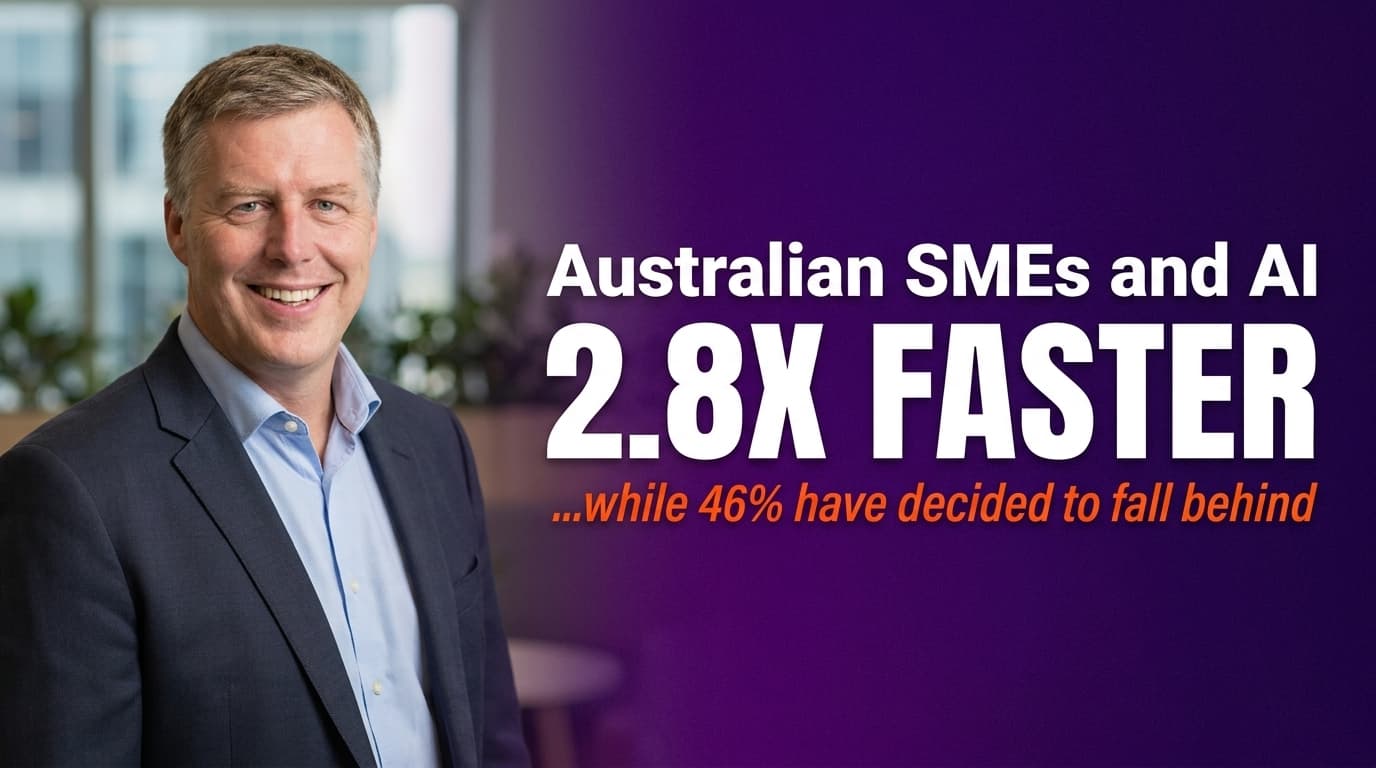
MYOB data from hundreds of thousands of Australian SMEs shows businesses using AI are growing 2.8 times faster than those that aren't. Despite this, 46% of SMEs have no plans to adopt AI in the next 12 months. The bottleneck isn't the technology, it's a leadership vacuum, a generational trust crisis, and a catastrophic failure to invest in training and governance. The gap is measurable, it's accelerating, and it's happening right now.
What does the MYOB data actually show?
The MYOB Bi-Annual Business Monitor surveyed more than 1,000 SMEs across Australia and found that 40% are currently adopting AI. Among those businesses, 54% report saving time and 34% say it is improving productivity. These aren't enterprise-scale deployments running custom language models, they are businesses activating practical features already built into their existing tools: AI-powered business insights, smart reconciliation, and automated invoice reminders.
The result is a 2.8x growth advantage. That is not a marginal efficiency gain. It is a structural competitive advantage that compounds with every month that passes.
"AI is the most powerful productivity lever the SME economy has experienced in years... Those adopting early are pulling ahead, and even modest uptake could unlock billions in additional revenue for the economy.", Paul Robson, MYOB CEO
Why are nearly half of SMEs refusing to act?
The same MYOB data reveals the other side: 46% of SMEs say they are not using AI and have no plans to do so in the next 12 months. In an environment where early adopters are growing at nearly triple the speed, that is not a neutral position, it is an active choice to fall behind.
- Two-thirds of SME employers are not looking for AI experience when hiring
- 72% have no plans to offer AI training to their current staff
- They are watching competitors pull away and responding with inaction
This pattern is not unique to Australia. A HubSpot study in Singapore found that while 78% of businesses have adopted some form of AI, only 18% are using it at an advanced level, the majority stuck in shallow adoption, using chatbots for basic content generation but failing to integrate AI into core operations. In the UK, an Accenture survey found that while 50% of executives expect AI to cut jobs, far fewer have invested in the training and governance frameworks needed to make adoption productive.
What is the generational AI trust gap?
Research from Amplitude exposes the structural fracture underneath the surface-level adoption numbers.
- Only 4% of workers aged 55–64 trust AI recommendations over their own judgement
- 31% of 18–24 year olds are willing to defer to the technology
- 39% of younger workers use AI daily, compared to just 20% of their older colleagues
- AI-related workplace friction is heavily concentrated among younger workers, only a quarter report no tension, compared to nearly two-thirds of older workers who seem entirely unbothered by the shift
The reason the older cohort is unbothered is straightforward: they are the ones in charge, and they are setting a tone of scepticism and delay. The most experienced, senior staff, the people actually running these businesses, are actively resisting tools that their most junior employees are already using every day.
See where AI fits in your business. Free.
A 45-minute audit. We map the highest-value automations and what they're worth in time and money. No pitch, no pressure.
Is the trust gap an excuse or a management challenge?
It is a management challenge, full stop. If senior staff don't trust the technology, it is a leadership job to show them why they should. If junior staff are already using AI tools quietly, the job is to bring that usage into the open, govern it, and scale it across the business.
The Gartner 2026 Data and Analytics Leadership Survey reinforces this directly:
- Organisations with successful AI initiatives invest up to four times more in their data and analytics foundations than those that are failing
- Highest-maturity organisations achieve 65% greater business outcomes
- Only 8% of organisations describe themselves as AI-driven
- 65% of workers spend less than one hour per week learning about AI
- More 18–24 year olds are upskilling on AI outside work hours (40%) than during them (32%)
When employees have to teach themselves the most important technology of their generation on their own time because their employers won't provide the training or the mandate, the business is failing at a strategic level.
What happens when AI is deployed without governance?
The result is workslop, a phenomenon where employees spend more time fixing AI output than it would have taken to do the work themselves. 23% of workers believe AI adds more work than it saves. 11% say it actively slows them down.
The Workday survey quantified the cost precisely: for every ten hours saved by AI, four hours are lost to rework. That is a 40% efficiency tax on every AI deployment that lacks proper governance and training.
Mandating usage without support makes this dramatically worse. A Harvard Business Review study found that mandated AI usage produces 65% more workslop than voluntary adoption. You cannot force people to use tools they don't trust and expect quality outcomes. The technology is only as good as the humans directing it, and right now most businesses are failing their humans.
What separates the top 20% of AI adopters from everyone else?
The PwC 2026 AI Performance Study makes the divide stark:
- The top 20% of companies capture 74% of all AI-driven economic gains
- They are 2.6 times more likely to have redesigned their business models around the technology
- They invest twice as much in governance and data readiness as the laggards
They are not deploying the most advanced tools. They are starting with what they already have, accounting software, CRM, project management platforms, and activating the AI features already built in. They identify the three or four most time-consuming administrative tasks, target those first, measure results, iterate on what works, and scale gradually. They treat AI adoption as a business transformation project, not a technology purchase.
The Gartner data makes the stakes explicit: the highest-maturity organisations are achieving 65% greater business outcomes. The gap between this group and everyone else is not closing. It is accelerating.
What to do this week
- Audit your existing tools. Open your accounting software, CRM, and project management platform today. List every AI feature available. How many are switched off?
- Identify your top three admin time drains. Pick the tasks that eat the most hours each week and are the most repetitive. Start there, not with the shiniest new tool.
- Assign an AI lead. Name one person, regardless of seniority, to own AI adoption and report back in 30 days on what they find.
- Bring AI usage into the open. If junior staff are already using AI tools quietly, create a shared channel or document where they can share what is working. Remove the secrecy and govern the upside.
- Build training into the working week. Even 30 minutes per person per week compounds significantly over a quarter. Sixty-five percent of workers currently spend less than one hour per week on AI learning, that is the floor you need to beat, not a target.
- Check the Federal Government's $17 million AI Adopt Program. It will not save your business on its own, but it is a resource available right now and worth knowing about.
The 2.8x growth advantage is not a one-off data point. It is a structural shift that compounds every month. The businesses that act now will define their industries for the next decade. Those that wait will be left wondering what happened.
Where to from here
Book a free 60-minute AI audit, we'll explore exactly what workflows are worth augmenting with AI.
Live with passion & AI,
Brett
Host a podcast? Have Brett on as a guest.
Straight talk on implementing AI in real SMEs, no jargon, plenty of receipts from the businesses we run.
Frequently asked questions
How much faster are AI-using Australian SMEs growing?
+
According to MYOB analysis of aggregated data from hundreds of thousands of SMEs, businesses using AI products and features are growing 2.8 times faster than those that are not.
What percentage of Australian SMEs are currently using AI?
+
The MYOB Bi-Annual Business Monitor found that 40% of SMEs are currently adopting AI. Among those, 54% report saving time and 34% say it improves productivity.
Why aren't more Australian SMEs adopting AI?
+
The MYOB data shows 46% of SMEs have no plans to adopt AI in the next 12 months. A generational trust gap, lack of leadership mandate, and absence of training are the primary barriers, two-thirds of SME employers are not hiring for AI experience, and 72% have no plans to offer AI training.
What is the generational AI trust gap in the workplace?
+
Amplitude research found that only 4% of workers aged 55–64 trust AI recommendations over their own judgement, compared to 31% of 18–24 year olds. This creates friction because senior staff, who run the business, are resisting tools that junior staff are already using daily.
What is workslop and why does it matter for AI adoption?
+
Workslop is the phenomenon where employees spend more time fixing AI output than it would have taken to do the work themselves. The Workday survey found that for every ten hours saved by AI, four hours are lost to rework, a 40% efficiency tax on poorly governed deployments.
Does mandating AI use make the workslop problem worse?
+
Yes. A Harvard Business Review study found that mandated AI usage produces 65% more workslop than voluntary adoption. Forcing staff to use tools they don't trust, without proper training or governance, creates confusion and resentment rather than efficiency.
What do the top-performing companies do differently with AI?
+
The PwC 2026 AI Performance Study found the top 20% of companies capture 74% of all AI-driven economic gains. They are 2.6 times more likely to have redesigned their business models around AI and invest twice as much in governance and data readiness as laggards.

Brett is a four-time founder (Darra Tyres, Gladfish, EzyTrac, Anaboo) and the operator behind AIOS, Anaboo's AI Operating System. He writes from inside the build, installing AI in his own businesses first and reporting back what actually moves the numbers. Based between Singapore, the UK and Australia.