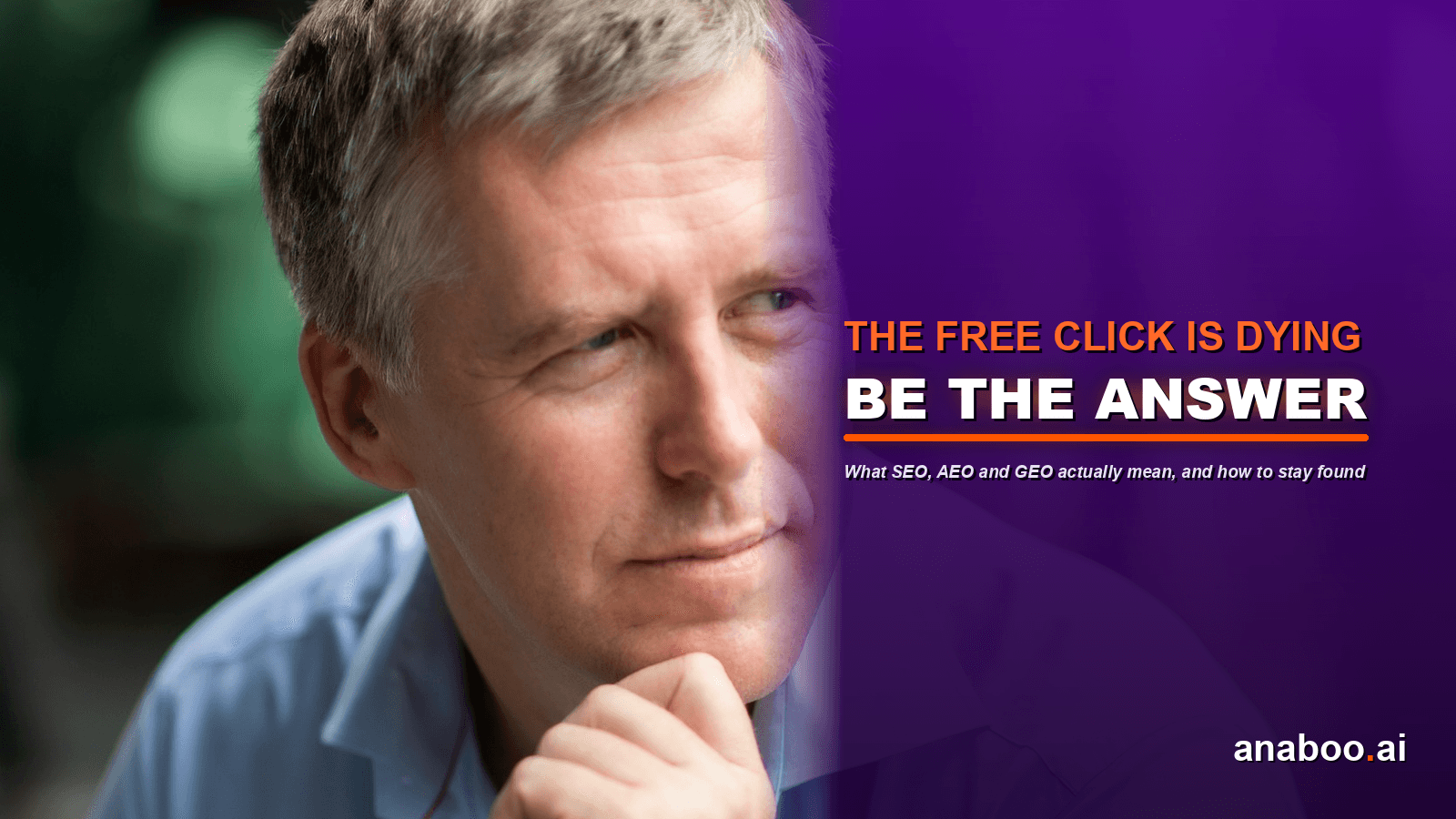
Be the Answer: SEO, AEO and GEO Explained for Business Owners
Start here
For twenty years the deal with Google was simple. You earned a good ranking, Google sent you visitors, and some of those visitors became customers. Rank well, get traffic, win work.
That deal is breaking.
Google now answers the question on the page itself, before anyone clicks. ChatGPT, Perplexity and Gemini recommend a shortlist before anyone opens a browser tab. The search box still exists. The free traffic behind it is draining away.
Here is the thing. You do not need to panic, and you do not need to throw money at the latest three-letter acronym. You need to understand what actually changed, so you can stay visible while your competitors keep optimising for a game that already ended.
Three disciplines now decide whether buyers find you:
- SEO so Google can find you in the first place
- AEO so you are the answer Google reads out
- GEO so you are the source the AI recommends
By the end of this piece you will know what matters, what is dead, what is snake oil, and what a serious website check looks like.
The shift nobody asked for
Before the how, the why. If you do not feel the stakes, none of the rest will get done.
You can hold your ranking and still lose the click. When Google shows one of its AI summaries at the top, the click-through to the winning result roughly halves. Independent studies put the drop somewhere between a third and nearly two-thirds depending on how they measure. One careful panel from Pew found people clicked a result 15% of the time without an AI summary, and only 8% with one. Same ranking. Half the visitors.
Most searches now end without a click at all. Around two thirds of Google searches in the US finish without anyone leaving for the open web. They got their answer on the results page and moved on. The pool of people who actually click through is shrinking, and it is shrinking fast.
Being absent from AI answers is the new being on page two. When an AI Overview or ChatGPT answers your buyer's question, your brand is either named in that answer or it is invisible at the exact moment someone decides. Buyers now arrive already half-sold, because they saw you cited as the trustworthy source. Trust gets built before the click, not after. If a competitor is the name the AI mentions and you are not, they own that moment.
The traffic that does come from AI is small but unusually good. AI assistants send roughly 1% of web traffic today. Tiny. But it converts well, by some measures close to paid search quality, and it is growing in double and triple digits year on year. Early movers are banking an advantage while it is still cheap to win.
Now the honest part, because we are not here to scare you.
Google disputes the gloomier numbers and says total traffic is roughly stable. Even if they are right, stable in aggregate still means winners and losers underneath, and you do not want to be a loser. And if your business runs on local or high-intent searches, "plumber near me", "[your brand] login", "best [product] for [job]", those still click through to your site at healthy rates. The click loss is heaviest on the top-of-funnel "how do I" and "what is the best" questions.
So this is not the end of search. It is a change in what winning looks like. The job moves from chasing traffic to earning influence. Rank well so the AI quotes you. Structure your site so machines can lift your words cleanly. Build a brand people ask for by name.
That is the whole game now. Three letters cover it.
SEO, AEO, GEO: one job, three scoreboards
The biggest mistake we see is treating these as three separate projects with three separate bills. They are not. They are one piece of work, measured in three places.
Think of it like being a good local expert.
To be recommended, people first have to know you exist (that is being findable). Then, when someone asks a direct question, you give a clear, useful answer on the spot (that is being the answer). And over time you become the name other people pass on when a friend asks who to use (that is being the source they recommend).
Same person. Same good work. Three different ways it pays off.
- SEO, Search Engine Optimisation. Be findable. Make sure Google can crawl your site, understand it, and rank it. This is the foundation. Skip it and nothing else works.
- AEO, Answer Engine Optimisation. Be the answer. Structure your content so Google lifts it into its AI summaries, featured snippets and "People also ask" boxes.
- GEO, Generative Engine Optimisation. Be the source. Earn citations and mentions inside ChatGPT, Perplexity, Gemini and Copilot.
Here is the truth the acronym-sellers will not tell you. Around 80% of the work behind all three is the same solid SEO that has mattered for years. The genuinely new part is narrow: how AI tools pull content together, making sure your words are readable without fancy code, getting mentioned on the right outside sites, and a new way of measuring whether any of it is landing.
So when someone tries to sell you "GEO" as a brand new discipline with secret tricks, keep your hand on your wallet. The fundamentals come first. Always.
Let us take the three in turn.
SEO: be findable
This is the ground floor. If Google cannot reach your pages, read them, and trust them, you will not show up anywhere, classic results or AI answers alike.
Most of SEO in 2026 is unglamorous hygiene done properly.
Let the machines in. Your pages need to load over a secure connection, return cleanly when requested, and not be accidentally hidden from search engines. Your site needs a current sitemap (a simple map of your pages) submitted to Google. Nothing important should be blocked.
Put your content in the page, not behind code. A lot of modern websites build their content with JavaScript that runs in the visitor's browser. People see it fine. The catch is that many search and AI crawlers do not run that code, so to them the page looks empty. The fix is to make sure your real words, your headings and your key facts are in the page as it is delivered, before any clever code runs. This one point matters for SEO and GEO both.
Pass the speed and stability checks. Google measures three things about how a page feels to load: how fast the main content appears, how quickly the page responds when you tap it, and whether things jump around as it loads. The targets are well known (main content under 2.5 seconds, response under 200 milliseconds, almost no unexpected shifting). Treat these as pass or fail hygiene, not a score to obsess over. Good enough is good enough. We measure these on every site we touch.
Write content that actually helps a person. Google rewards original information, real experience, and a clear point of view, written for humans rather than for an algorithm. There is no magic word count. A short page that answers the question beats a padded one that buries it. Genuine expertise, a named author who knows the subject, honest sourcing, and accurate dates all build the trust Google is looking for.
A note on that trust, because it gets oversold. The famous "E-E-A-T" (experience, expertise, authority, trust) describes what trustworthy content looks like. Google uses it to judge quality, but it is not a switch you flip to climb the rankings, and you cannot rent a famous byline to do it for you. Do the real thing instead.
Get the basics right on every page. A unique, descriptive title. One clear main heading. Sensible internal links with words that describe where they go. Plain, readable web addresses. Schema markup, which is a small piece of structured code that tells Google what your business, articles and products are, helps it understand you and is worth having.
And know what is dead. Stuffing pages with keywords, the old "keywords" meta tag, doorway pages built only for search engines, hidden text, and buying links from dodgy networks. None of these work now. Several of them will get you penalised. If an agency still pitches them, walk away.
Get this floor solid and you are most of the way to the other two.
See where AI fits in your business. Free.
A 45-minute audit. We map the highest-value automations and what they're worth in time and money. No pitch, no pressure.
AEO: be the answer
Answer Engine Optimisation is about earning your place inside the answers Google gives directly: the AI Overview at the top, the featured snippet box, the "People also ask" questions.
You cannot buy your way into these, and you cannot force them. You can only make your content the easiest, clearest thing for Google to lift. A few habits do most of the work.
Answer the question first, then explain. Pick one clear question per page. Put the direct answer in the first two or three sentences, right under a heading that uses the question the way a person would type it. Roughly forty to sixty words, no throat-clearing. Then go deeper for the readers who want it. Answer engines reward the page that gets to the point.
Make it liftable. Use real lists and real tables in the page, not pictures of them and not styled-up decoration. When the answer is a set of steps or a comparison, format it as one. Machines lift structure cleanly.
Be clear about who and what you are. Define your key terms and entities plainly. A sentence like "[Your company] is a [type of business] that [does the specific thing]" can be lifted word for word. Link your business to the obvious public reference points so there is no confusion about which company you are.
Rank first. None of this matters if you are not already on the first page for the question. Classic ranking is the gateway. The pages Google quotes in its AI answers are almost always pages already ranking near the top. SEO feeds AEO. Again.
One myth to put down here. For years agencies sold "FAQ schema" as a way to get those expandable question boxes in the results. Google has wound that down for ordinary business sites. Adding FAQ code today will not earn you a rich result. It does no harm to leave existing markup in place, but do not pay anyone to chase a box that no longer appears.
GEO: be the source AI recommends
Generative Engine Optimisation is the newest of the three. It is about being cited, quoted and recommended inside the AI assistants people now ask directly: ChatGPT, Perplexity, Gemini, Copilot, Claude.
These tools do not all work the same way, and that matters. Google's own AI leans heavily on what already ranks in Google. ChatGPT leans on the Bing index and on third-party directories and reviews. Perplexity cites its own mix. You cannot treat them as one channel. You earn visibility across them with a few durable moves.
Back your claims with substance. The founding academic research on this, and every practitioner study since, points the same way. Content that includes genuine statistics, direct quotations from credible people, and citations to authoritative sources gets pulled into AI answers more often. Vague marketing adjectives do not. So if you say you are faster, show the number and where it came from.
Stay readable without the clever code. Same point as the SEO section, and worth repeating because it is the single most common technical failure. Most AI crawlers do not run JavaScript. If your facts only appear after code runs in the browser, the AI never sees them. Put them in the delivered page.
Earn a presence off your own website. AI tools trust what the wider web says about you, not just what you say about yourself. Accurate listings in the directories that matter for your industry. A truthful, well-kept presence on the handful of forums and communities where your buyers actually talk, Reddit chief among them. Video where your topic is commonly searched. Wikipedia where you genuinely qualify. This outside presence is one of the biggest drivers of whether an AI names you, and it is volatile, so it needs keeping an eye on.
Name yourself properly. Say "[Your company] does X", not "we offer a solution". Machines connect facts to names, not to "we".
Now the two warnings, because this is where the snake oil lives.
First, llms.txt. This is a little file some people add to their site, claiming it tells AI tools how to read them. The major AI engines do not use it. Google has said as much, plainly, comparing it to a long-dead trick. Server logs show the AI bots do not even fetch it. It is harmless and pointless for visibility. Do not let anyone bill you for it as a "GEO tactic".
Second, guarantees. Anyone promising you guaranteed AI citations or a guaranteed spot in ChatGPT is selling you something they cannot deliver. Citations are decided by the AI provider, they shift from week to week, and nobody controls them from the outside. The work of earning them is real and worth doing. The guarantee is the tell of a charlatan.
What is dead, what is snake oil
A quick reference, so you can spot the bad advice when you hear it.
| You will be told | The truth |
|---|---|
| "FAQ schema gets you rich results" | Withdrawn for ordinary sites. It will not show. Do not pay for it. |
| "Add an llms.txt file for AI visibility" | The major AI engines ignore it. No visibility upside. |
| "AI content is banned by Google" | False. Google judges quality, not how it was made. Mass-produced rubbish is the problem, not the tool. |
| "AI content ranks for free" | Also false. It needs human oversight, real value and editing, same as anything. |
| "We guarantee you AI citations" | Nobody can. Citations are provider-controlled and volatile. Walk away. |
| "Keyword stuffing helps with AI" | It actively lowers how often AI tools cite you. It backfires. |
| "Hire a famous byline to rank" | Trust is real, but a rented name is not a ranking lever. |
The pattern is simple. The fundamentals are unglamorous and they work. The "secret new tactics" are usually either dead, useless, or impossible to promise. When in doubt, ask the person selling to you to explain it in plain English. If they cannot, that is your answer.
How you know it is working
You cannot manage what you do not measure, and the old report of "we rank number three" no longer tells the whole story. You now keep two scoreboards side by side.
The classic scoreboard. Your rankings, clicks and impressions in Google, tracked over time from a clear starting point. This is the foundation and it still matters.
The AI scoreboard. How often you are cited or mentioned across the main AI tools for the questions your buyers actually ask. How many of your important keywords now trigger an AI answer at the top. How much traffic, and how many enquiries, are arriving from AI tools.
A few honest notes on measurement, because this field is full of confident nonsense.
The AI visibility tools on the market are useful, but treat their numbers as directional, not gospel. They sample a set of questions, they do not see everything. Watch for the quiet pattern where your ranking holds steady but your clicks fall, that is usually an AI answer absorbing the traffic above you. And lead your own reporting with influence, are you the trusted, cited name, not just raw visits. Visits are one input now, not the headline.
When we run this for a client, we set a baseline on both scoreboards, then report them together every month, with the honest caveats attached. No vanity metrics. No pretending anyone controls what they do not.
The Anaboo website check
This is the check we run on a website to see whether it is built to be found, to be the answer, and to be recommended. Use it as a self-assessment, or let us run it for you properly.
Foundations (SEO)
- Secure, fast, and stable: passes Google's loading and stability checks on mobile.
- Crawlable and indexable: nothing important is accidentally hidden from search engines.
- Content lives in the delivered page, readable without JavaScript running.
- A current sitemap is submitted and clean.
- Every page has a unique, descriptive title and one clear main heading.
- Content is original, genuinely helpful, and written for people, with real authorship.
- Sensible internal linking with descriptive link text.
- Business, article and product markup (schema) is present and valid.
- No keyword stuffing, no doorway pages, no bought links.
Be the answer (AEO)
- Each key page targets one clear question and answers it in the first few sentences.
- Lists and comparisons use real lists and tables, not images.
- Key terms and the business itself are defined in plain, liftable sentences.
- The important question pages actually rank on the first page.
- No spend wasted on FAQ markup chasing a result that no longer appears.
Be the source (GEO)
- Key claims are backed by real statistics, quotes and citations.
- Facts are in the delivered page, not hidden behind code most AI crawlers cannot read.
- AI crawlers are not accidentally blocked.
- The brand has an accurate presence on the outside sites that matter: directories, the right communities, video, and Wikipedia where it qualifies.
- The business names itself clearly throughout, not just "we" and "our".
Measurement
- A dated baseline exists on both the classic and the AI scoreboard.
- AI referrals and AI citations are tracked for real buyer questions.
- Reporting leads with influence and trust, with honest caveats, not vanity numbers.
Red flags to avoid
- No llms.txt sold as a visibility tactic.
- No guaranteed-citation or guaranteed-ranking promises.
- No thin, mass-produced pages.
- No treating AEO and GEO as separate, expensive workstreams. One programme, measured in three places.
Where Anaboo comes in
Most businesses do not need another tool, another dashboard, or another acronym. They need a guide who has done the work and will build it properly.
That is what we do. We sit with you, we run this exact check on your site, and we build the fixes, the foundations, the answer-ready content, and the outside presence, so you are visible whether your buyer asks Google, asks ChatGPT, or asks a friend. Then we measure both scoreboards and keep it honest.
The search era you grew up with is changing. The businesses that understand it early, and build for it properly, become the answer everyone else gets compared to.
Book a free 60-minute AI audit. Tell us your worst, most invisible page, and we'll show you what we would do with it.
Get the full field guide
Everything above is drawn from our field guide, Be the Answer: SEO, AEO and GEO, including the one-page printable checklist you can pin up and run against your own site. It is free, and it is ungated.
Live with passion & AI,
Brett
Running an event? Put practical AI on your stage.
Keynotes and workshops that send business owners home with a plan they can use Monday morning. No hype.

Brett is a four-time founder (Darra Tyres, Gladfish, EzyTrac, Anaboo) and the operator behind AIOS, Anaboo's AI Operating System. He writes from inside the build, installing AI in his own businesses first and reporting back what actually moves the numbers. Based between Singapore, the UK and Australia.