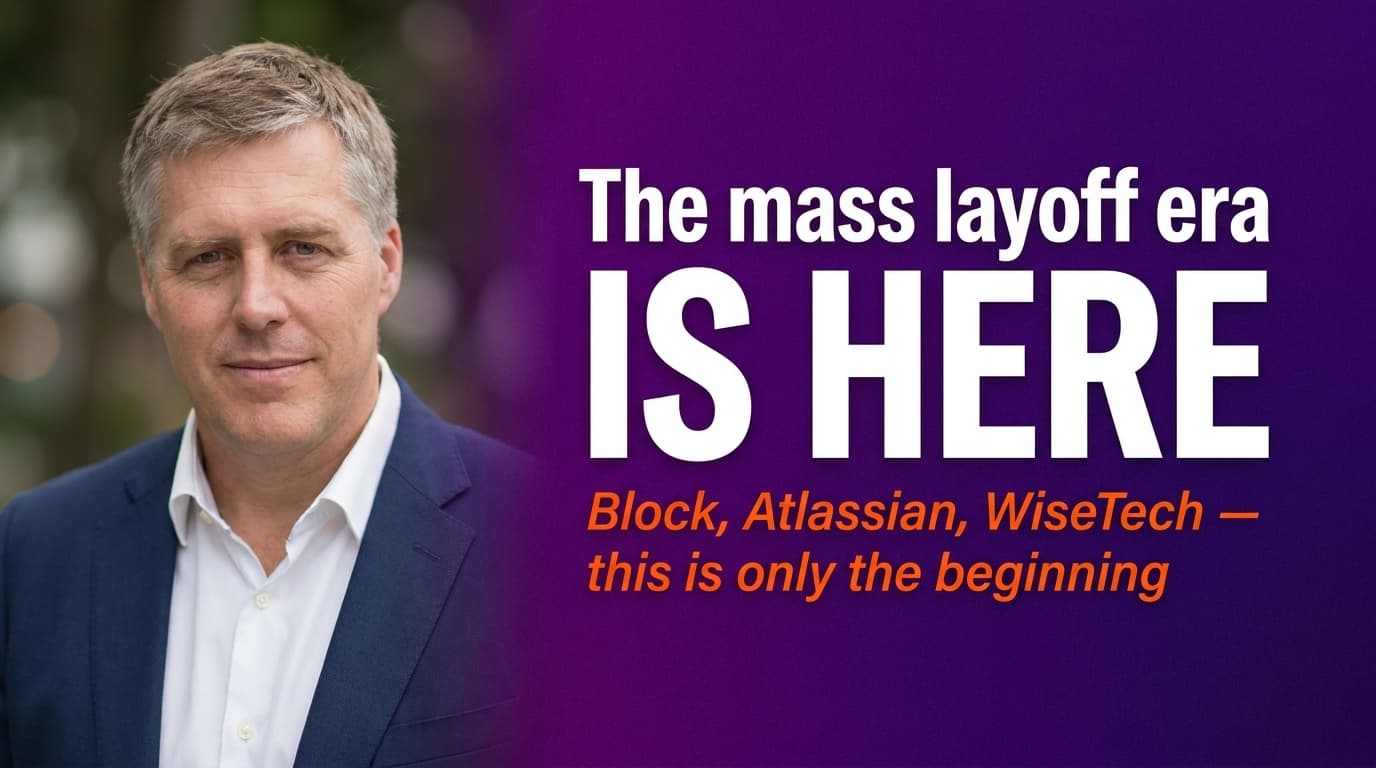
Block fired 40% of its staff and blamed AI, the mass layoff era is here
TL;DR
Block, the fintech giant behind Square and Afterpay, has cut 4,000 staff, 40% of its global workforce, and publicly attributed the decision to AI. Atlassian (1,600 jobs) and WiseTech Global (2,000 roles) have done the same. The share of tech layoffs explicitly blamed on AI has jumped from under 8% to over 20.4% in just 18 months, with full-year projections pointing to 264,000 tech sector job losses. We are not approaching the AI disruption era, we are inside it.
What actually happened at Block?
Jack Dorsey's Block, the financial technology company that owns Square and Afterpay, showed 4,000 employees the door. That is 40% of its entire global workforce. The stated reason was not buried in a footnote or softened with corporate language. Block stood up, looked the world in the eye, and pointed directly at AI.
The significance is not just the scale, it is the candour. Corporate layoffs have always come wrapped in euphemisms: "synergies", "strategic realignments", "organisational optimisation". Block dropped the theatre entirely. A major, publicly-traded, respected company has declared that AI can perform the work of thousands of experienced professionals faster and cheaper. That declaration is a permission slip for every other board of directors weighing the same calculation. The taboo has been broken.
Is this an isolated event, or the start of something much bigger?
It is not isolated. Atlassian, one of Australia's most celebrated tech companies, internationally lauded for its culture, has already cut 1,600 jobs, citing the need to pivot toward an AI-centric future. WiseTech Global, a leader in logistics software, is shedding 2,000 roles for the same stated reason. These are not struggling businesses in survival mode. These are profitable, market-leading organisations making cold, deliberate, strategic decisions to replace human labour with AI.
The uncomfortable truth is now not only being spoken, it is being celebrated as a strategic masterstroke.
The dominoes are being pushed over with deliberate force. What happened at Block is the first wave of a disruption that is building momentum across the entire global economy.
What do the numbers actually say?
- Eighteen months ago, fewer than 8% of tech sector job cuts were explicitly attributed to AI.
- That figure has now surpassed 20.4%, more than one in five tech jobs lost is a direct AI casualty.
- Full-year projections point to 264,000 tech sector job losses.
- The tech sector unemployment rate has surged to 5.8%, a level that echoes the aftermath of the dot-com bust.
- In Q1 alone, aggregate lost compensation from tech layoffs exceeded $8.4 billion.
This is not the gentle, gradual process of technological evolution we have seen in previous eras. This is a violent, high-speed revolution. The pace is what makes it categorically different, and categorically more dangerous.
See where AI fits in your business. Free.
A 45-minute audit. We map the highest-value automations and what they're worth in time and money. No pitch, no pressure.
Why should businesses outside tech care?
That $8.4 billion in lost Q1 compensation is not an abstract figure in an analyst's report. It is money no longer being spent on mortgages, rent, school fees, groceries, or restaurants. It is a demand-side shock, and its effects spread well beyond Silicon Valley.
The local café that sold coffee to those software engineers feels it. The real estate agent banking on their commissions feels it. The car dealer, the restaurant owner, the financial adviser, the local builder, they all feel the chill. Dismissing this as a "tech problem" fundamentally misunderstands the deeply interconnected nature of our modern economy. With tech sector unemployment sitting at 5.8%, every business downstream from a high-earning sector is exposed.
What is the skills chasm, and why does it matter?
New roles are being created, at a phenomenal rate. LinkedIn has reported a 340% increase in job postings with "AI" in the title since 2024. The demand for people who can build, train, deploy, and manage AI systems is intense. The supply of those people is not.
This is the skills chasm. On one side: a rapidly expanding pool of experienced professionals whose skills have been rendered obsolete by automation. On the other: a desperate scramble for workers with a completely different cognitive toolkit. The person who mastered manual data entry is not the person who can design a neural network. The project manager who excelled at coordinating human teams is not automatically equipped to orchestrate complex AI agent workflows.
The 20th-century model, learn a trade, practise it for 40 years, is not just dying. It is dead. What replaces it is a structural labour market problem: a simultaneous surplus of outdated skills and a critical shortage of relevant ones. This is the central economic and social challenge of this generation, and it demands a radical reinvention of how we think about education, corporate training, and lifelong career development.
What does this mean for you as a business owner?
You are caught between two forces, and you need to act on both simultaneously.
First, integrate AI aggressively. Not just as a cost-cutting exercise, but as a means of augmenting your team's capabilities, eliminating repetitive work, and freeing your best people for high-value, uniquely human work: strategy, creativity, complex problem-solving, and deep client relationships. If you ignore this imperative, you are not standing still, you are actively choosing to become obsolete.
Second, become obsessive about bridging the skills chasm inside your own organisation. The traditional recruitment model, hiring for a static list of existing skills, is like navigating a motorway with a 19th-century map. Hire for adaptability, insatiable curiosity, robust critical thinking, and a demonstrated ability to learn quickly. Transform your business from a place people work into a perpetual learning engine where continuous reskilling is not a perk, it is the culture.
Your long-term competitive advantage will not be the talent you hold today. It will be your organisation's capacity to build the talent it will desperately need tomorrow.
What to do this week
- Audit your most repetitive roles. Identify tasks that are high-volume, rule-based, and low-judgment. These are the first candidates for AI augmentation, before a competitor acts on them first.
- Run a skills-gap assessment. Map what your team can do today against what an AI-augmented workflow will require in the next 12–24 months. The gap is the risk.
- Stop hiring only for today. Add demonstrated adaptability and learning velocity to your hiring criteria alongside technical skills.
- Have the honest conversation with your team. They know AI is coming. Pretending otherwise breeds anxiety. Be direct about the transition and clear about your plan to bring them through it.
- Pick one process to pilot AI on this month. Not a strategy document, one live process, one measurable outcome.
Where to from here
Book a free 60-minute AI audit, we'll explore exactly what workflows are worth augmenting with AI.
Live with passion & AI,
Brett
Host a podcast? Have Brett on as a guest.
Straight talk on implementing AI in real SMEs, no jargon, plenty of receipts from the businesses we run.
Frequently asked questions
Why did Block fire 40% of its staff?
+
Block, the fintech company behind Square and Afterpay, cut 4,000 roles, 40% of its global workforce, citing artificial intelligence as the reason. The company stated that AI could perform the work of those employees more efficiently and cost-effectively.
Which Australian companies have cut jobs because of AI?
+
Atlassian has cut 1,600 jobs citing the need to pivot toward an AI-centric future. WiseTech Global is in the process of shedding 2,000 roles for the same reason. Both are profitable, market-leading companies making deliberate strategic decisions, not businesses in financial distress.
What percentage of tech layoffs are now attributed to AI?
+
As of the most recent quarter, over 20.4% of tech sector job cuts are explicitly attributed to AI, up from fewer than 8% just 18 months earlier. Full-year projections for the tech sector point to 264,000 AI-driven job losses.
How much income has been lost due to AI-driven tech layoffs?
+
In Q1 alone, aggregate lost compensation from tech layoffs exceeded $8.4 billion. This represents a significant demand-side shock that affects not just those laid off, but every business they would otherwise have spent that money with.
What is the AI skills chasm?
+
The skills chasm is the gap between the large pool of professionals whose existing skills have been made obsolete by AI, and the critical shortage of people who can build, train, deploy, and manage AI systems. LinkedIn reported a 340% increase in job postings with "AI" in the title since 2024, but supply of those skills remains far too low.
What is the tech sector unemployment rate right now?
+
The tech sector unemployment rate has surged to 5.8%, a level that echoes the aftermath of the dot-com bust and signals broader economic pressure well beyond the technology industry itself.
What should business owners do in response to AI-driven layoffs?
+
Business owners need to act on two fronts simultaneously: integrate AI into operations to unlock new capabilities and eliminate repetitive work, and invest in reskilling their teams to build adaptability, critical thinking, and AI literacy before the skills gap becomes a crisis inside their own organisation.

Brett is a four-time founder (Darra Tyres, Gladfish, EzyTrac, Anaboo) and the operator behind AIOS, Anaboo's AI Operating System. He writes from inside the build, installing AI in his own businesses first and reporting back what actually moves the numbers. Based between Singapore, the UK and Australia.