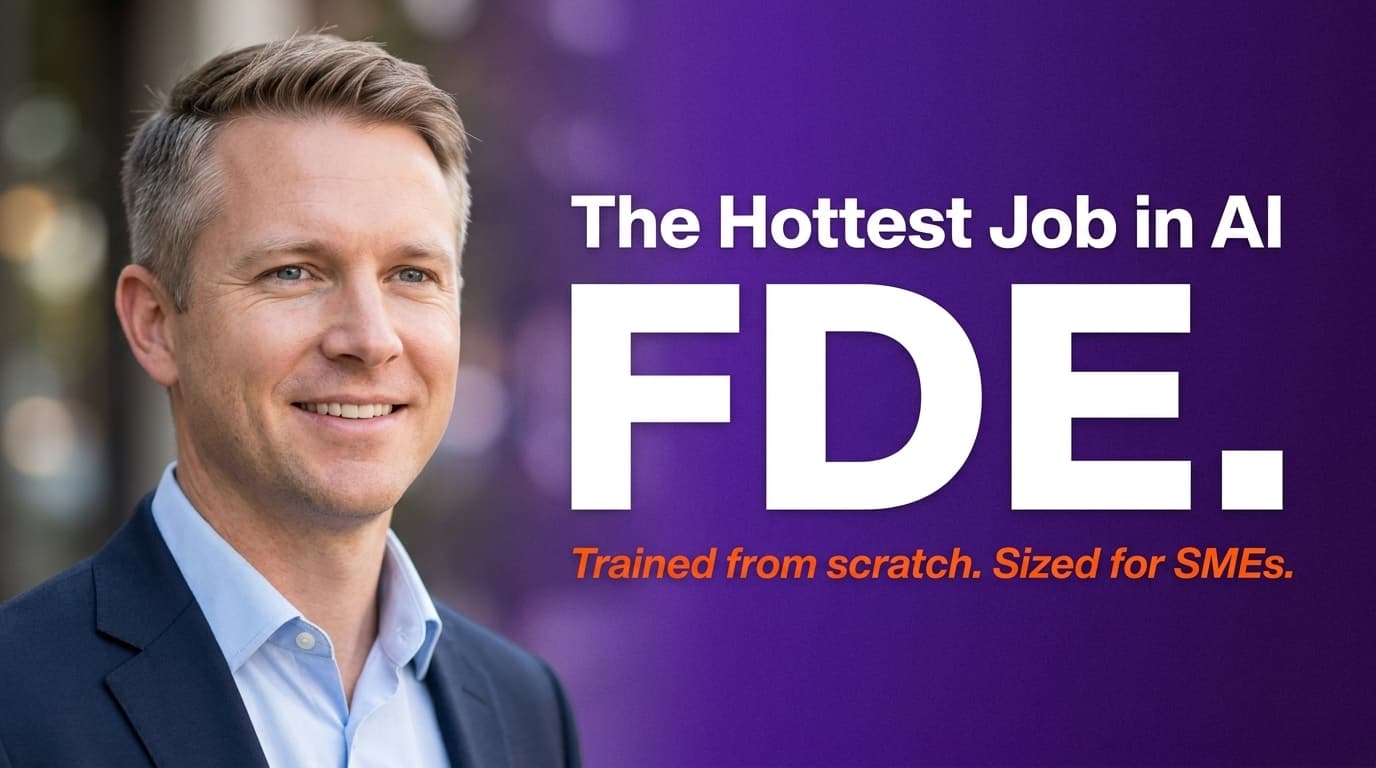
The hottest job in AI is a Forward Deployed Engineer, and Anaboo trains you from scratch
TL;DR
The Forward Deployed Engineer (FDE) is the role Palantir invented and OpenAI, Anthropic, Scale AI and Databricks are now racing to scale. Job postings grew 1,165% in 2025 and total compensation reaches $600,000 at frontier labs. But every public FDE programme targets Fortune 500 customers paying seven-figure contracts, no one runs an FDE motion for businesses under 200 staff. Anaboo does. We train people into the role from scratch through paid client work, and we deploy them into SMEs as the embedded engineer who actually makes AI land. This is the operator role of the AI era. If you've ever wondered why 95% of enterprise AI pilots fail, you're looking at the answer in the negative.
What is a Forward Deployed Engineer?
A Forward Deployed Engineer is a software engineer who embeds inside a customer's business to make a complex product actually work in production. They don't demo it. They don't hand it off after the kick-off. They don't write a deck and disappear. They stay until the AI is shipped and the team can run it without them.
Palantir invented the role in the early 2010s and named it internally as "Delta." Until 2016, Palantir employed more Deltas than traditional software engineers, an inverted org chart no other tech company has matched. The cleanest one-line definition in the canon comes from Palantir's own blog:
"A Dev's focus is 'one capability, many customers.' A Delta's focus is 'one customer, many capabilities.'"
Or in the words of Palantir's own job ads: "FDE responsibilities look similar to those of a startup CTO, you'll work in small teams and own end-to-end execution of high-stakes projects." When asked directly whether FDEs are consultants, Palantir's blog answer is blunt: "No, not really." The difference is that an FDE builds, deploys and operates the actual solution. Not a recommendation. Not a slide deck.
Why is this the hottest job in AI right now?
Andreessen Horowitz called it "the hottest job in startups" in June 2025. The data backs it up. Bloomberry analysed 1,000 Forward Deployed Engineer job postings in late 2025 and found:
- 1,165% year-on-year growth in FDE postings
- Median base salary of $173,816 across all roles
- 55% of postings list "working directly with customers" as the top responsibility
- Zero of the 1,000 jobs carried a sales quota, FDEs are paid like engineers, not salespeople
The reason this role exploded into the market is not mysterious. In August 2025, MIT published research showing that 95% of enterprise generative AI pilots fail to create measurable business value. The framing, the "GenAI Divide", has become the dominant vocabulary in the AI services industry.
Almost every failure traces back to the same root cause: nobody embedded long enough to make the technology stick.
"Enterprises buying AI are like your grandma getting an iPhone, they want to use it, but they need you to set it up.", Joe Schmidt IV, a16z
A consultant hands you a deck. A SaaS vendor hands you a login. A freelancer hands you a half-finished build. The FDE is the only model that hands you a running AI system and a trained team, because it's the only model where the engineer doesn't leave the moment the contract closes.
What does the role pay?
At frontier AI labs, Forward Deployed Engineer compensation is among the highest in the industry:
| Company | Comp band (USD) |
|---|---|
| OpenAI (San Francisco) | $185k, $325k + equity |
| Anthropic (Applied AI) | $200k, $300k base |
| Scale AI (GenAI) | $179k, $224k base + equity |
| Palantir (total comp) | $199k, $342k |
| Frontier-lab ceiling | up to $600k |
Sources: OpenAI, Anthropic, Scale, [Glassdoor, Palantir](https://www.glassdoor.com/Salary/Palantir-Technologies-Forward-Deployed-Engineer-Salaries-E236375_D_KO22, 47.htm), Sundeep Teki.
These are engineer-level numbers, not consultant-level numbers. And the demand profile keeps climbing, every major AI lab built or expanded its FDE team in 2024–2025, and none of them are slowing down.
Why have SMEs never had access to this role, until now?
Here's the catch. Every public FDE programme is built for Fortune 500 customers signing seven-figure contracts. Palantir won't take you on for under a million. OpenAI's FDE team partners with "strategic" customers, meaning enterprise. Anthropic's Applied AI team explicitly targets "most strategic customers." Scale, Databricks, Snowflake, same shape.
If you run a 30-person wealth firm or a 90-person broker, none of these companies will deploy an engineer into your business. The economics don't work for them. A frontier-lab FDE costs the lab around $250,000 a year fully loaded. To make that work, the engagement has to anchor to a million-dollar contract minimum. The maths is the maths.
This is the gap Anaboo fills.
We run the same playbook as Palantir, OpenAI and Anthropic, but at the SME scale. The mechanism that makes it work is AIOS, Anaboo's productised AI Operating System. AIOS ships with the agents, dashboards, integrations and governance already built. Vertical editions (Wealth AIOS, Broker AIOS, Founders AIOS) walk in with industry-specific skills out of the box.
Your Anaboo FDE doesn't start from zero on day one. They start with AIOS already deployable, and customise from there. That's the structural reason this works for a 60-person business, not just a 60,000-person one. We deliberately specialise in established SMEs of 20–200 staff because that's the seat where the FDE model creates the most leverage and where nobody else is showing up.
See where AI fits in your business. Free.
A 45-minute audit. We map the highest-value automations and what they're worth in time and money. No pitch, no pressure.
How does Anaboo train people from scratch into this role?
There are two ways to become an Anaboo Forward Deployed Engineer.
The Trained pathway is for people who have the operator instinct but need the AI skill. Career changers from ops, sales, finance or product. Technically curious people stuck in the wrong seat. People who can already make things happen in messy real-world environments, they just need the technical depth to do it with agents and language models.
The pathway works like this:
- Apply through the unified Anaboo Careers form. Select Forward Deployed Engineer as the role and Trained as the pathway. We screen for evidence of shipping things in real businesses, not certificates, not credentials. Receipts.
- Structured training, paid through client work. Trainees attend Anaboo training and workshops. You earn through paid client engagements we route to you, Zoom consults, solution delivery for Anaboo clients, working alongside senior FDEs. Training runs until you're production-ready.
- Production matching. When you clear the bar, we match you to your first engagement. From that point you're a working Anaboo FDE, deployed into client businesses on a 3 to 6 month embed.
There's no fee for the training. No debt. No salary lockup. The pathway exists because the talent pool for FDEs is the bottleneck on the whole industry, and bringing operators into the role through real work is the fastest way to build engineers who can survive the role's two hardest demands: living inside a customer's business, and shipping production code that actually changes outcomes.
The Experienced pathway is for people who've already deployed AI in production. We vet, match and place into engagements. The screening is harder and the matching is faster.
Both pathways feed the same bench. The same code. The same client outcomes.
Who clears the threshold to train as an Anaboo FDE?
We screen for four things, and we screen hard.
- Five-plus years shipping things in real businesses. Ops, sales, finance, product, engineering, the seat doesn't matter as much as the evidence that you made stuff happen in environments where nobody held your hand.
- Bias toward adoption, not deployment. The whole point of an FDE is to make AI stick with humans. We screen for people who measure success by whether the team kept using the system, not by whether the demo passed.
- Comfortable with technical work, even if you're not a developer yet. Trained pathway is for operators who can learn to ship code. Experienced pathway is for engineers who can already ship.
- Comfort with a CEO at 10am, junior ops at 2pm, broken integration at 6pm. The role lives at the intersection of business and engineering. We screen for people who can move between those worlds in a single day.
Reddit threads on the FDE role surface three recurring concerns from candidates: Is this just a sales engineer with a fancy title? Will I lose my technical edge? Is the travel brutal? The Anaboo answer to all three: no quota, you contribute back to AIOS so the technical edge sharpens, and our regional footprint (Singapore, UK, Australia, SE Asia) means most engagements are regional, not transatlantic.
What does an Anaboo FDE actually do inside a 50-to-200 person business?
Three streams of work running in parallel for the length of the engagement. None of them are optional.
On-site with the team. Your FDE sits with the people doing the work, front desk, ops, finance, sales. They map workflows by watching them happen, not by reading a PDF. Adoption starts here, in week one.
Building, shipping, fixing. They write the agents, wire the integrations, configure AIOS to the business, and fix things at the desk when they break. Production code, not slide decks. Engineering-level work, owned end to end.
Hand-over and drift. Every week of the engagement is also a week of teaching. The team learns the workflows. Documentation is left behind. When the FDE leaves, the AI keeps running, and Anaboo's optional drift maintenance keeps it running as the underlying models change.
The whole job is to work yourself out of a job. The leave-behind is the deliverable.
What's the difference between engaging an FDE and hiring a consultant?
This is the question most SME owners ask, and it's worth answering directly.
| Consultant | Freelancer | In-house AI hire | Anaboo FDE | |
|---|---|---|---|---|
| What you get | A recommendation deck | A half-built feature | A new headcount | A shipped AI system + a trained team |
| Time to first impact | 8–12 weeks of discovery | Days, but no system | 6+ months to ramp | First sprints ship in weeks |
| Who owns the outcome | "We recommended X" | "I built what you asked for" | "We're still learning" | "It runs in production" |
| Stays until it works | No, leaves at signoff | No, leaves at delivery | Stays but is one person | Yes, 3–6 months embedded |
| Cost shape | $300k, $500k+ retainer minimums | Day rates, no system | $200k+ salary, 6+ mo ramp | Monthly retainer, scoped engagement |
| What survives after | The deck | The feature | The person | A working system + a trained team |
The consultant motion is the dominant one in the SME market. It's also the one MIT keeps measuring as 95% failure. The FDE motion is the way out, and Anaboo is the only firm running it at SME scale.
How do I apply, or engage one?
If you're a business owner, start with a free AI audit. We sit with you, walk through the operation, and find the workflow where an embedded engineer creates the most leverage. Output: a scoped engagement brief you keep, whether you proceed or not. The full breakdown of the engagement model lives on the Forward Deployed Engineer page.
If you want to become an Anaboo FDE, either trained from scratch or as an experienced engineer, apply through the unified Anaboo Careers form. Pick your role (Forward Deployed Engineer) and pathway (Trained or Experienced) inside the form. We come back to qualified applicants within 48 hours.
The role Palantir invented twelve years ago is now the hottest job in AI. Until now it's been built for the Fortune 500. We're building it for the rest of you.
Live with passion & AI,
Brett
Running an event? Put practical AI on your stage.
Keynotes and workshops that send business owners home with a plan they can use Monday morning. No hype.
Frequently asked questions
What is an AI Forward Deployed Engineer?
+
A software engineer who embeds inside a customer's business to make AI actually work in production. They build the agents, wire the integrations, train the team, and stay until the deployment runs without them. The role was invented at Palantir in the early 2010s and is now run by OpenAI, Anthropic, Scale AI, Databricks and Palantir, paying $180,000 to $600,000 in total compensation.
How fast is the Forward Deployed Engineer market growing?
+
Job postings grew 1,165% year on year in 2025 according to Bloomberry's analysis of 1,000 FDE roles. Andreessen Horowitz labelled it 'the hottest job in startups' in June 2025. The demand is being driven by an MIT report finding 95% of enterprise AI pilots fail, almost always because nobody embedded long enough to make them stick.
Why have SMEs never had access to an FDE before?
+
Every public FDE programme, Palantir, OpenAI, Anthropic, Scale AI, Databricks, targets Fortune 500 customers paying seven-figure contracts. None of them run an FDE motion for businesses under 200 staff. The economics don't work without a leverage layer. Anaboo's AIOS platform is that leverage layer, which is what makes the role accessible to smaller businesses for the first time.
Can Anaboo really train someone into this role from scratch?
+
Yes, for people with the operator instinct but not the AI skill. Anaboo's Trained pathway pairs paid client engagements with structured training. You earn through real work we route to you, while training builds the technical depth. The pathway runs until you're production-ready and matched to an engagement. No fee, no debt, no salary lockup.
Who clears the threshold to train as an Anaboo FDE?
+
Five-plus years shipping things inside real businesses, ops, sales, finance, product, or engineering. Strong evidence you've made things happen in messy environments. Comfortable with technical work even if you're not a developer. We screen hard on adoption instinct, your job is to make AI stick with humans, not just to deploy it.
What kind of businesses engage an Anaboo Forward Deployed Engineer?
+
Established SMEs from roughly 20 to 200 staff. Profitable, ambitious, fed up with consultants who hand them a deck and disappear. Industries range, wealth management, mortgage broking, property, professional services, manufacturing, owner-operator businesses. The common thread is a business that wants AI to work in production, not in a pilot.
How is an Anaboo FDE different from a consultant or freelancer?
+
A consultant recommends. A freelancer ships one thing and leaves. An FDE embeds for 3 to 6 months, ships production code, trains your team, and stays until the AI runs without them. Bloomberry's analysis of 1,000 FDE jobs found 0% carry a sales quota, every one is measured on production outcomes.
What does it cost to engage an Anaboo FDE?
+
A monthly retainer, scoped per engagement on a discovery call. We don't publish a number because engagement length, on-site cadence and scope vary widely. The starting point is a free AI audit, we sit with the business, find the workflow where embedded engineering creates the most leverage, and put a number in front of you.

Brett is a four-time founder (Darra Tyres, Gladfish, EzyTrac, Anaboo) and the operator behind AIOS, Anaboo's AI Operating System. He writes from inside the build, installing AI in his own businesses first and reporting back what actually moves the numbers. Based between Singapore, the UK and Australia.