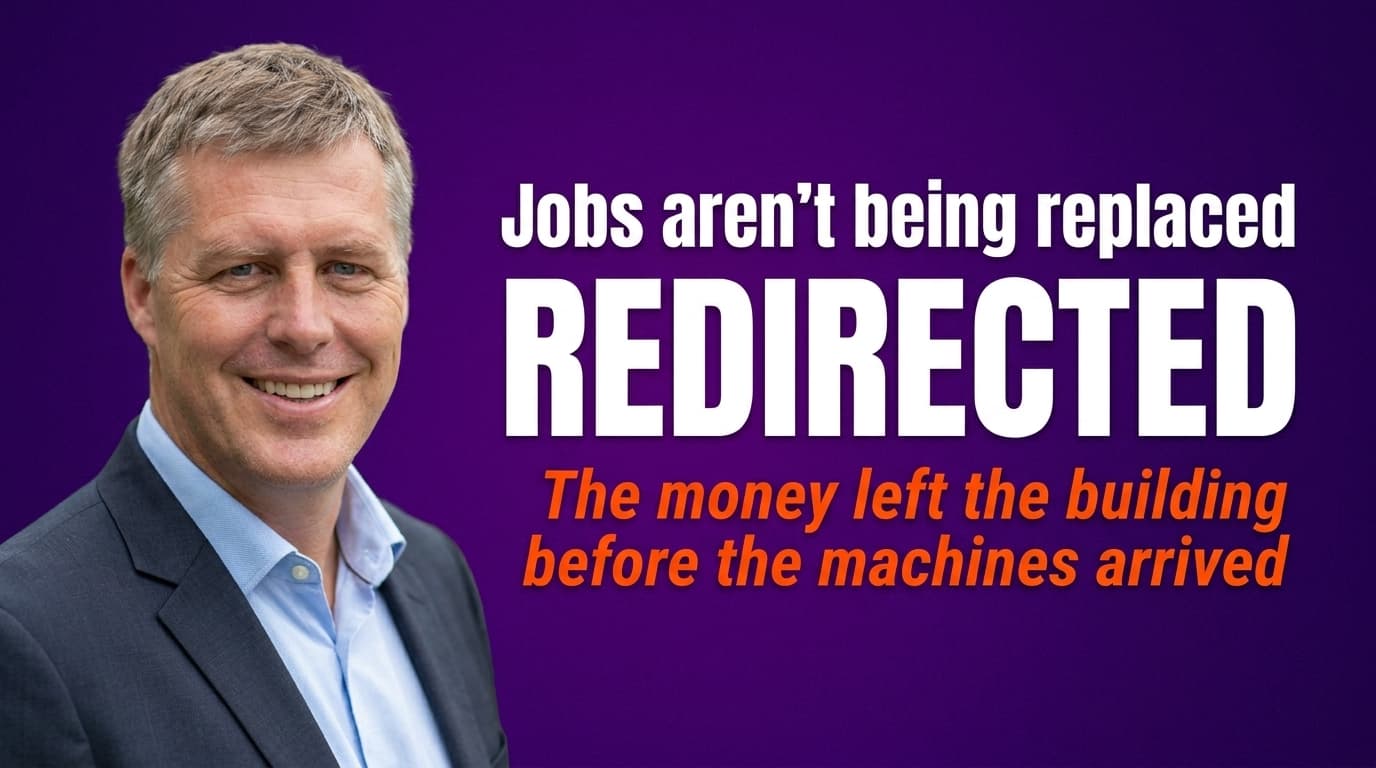
The great AI reallocation: companies are cutting jobs to fund compute
TL;DR
The dominant narrative, that AI replaces jobs by automating tasks, is wrong. The real mechanism is capital reallocation: companies are defunding payroll to buy compute infrastructure. The work often still exists; the budget has simply been redirected. Understanding this distinction is the difference between navigating the shift and being caught by it.
What is the great AI reallocation?
The story we've been told about AI and the future of work is fundamentally flawed. The standard version goes: a machine learns to do what a human used to do, and the human is let go. That treats displacement as a task-level event, a role is automated, so the role disappears.
The reality is more ruthless. A landmark investigation by Quartz and Yahoo Finance has exposed the true mechanism: companies aren't cutting jobs because AI can do the work. They are cutting jobs because they need the money to buy the AI.
The budget that paid your salary wasn't eliminated because you became obsolete. It was redirected toward servers, data centres, and compute power.
This is the great reallocation. If you don't understand how it works, you will be caught on the wrong side of the ledger.
How big is the $660 billion capital shift?
The scale is difficult to comprehend. The five largest US cloud and AI infrastructure providers, Microsoft, Alphabet, Amazon, Meta, and Oracle, have collectively committed to spending between $660 billion and $690 billion on capital expenditures in 2026. Capital expenditures among major tech companies have more than doubled in the last two years, reaching $427 billion in 2025 alone.
That money flows into data centres, graphics processing units, and networking equipment. It is not translating into hiring. Those assets are capital-intensive, not labour-intensive, and the money has to come from somewhere. In corporate boardrooms around the world, the easiest place to find it is the payroll.
What are companies actually saying when they cut staff?
The clearest evidence is in corporate language itself. In March 2026, AI led all cited reasons for US job cuts, 15,341 layoffs attributed to the technology, accounting for 25 percent of total planned cuts. Through Q1 2026, over 81,000 tech layoffs were recorded.
But look at what these companies are actually saying:
- Dell reduced its workforce by about 11,000 employees in fiscal 2026, bringing headcount to 97,000, a 10 percent year-over-year reduction, marking the third consecutive year the company trimmed its workforce by a similar proportion. The cuts were described as "disciplined cost management" in SEC filings. But Dell's Infrastructure Solutions Group saw revenue increase by 40 percent, and the company expects AI-optimised server revenue to double next year. They didn't automate 11,000 jobs. They defunded them to buy servers.
- Cisco CEO Chuck Robbins was direct: when cutting 7 percent of the workforce, he explicitly stated the company was "shifting hundreds of millions of dollars" into AI and other growth areas. His CFO framed the cuts not as cost savings, but as reallocation.
- Meta reached $201 billion in revenues in 2025, these were not financial hardship cuts. CEO Mark Zuckerberg set 2026 capex guidance at $115 billion to $135 billion, almost double the prior year. To absorb that outlay without collapsing profit margins, Meta has been redirecting salary money. Since 2022, the company has eliminated about 25,000 positions.
See where AI fits in your business. Free.
A 45-minute audit. We map the highest-value automations and what they're worth in time and money. No pitch, no pressure.
Is this pattern spreading beyond Big Tech?
It is spreading into every sector of the economy.
Bank of America's CFO described a quieter version of the same dynamic, simply making decisions not to hire and letting headcount "drift down" to fund AI ambitions. Block CEO Jack Dorsey cut 4,000 employees, roughly 40 percent of his workforce, and explicitly cited AI as the reason, predicting most companies would reach the same conclusion within a year.
Morgan Stanley's latest analysis found that 25 percent of S&P 500 companies mentioned quantifiable AI impact in their Q1 2026 earnings calls, up from 13 percent in the same period last year. The narrative has shifted from aspirational to operational, and the operational reality is that human capital is being sacrificed to fund machine capital at an accelerating rate.
In Singapore and across Asia-Pacific, the dynamic mirrors this pattern. The Pearson and AWS study found that 53 percent of employers across the Asia-Pacific region are struggling to find AI-ready graduates, the talent pipeline is drying up at the exact moment capital is being redirected away from human resources. A double squeeze: less money for people, and fewer qualified people available even if the money were there.
In the UK, the Accenture survey found that 50 percent of UK executives now expect AI to cut jobs within a decade, up from 33 percent just two years ago. Over 73,000 tech jobs were cut in Q1 2026 alone. The UK government's £500 million Sovereign AI Fund is attempting to channel this disruption productively, but the reality on the ground is that businesses are cutting first and strategising second.
As Daniel Keum, a professor at Columbia Business School, noted: workers are losing jobs not because their specific roles have been automated, but because companies are reallocating resources toward AI and away from everything else.
What does the data show in Australia?
The Australian picture is particularly stark. KPMG's latest research shows that while 95 percent of Australian businesses have an AI strategy, only 8 percent are seeing measurable returns. The money is being spent, headcounts are being trimmed, and the productivity gains are not materialising at the promised pace.
Meanwhile, MYOB data shows that the 40 percent of Australian SMEs actually using AI are growing 2.8 times faster than those that aren't. The gap between those getting it right and those simply cutting costs is widening by the day.
How are companies using the AI narrative to suppress wages?
A recent survey of US business leaders found that 54 percent of companies have reduced or will reduce employee compensation to free up capital for AI spending in 2026.
More than half of companies are actively cutting what they pay their people so they can buy more software.
Eighty-eight percent of those leaders admitted the weak job market makes it easier to reduce compensation without losing talent. They are using the threat of AI as leverage to suppress wages, while funnelling the savings into the very technology they claim will eventually replace the workers. It is a ruthless, highly effective strategy that is fundamentally reshaping the relationship between capital and labour.
Are businesses actually getting a return on their AI spending?
Most are not. An NBER study of 6,000 CEOs found that nearly 90 percent of firms report zero measurable productivity gains from AI over the past three years.
If you are cutting staff to fund technology that isn't delivering, you are not reallocating capital, you are destroying it.
The successful businesses are those using AI to fundamentally redesign their workflows, eliminating the need for the work itself rather than just eliminating the budget that pays for it. They are investing heavily in data readiness and governance, ensuring that when they deploy these tools, they generate an actual return on investment. The winners treat AI investment with the same rigour they would apply to any major capital expenditure: clear objectives, measurable outcomes, and a willingness to pull the plug if it isn't working.
What to do this week
If you are a business owner or manager:
- Map where your AI spend is actually going. Infrastructure, tools, or genuine workflow redesign?
- Set clear, measurable ROI targets for every AI expenditure, or acknowledge honestly that you are following the herd.
- Do not cut staff to fund technology that hasn't delivered yet. Redesign workflows first; eliminate the need for the work itself, not just the budget that pays for it.
- Benchmark against the data: if 95 percent of Australian businesses have an AI strategy but only 8 percent see measurable returns, ask honestly which group you are in.
- Be brutally honest about whether your AI spending is generating returns or whether you are simply following the herd.
If you are an employee or a professional:
- Understand that your value is now benchmarked against the potential return on investment of an AI server rack.
- Position yourself not just as someone who can do the work, but as someone who can orchestrate the technology that does the work.
- Be the person directing the capital. Not the capital that gets redirected.
Where to from here
Book a free 60-minute AI audit, we'll explore exactly what workflows are worth augmenting with AI.
Live with passion & AI,
Brett
Running an event? Put practical AI on your stage.
Keynotes and workshops that send business owners home with a plan they can use Monday morning. No hype.
Frequently asked questions
Why are companies cutting jobs even when AI can't fully replace those roles?
+
Companies are reallocating the budget that paid salaries toward AI infrastructure, servers, data centres, and compute power. The work may still need doing, but the capital has been redirected elsewhere, leaving remaining staff to absorb the load while productivity gains wait to materialise.
How much are major tech companies spending on AI infrastructure in 2026?
+
The five largest US cloud and AI infrastructure providers, Microsoft, Alphabet, Amazon, Meta, and Oracle, have committed to spending between $660 billion and $690 billion on capital expenditures in 2026. Major tech capex more than doubled in two years, reaching $427 billion in 2025 alone.
What did Cisco's CEO say about its AI-related workforce cuts?
+
Cisco CEO Chuck Robbins explicitly stated the company was 'shifting hundreds of millions of dollars' into AI and other growth areas when cutting 7 percent of its workforce. His CFO framed the cuts as reallocation, not cost savings.
Are Australian businesses actually seeing returns from AI investment?
+
KPMG research shows that while 95 percent of Australian businesses have an AI strategy, only 8 percent are seeing measurable returns. However, MYOB data shows the 40 percent of Australian SMEs actively using AI are growing 2.8 times faster than those that aren't.
How many tech jobs were cut in Q1 2026?
+
Over 81,000 tech layoffs were recorded through Q1 2026. In March 2026 alone, AI led all cited reasons for US job cuts, with 15,341 layoffs attributed to the technology, accounting for 25 percent of total planned cuts.
What did the NBER study find about AI productivity gains?
+
An NBER study of 6,000 CEOs found that nearly 90 percent of firms report zero measurable productivity gains from AI over the past three years, meaning most businesses cutting staff to fund AI are not yet seeing a return on that investment.
How are companies using the AI narrative to reduce employee compensation?
+
A survey of US business leaders found 54 percent of companies have reduced or will reduce employee compensation to free up capital for AI spending in 2026. Eighty-eight percent of those leaders admitted the weak job market makes it easier to cut compensation without losing talent.

Brett is a four-time founder (Darra Tyres, Gladfish, EzyTrac, Anaboo) and the operator behind AIOS, Anaboo's AI Operating System. He writes from inside the build, installing AI in his own businesses first and reporting back what actually moves the numbers. Based between Singapore, the UK and Australia.