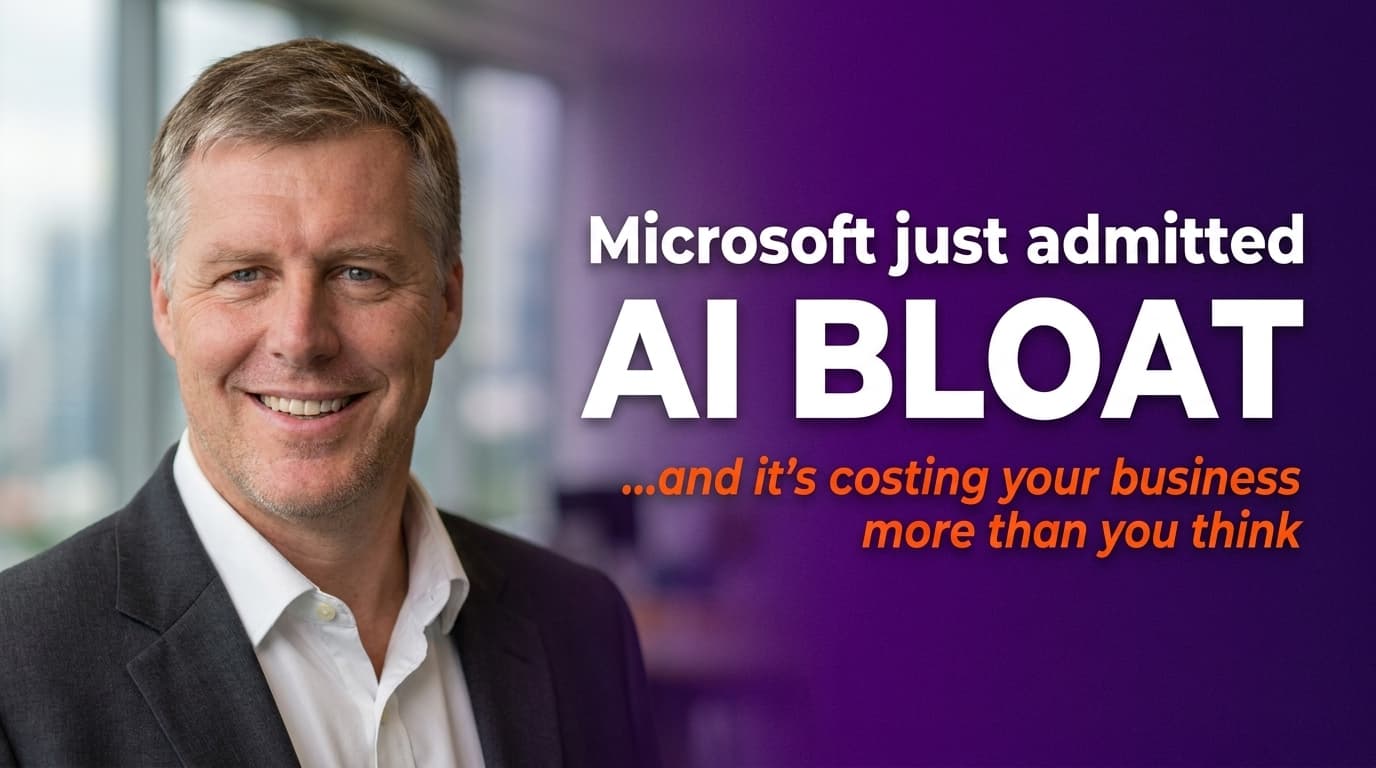
Microsoft's Copilot retreat proves AI bloat is costing your business
TL;DR
Microsoft's quiet rollback of Copilot features in Windows 11 is the most honest signal the AI industry has produced in years. AI bloat, piling on tools without a clear problem to solve, is draining budgets, frustrating teams, and producing nothing. A McKinsey study found only 10% of enterprise functions are actually using AI agents, despite the billions being spent. The fix is ruthless focus: one problem, one tool, measurable outcome.
What is AI bloat and why does it matter?
AI bloat is what happens when a business buys tools because of pressure, not purpose. Every subscription, every integration, every Copilot button tucked into a toolbar represents money and attention your team can never get back. The result is a tech stack that looks impressive on a slide and performs poorly in practice, and a team that's exhausted trying to keep up with it.
This is not a fringe problem. When one of the most resourced technology companies on the planet quietly pulls back on its flagship AI product, that's a signal worth paying attention to.
Why did Microsoft scale back Copilot in Windows 11?
Microsoft didn't hold a press conference. There was no CEO on stage in a black turtleneck. They rolled back parts of their Copilot integration through a software update, the corporate equivalent of quietly moving the furniture back after a party that didn't quite land.
Strategy matters more than saturation.
The lesson is not that Copilot is bad technology. The lesson is that layering AI onto everything without a coherent strategy produces friction, not value. Microsoft had the budget, the talent, and the platform, and they still got it wrong. If that doesn't make you pause before your next AI purchase, nothing will.
The shiny new toy problem: why FOMO is burning your budget
The pressure to be seen as innovative is real, and vendors know it. The playbook is simple: release a new AI-powered feature, drape it in language about transformation and efficiency, and let fear of missing out do the rest. Businesses buy before they've defined the problem.
Think back to the dot-com bubble. Everyone scrambled to get online. Any website would do. Most had no strategy, no idea how it would actually help their business. A lot of people lost their shirts. AI adoption in 2024 and 2025 rhymes with that history. Just because you can do something does not mean you should.
Technology is a tool, not a magic wand. The goal is never to have the most AI. The goal is to solve the real-world problem that is holding your business back. More AI, applied without purpose, leads to more complexity, more cost, and more confusion. The exact opposite of what was promised.
Are we losing the human touch at work?
A Resume Now survey found that 63% of workers believe AI will make the workplace feel "less human." That is not a statistic to file away and forget. It's a reflection of a real and growing sentiment, a backlash forming against the very technology being sold as our saviour.
The pattern goes like this: a well-intentioned leader decides to modernise. They roll out a suite of AI tools. The intention is empowerment. The outcome is often the opposite: staff feeling micromanaged by algorithms, disconnected from each other, and buried under new workflows that nobody properly explained. The casual hallway conversation, the whiteboard session, the quick check-in over a desk. All of it replaced by automated prompts and digital handoffs.
Technology should serve people, not the other way around. When we forget that, we lose the very essence of what makes a business thrive.
The culture erodes slowly. It doesn't show up on a spreadsheet until it's too late. This is the danger of AI bloat. It chips away at the people and relationships that actually make a business work.
See where AI fits in your business. Free.
A 45-minute audit. We map the highest-value automations and what they're worth in time and money. No pitch, no pressure.
The great AI ROI myth: what the McKinsey data actually shows
The promised returns from AI have been astronomical. The reality for most businesses is falling painfully short. A McKinsey study found that only 10% of enterprise functions are actually using AI agents despite the billions being spent. Sit with that number for a moment.
Despite the billions poured into AI development and the relentless marketing campaigns, the vast majority of businesses are not seeing a meaningful operational impact. They've bought the tools. They've paid the subscriptions. The technology is sitting on the shelf gathering digital dust, the corporate equivalent of a gym membership bought in January and forgotten by March. The only one getting fitter is the vendor's bank account.
Why? Because implementation is hard. Integrating AI effectively requires:
- A clear strategy before the first tool is purchased
- A deep understanding of existing workflows
- Significant investment in training and change management
- Brutal honesty about whether the tool solves a real problem
Vendors leave these parts out of the pitch. They sell the dream. Your P&L pays for the gap between the dream and reality. You need to be fiercely critical. The hype is a long way from the reality.
What Anthropic's rise tells us about what businesses actually want
While OpenAI has dominated headlines with an "everything to everyone" approach, Anthropic has been quietly winning in the enterprise space. A report from Ramp (a corporate card and expense management platform) found that businesses are 70% more likely to choose Claude for their first AI service.
This is not a fluke. It's a sign of a fundamental shift in what businesses are looking for. They're moving past the initial hype and starting to prioritise safety, reliability, and a clear focus on enterprise needs over feature counts and flashy demos.
Anthropichasn't tried to build the tool with the most features. They've built a tool businesses can actually rely on. Safety and predictability might not sound as exciting as "world-changing AI, " but they're what matter when you're dealing with real-world business challenges, customer data, and your company's reputation. Businesses are getting smarter. They want a partner they can trust, not just the latest shiny object.
How to cut through the noise and avoid AI bloat
Stop buying tools before you have a problem defined. The question to ask, and answer honestly before a single vendor gets in the room, is this:
What is the one problem I am trying to solve?
Not what the vendors are pitching. Not what your competitors appear to be doing. The single biggest bottleneck, the most persistent headache in your business right now. Write it down. Stick it on your monitor. Everything else is noise until that answer is clear.
Once you have the problem defined:
- Evaluate tools against that specific problem, nothing else
- If a tool doesn't directly address it, it is a distraction regardless of how impressive the demo is
- Be ruthless: complexity is a cost, not a feature
- Demand evidence of real-world results, not case studies from companies with ten times your budget
The right AI applied to the right problem can be genuinely transformative. The wrong AI applied indiscriminately is a fast track to frustration and wasted money. Stop collecting shiny toys and start building a real, effective toolkit.
What to do this week
- Audit your current AI tools. List every subscription, integration, and AI-powered feature your business is paying for or using. Be honest about which ones your team actually uses daily.
- Define your single biggest bottleneck in one sentence. If you can't, the problem isn't clear enough yet. That's the real work.
- Check your ROI assumptions. For each tool, identify the specific outcome it was supposed to deliver. Has it delivered? If not, why not?
- Ask your team directly. Is this technology making your work easier or harder? Their answer will tell you more than any vendor benchmark.
- Apply the one-question test before the next purchase: Does this directly solve the problem I wrote down? If the answer is not an immediate yes, don't buy it.
Where to from here
Book a free 60-minute AI audit and we'll explore exactly what workflows are worth augmenting with AI.
Live with passion & AI,
Brett
Host a podcast? Have Brett on as a guest.
Straight talk on implementing AI in real SMEs, no jargon, plenty of receipts from the businesses we run.
Frequently asked questions
What is AI bloat and how does it hurt businesses?
+
AI bloat is what happens when businesses adopt multiple AI tools driven by FOMO rather than a clear problem to solve. The result is wasted subscriptions, confused teams, and no measurable return on investment.
Why did Microsoft scale back Copilot in Windows 11?
+
Microsoft quietly rolled back parts of its Copilot integration through a software update rather than a public announcement. It signals that layering AI onto everything without a coherent strategy creates friction rather than value.
What does McKinsey's research say about enterprise AI usage?
+
A McKinsey study found that only 10% of enterprise functions are actually using AI agents, despite the billions spent on AI tools and the relentless marketing behind them.
Why are businesses choosing Anthropic's Claude over competitors?
+
A Ramp report found businesses are 70% more likely to choose Claude for their first AI service. Anthropic's focus on safety, reliability, and enterprise needs is winning over businesses that have moved past initial hype.
How many workers think AI will make the workplace feel less human?
+
A Resume Now survey found that 63% of workers believe AI will make the workplace feel less human, a reflection of growing tech fatigue and genuine concern about the erosion of team culture.
How do you avoid AI bloat in your business?
+
Define the single biggest bottleneck in your business before looking at any tools. Evaluate every AI product against that specific problem only. If it doesn't directly address it, it's a distraction regardless of the demo.
Is AI adoption still worth pursuing given most businesses aren't seeing results?
+
The right AI applied to the right problem can be genuinely transformative. The issue is not AI itself but the indiscriminate adoption of tools without strategy, proper training, or change management.

Brett is a four-time founder (Darra Tyres, Gladfish, EzyTrac, Anaboo) and the operator behind AIOS, Anaboo's AI Operating System. He writes from inside the build, installing AI in his own businesses first and reporting back what actually moves the numbers. Based between Singapore, the UK and Australia.