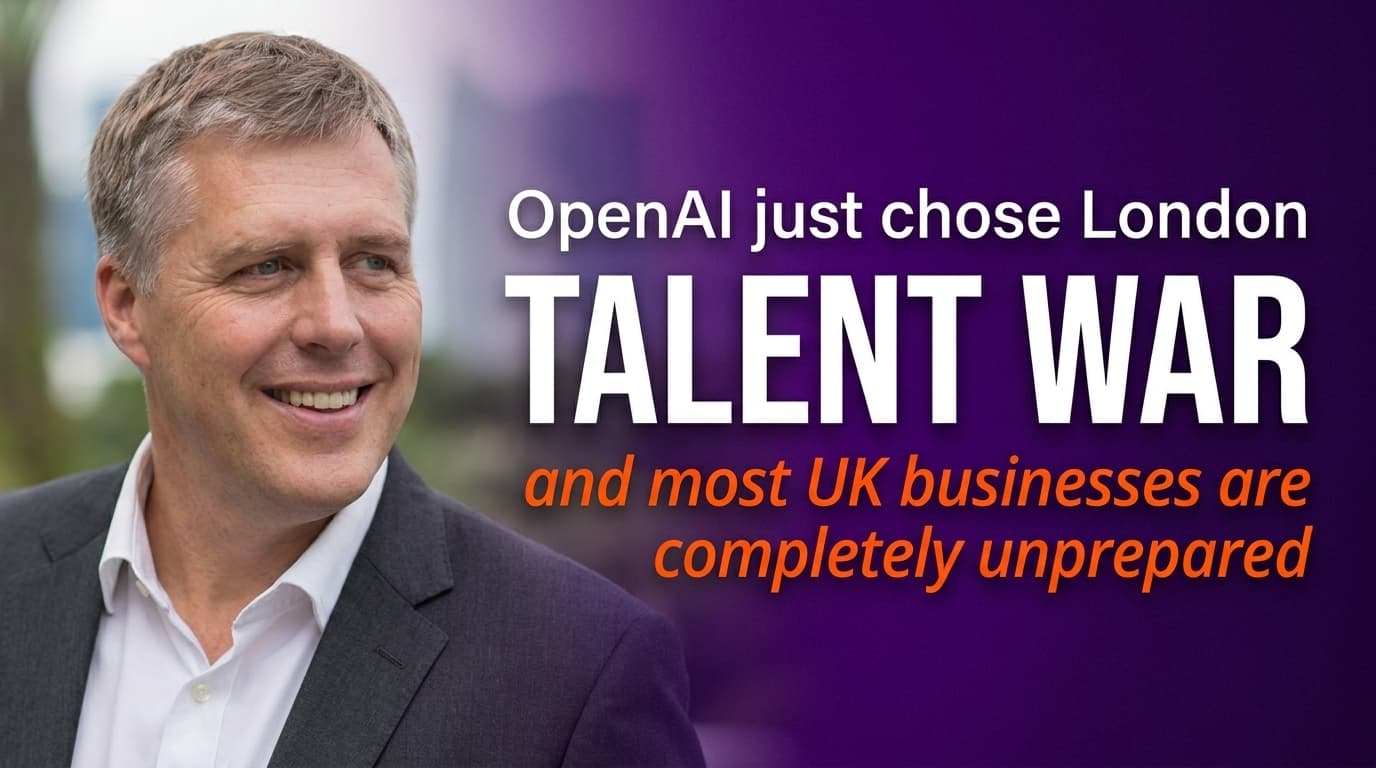
OpenAI chose London, what the AI talent war means for your business
TL;DR
OpenAI's decision to plant its biggest international research hub in London is being celebrated as a UK win, it is not. It is the opening shot in a talent war that 60% of UK businesses are already losing before it has even started. With Singapore, arguably the world's most AI-advanced nation, reporting that 71% of employers cannot fill AI roles, the UK faces a systemic crisis hiding in plain sight. The only rational response is to stop waiting for the government and start building AI capability into your own business now.
Is OpenAI's London hub actually good news for UK businesses?
For a handful of elite researchers, yes. For everyone else, no. OpenAI is arriving with a war chest that could buy a small country, and they are not coming to help local businesses. They are coming to sign the best AI talent in the country to exclusive, multi-million-pound packages that no SMB can match. The government is cheering from the sidelines while the grassroots of the talent pipeline is about to be stripped bare.
Think of it like a Premier League club deciding to build its new training ground on the local park where the kids play. They are not there to help the local team. They are there to scout the best players and lock them into contracts no local club could afford. The government sees the glamour. It is missing the damage being done beneath it.
Why the talent war will hit businesses that have nothing to do with AI research
The ripple effect will reach far beyond developers. Project managers, data analysts, product owners, and marketing professionals with any AI experience on their CVs will see their salary expectations spike overnight. The skills gap that already sits at 60%, according to SAP research, will widen into something that looks considerably more like a canyon.
The real-world version plays out quietly. On a Tuesday afternoon, a LinkedIn message from a well-resourced recruiter lands in your best person's inbox. They are offered double their salary, stock options, and a campus with perks you could not dream of matching. By Friday they are gone. You spend the next six months rebuilding. That was the pressure before OpenAI arrived. Multiply it across the entire market and you begin to see the scale of what is coming.
What does the 60% problem actually look like on a Tuesday morning?
SAP's research found that 60% of UK businesses admit their staff lack the AI skills they need. That is not a rounding error or a cluster of laggard companies. It is a majority, a systemic, national failure at the exact moment the most resourced AI company on earth arrives to compete for the same people.
On a practical level, the 60% problem looks like this:
- Marketing teams spending half the week manually pulling together reports that are out of date by the time they are finished
- Sales teams guessing at lead prioritisation because they lack the tools to analyse customer behaviour properly
- Operations managers unable to accurately forecast demand
- A thousand small inefficiencies accumulating into a slow, quiet drain on the business
None of these problems are dramatic. None of them appear in a board report. They are the steady accumulation of missed opportunity, and they are already happening in most businesses before OpenAI has even opened its doors.
See where AI fits in your business. Free.
A 45-minute audit. We map the highest-value automations and what they're worth in time and money. No pitch, no pressure.
What Singapore tells us about where the UK is heading
If you want to see what the future looks like, look at Singapore. This is a country that has done almost everything right on AI: heavy state investment in education, a ruthlessly efficient business environment, and active encouragement of innovation at every level of society. By any measure, it is one of the most AI-advanced nations on earth.
And yet: 71% of Singapore employers are struggling to find people with the right AI skills. It is the number-one hardest-to-fill role in the entire country. If a nation that has poured billions into becoming an AI powerhouse still cannot find enough people to do the work, the UK, with its fragmented strategy and deep-seated cultural resistance to change, is heading for something considerably worse. The warning signs are flashing red. It is not clear anyone in government is reading them.
What is the UK government actually doing about the AI skills gap?
They have tasked 19 different regulators with generating ideas. Nineteen. There are also some free online courses on offer. Neither of these things will help a business competing for talent against a company with OpenAI's resources. A three-hour introduction to AI does not close a skills gap when six-figure salaries are being offered to anyone who can demonstrate real capability. It is a well-intentioned plaster on a multi-car pile-up.
The government's fundamental mistake is treating a major American company opening a London office as a vote of confidence in the UK economy. They are not seeing the Trojan horse. The long-term damage will be felt in the thousands of smaller, agile businesses that are the actual lifeblood of the economy, the ones that do not make the press release, but that pay taxes, create jobs, and keep communities running.
How do you change the rules when you cannot win the salary war?
You stop trying to win on their terms. The only viable move is to build your own AI capability from the inside out, starting with the people you already have.
Your existing team knows your customers, your products, and your market. That knowledge is the real asset. The job is to layer AI capability on top of it:
- Invest continuously, not once. A single training course is a plaster on a fracture. A continuous programme of learning and experimentation is what actually builds capability over time.
- Embed AI in every workflow. Look at every process in the business, from lead generation to customer service, and ask how AI can make it better. Automate the mundane tasks that drain energy and creativity. Surface the insights buried in your data.
- Empower your existing roles. This is not about turning your accountant into a data scientist. It is about giving your accountant AI tools that automate reconciliations, spot anomalies in real time, and deliver deeper financial insight. It is about turning your marketing manager into an AI-enabled marketer who can create personalised campaigns at scale.
- Build culture, not just capability. The businesses that will retain smart, ambitious people are the ones offering a genuine mission and real impact, not just a pay cheque. You cannot out-muscle the giants on compensation. You can become the place where people want to do their best work and build something that matters.
The only move you have is to change the game. And that starts with the people already on your team.
What to do this week
- Audit your actual AI skills gap. Not what people claim on their CVs, what they can genuinely do with AI tools today. The SAP number is 60% nationally. Find out where your business sits.
- Pick one workflow and fix it. Identify the most painful manual process in your business and find an AI tool that addresses it this week. Do not wait for a company-wide strategy.
- Protect time for experimentation. Do not just send people on a course. Allocate regular, protected time for your team to experiment with AI tools in the context of their actual work.
- Brief your leadership team on the talent risk now. This is not a future problem. OpenAI's London hub makes it a present one. The businesses that treat it as urgent today will be in a materially different position in 12 months.
Where to from here
Book a free 60-minute AI audit, we'll explore exactly what workflows are worth augmenting with AI.
Live with passion & AI,
Brett
Host a podcast? Have Brett on as a guest.
Straight talk on implementing AI in real SMEs, no jargon, plenty of receipts from the businesses we run.
Frequently asked questions
Why did OpenAI choose London for its biggest international hub?
+
OpenAI chose London for its biggest international research hub, drawn by the UK's concentration of AI talent and a government eager to attract major tech investment. The UK government has celebrated the move as a win for 'UK plc'.
What percentage of UK businesses lack the AI skills they need?
+
According to SAP research, 60% of UK businesses admit their staff lack the AI skills they need. That is not a fringe problem, it is a majority, and it represents a systemic national failure at precisely the wrong moment.
How does Singapore's AI talent shortage compare to the UK's situation?
+
Despite being one of the most AI-advanced nations on earth, with heavy state investment in AI education and a business-friendly environment, 71% of Singapore employers still struggle to fill AI roles. It is the hardest-to-fill position in the entire country, which is a stark warning for the UK.
What is the UK government doing to address the AI skills gap?
+
The government has tasked 19 different regulators with generating ideas and is offering free online courses. Neither measure comes close to addressing the scale of the problem, a three-hour introduction to AI cannot compete with the six-figure packages that OpenAI can offer.
How can small businesses compete for AI talent against companies like OpenAI?
+
They cannot compete on salary and perks, that is a war SMBs will lose every time. The only viable move is to stop playing on those terms entirely: invest in your existing team, embed AI into your processes, and build a culture where smart people want to do their best work.
How do you build AI capability without hiring AI specialists?
+
By upskilling the people you already have. This means giving your existing staff the tools and protected time to experiment with AI in their actual roles, not turning your accountant into a data scientist, but giving them AI tools that automate reconciliations and surface anomalies in real time.
What is the immediate business risk of OpenAI's London expansion for SMBs?
+
Salary expectations for anyone with AI experience will spike across the board, widening an already critical skills gap. The ripple effect reaches beyond developers to project managers, data analysts, product owners, and marketing professionals, anyone with 'AI' on their CV.

Brett is a four-time founder (Darra Tyres, Gladfish, EzyTrac, Anaboo) and the operator behind AIOS, Anaboo's AI Operating System. He writes from inside the build, installing AI in his own businesses first and reporting back what actually moves the numbers. Based between Singapore, the UK and Australia.