OpenAI is hiring 4,000 people while your AI skills gap widens
TL;DR
OpenAI is reportedly doubling its workforce to 8,000 people and deploying "technical ambassadors" directly inside enterprise businesses. A report from Ramp shows businesses are now 70% more likely to choose Anthropic's Claude over OpenAI for their first enterprise AI service, safety and reliability are beating brand recognition. Goldman Sachs estimates 300 million jobs are exposed to automation, with entry-level roles bearing the brunt. You cannot compete with OpenAI for talent; the only viable path is to build your own AI-literate workforce from within.
Why is OpenAI doubling its workforce to 8,000 people?
OpenAI is reportedly on track to double its headcount to 8,000 people by the end of the year, an addition of roughly 4,000 roles. This is not just a company expanding; it is a strategic mobilisation. Among these hires are roles they call "technical ambassadorships", AI specialists embedded directly inside businesses to weave OpenAI's models into enterprise operations at the deepest level.
This isn't about selling software licences. It's about owning the entire operational layer of every significant industry.
The goal is dependency. They are building an ecosystem where their platforms become as fundamental as the internet itself. Every specialist placed inside a business is a foothold, a guarantee that OpenAI's infrastructure becomes indispensable to that organisation's future. This is a level of strategic workforce planning that most companies can only dream of.
What does this arms race mean for your available talent pool?
You cannot out-bid Google, Microsoft, or a pre-IPO rocket ship like OpenAI. The stock options alone are enough to pull every capable AI researcher, engineer, and strategist toward the tech giants. The sheer gravitational pull of these companies is creating a vacuum for everyone else.
The talent war is no longer polite competition. It is a zero-sum game, and the side with the most resources is winning decisively. The AI giants are not just hiring the best, they are hiring the entire graduating class. Every hire they make is one fewer person available to help your business navigate this shift. Every time they hire someone, it's one less person in the ecosystem who could have helped you.
Why are businesses choosing Anthropic's Claude over OpenAI for enterprise?
The market is maturing fast. A report from Ramp, a corporate card and spend management company, found that businesses are now 70% more likely to choose Anthropic's Claude over OpenAI for their first AI service. The company that started this whole revolution, the one with all the brand recognition, is losing ground in the enterprise space.
Why? Because Anthropic has been laser-focused on what actually matters to a real business:
- Safety frameworks that a compliance officer can actually sign off on
- Reliability and auditability at enterprise scale
- Data security and model transparency
- A framework that does not expose businesses to reputational or legal risk
Anthropicis not winning because their technology is necessarily superior in a raw, academic sense. They are winning because they are selling trust, and in business, trust is the ultimate currency. The conversation has moved from the sandbox to the boardroom. The era of playing around with a cool new toy is finished.
See where AI fits in your business. Free.
A 45-minute audit. We map the highest-value automations and what they're worth in time and money. No pitch, no pressure.
Which jobs are most exposed to AI automation?
A Goldman Sachs report put a number on it: 300 million jobs are exposed to automation. "Exposed" means their core functions can be done faster, cheaper, and more efficiently by AI. These are not C-suite roles, they are the entry-level positions held by graduates in their 20s and 30s.
The roles disappearing first:
- Research and first-draft writing
- Handling customer queries
- Spreadsheet analysis and data manipulation
- Foundational analytical work across most professional services
These are the engine-room roles most businesses depend on. They are also the training ground through which future senior leaders are built. That is the part most business owners have not grasped yet.
Is the professional talent pipeline actually breaking?
Yes. The system most businesses rely on, hire young people, let them learn by doing foundational work, promote them into leadership, is under direct threat. The foundational work is being automated. The training ground is disappearing.
The talent pipeline is being dismantled, and we're automating professional development without grappling with the consequences.
In five to ten years, where does your next generation of senior leaders come from? If you have not thought about this, you have a sustainability problem, not just a hiring problem. The social contract between employers and early-career workers is being rewritten without debate, and most business owners have not registered the threat.
What is a Chief Workforce Architect and does your business need one?
A Chief Workforce Architect is an emerging role that blends strategy, technology, and HR. It is not a rebrand of an HR manager, it is a fundamental reimagining of how organisations are designed in the age of AI. The questions this role asks are strategic ones:
- Which roles can be automated or augmented?
- What new skills does the business actually need?
- How do we build career paths that do not dead-end at automation?
- How do we make human-AI integration productive and humane?
An AI-literate workforce is a strategic advantage. A non-literate one is a liability. Forward-thinking companies are already building this function. If yours has not, someone needs to own these questions, even if the title does not exist yet. This is not an IT problem; it is a fundamental business strategy problem about value creation.
Are AI and automation actually creating any new jobs?
Yes, and this matters. The same Goldman Sachs report that flagged 300 million at-risk jobs also pointed to significant new job creation. It forecast 500,000 new US jobs by 2030 just for data centres, the backbone infrastructure of the AI revolution.
These are not low-skill construction roles. They cover:
- Engineering and network management
- Logistics and supply chain
- Security and infrastructure management
Work is changing, not disappearing. The demand for skilled, adaptable people is as high as ever. The question is whether your workforce is positioned to fill these emerging roles, or whether you are training people for a world that no longer exists. The future is unwritten. You can shape the outcome with a proactive approach, or you can wait and find yourself left behind.
What to do this week
The two-speed economy is not a forecast, it is already here. These are the concrete actions worth taking now:
Audit your entry-level roles. Which tasks are already being done, or could be done, by AI tools your team uses today? Document it. This becomes the foundation of your upskilling plan.
Find your AI-literate people. Who on your team is already experimenting with AI beyond basic prompts? These are your internal ambassadors. Give them a mandate, not just permission.
Assign a Workforce Architect function. You may not be ready to hire a Chief Workforce Architect, but someone needs to own the hard questions: which roles are at risk, what new skills are needed, and how do you build future leaders in an automated environment?
Evaluate your AI platforms on enterprise criteria. Do not choose tools based on brand recognition or novelty. Ask about data security, auditability, compliance frameworks, and long-term viability. The Ramp data is unambiguous, safety and reliability are winning.
Build a learning culture, not a one-day course. This is a sustained commitment to keeping your team curious, experimenting, and adapting. The businesses that thrive will be talent creators, not talent consumers. That is your only durable competitive advantage in this market.
Where to from here
Book a free 60-minute AI audit, we'll explore exactly what workflows are worth augmenting with AI.
Live with passion & AI,
Brett
Host a podcast? Have Brett on as a guest.
Straight talk on implementing AI in real SMEs, no jargon, plenty of receipts from the businesses we run.
Frequently asked questions
How many people is OpenAI hiring in 2026?
+
OpenAI is reportedly doubling its workforce to 8,000 people, meaning it is adding around 4,000 new roles. Among these are positions described as "technical ambassadorships", specialists embedded directly inside businesses to integrate OpenAI's models at the enterprise level.
Why are businesses choosing Anthropic's Claude over OpenAI for enterprise?
+
According to a report from Ramp, businesses are now 70% more likely to choose Anthropic's Claude over OpenAI for their first AI service. Anthropic has prioritised safety, reliability, and compliance frameworks, the criteria that matter most in enterprise environments, where trust outweighs novelty.
How many jobs are at risk from AI automation?
+
A Goldman Sachs report estimated that 300 million jobs are exposed to automation, meaning their core functions can be performed faster and more cheaply by AI. These are predominantly entry-level roles, not senior or C-suite positions, which makes the impact on the talent pipeline especially severe.
What is a Chief Workforce Architect?
+
A Chief Workforce Architect is an emerging leadership role that blends strategy, technology, and HR. Their remit is to identify which roles can be automated or augmented, design new career paths, build upskilling programmes, and ensure human-AI integration is both productive and humane.
What new jobs is AI actually creating?
+
The same Goldman Sachs report that flagged 300 million at-risk jobs also forecast 500,000 new US jobs by 2030 just for data centres, covering engineering, logistics, security, and network management. Work is changing, not disappearing.
What is the two-speed economy in AI?
+
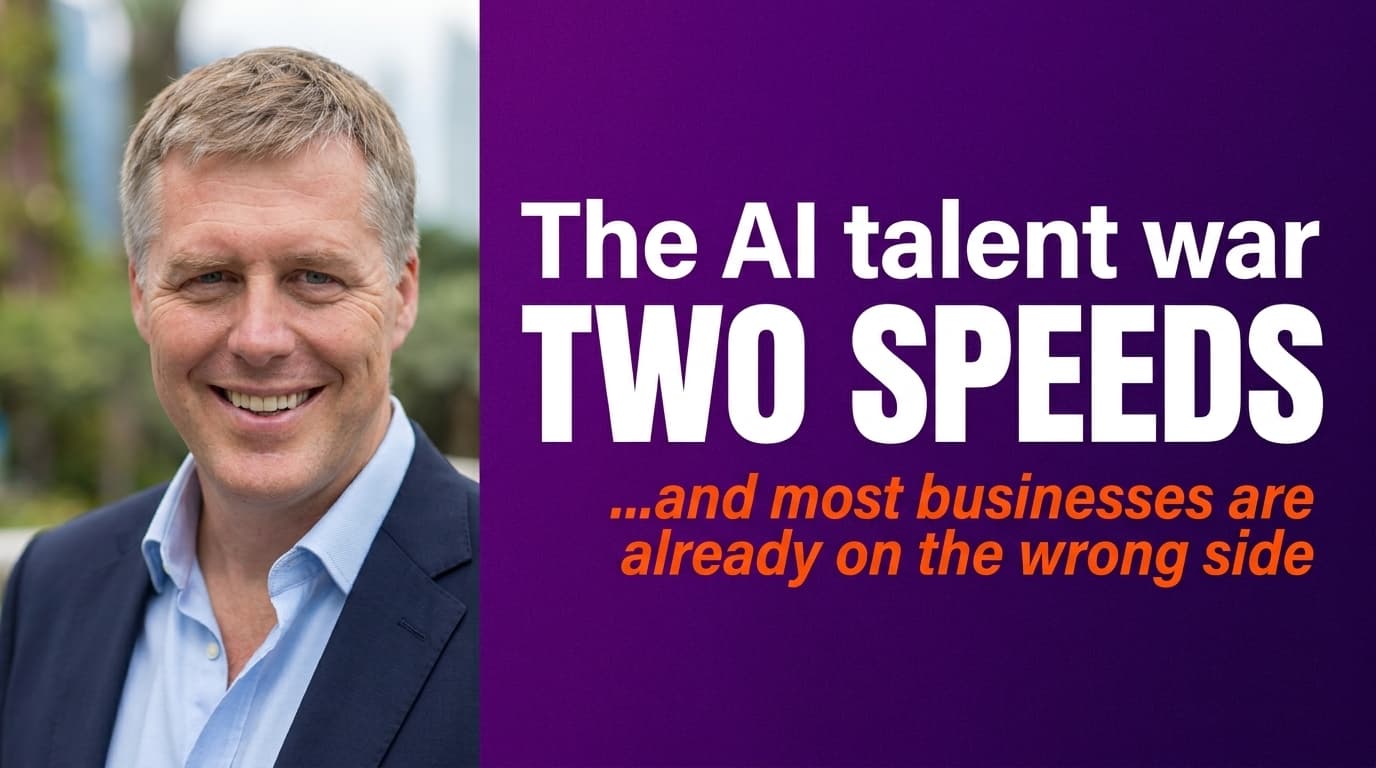
The two-speed economy refers to the widening gap between large AI companies like OpenAI, Google, and Microsoft, who are aggressively embedding AI expertise directly into enterprises, and most other businesses still struggling to find a single person who understands AI beyond basic prompt engineering.
How can a business compete in the AI talent war without massive resources?
+
You cannot out-bid OpenAI or Google for top AI talent. The only viable path is to become a talent creator rather than a talent consumer, investing in your existing team, building a genuine learning culture, and upskilling your workforce from within rather than waiting for the market to deliver ready-made AI expertise.

Brett is a four-time founder (Darra Tyres, Gladfish, EzyTrac, Anaboo) and the operator behind AIOS, Anaboo's AI Operating System. He writes from inside the build, installing AI in his own businesses first and reporting back what actually moves the numbers. Based between Singapore, the UK and Australia.