OpenAI kills Sora and Microsoft retreats: what the AI hype crash means for SMEs
TL;DR
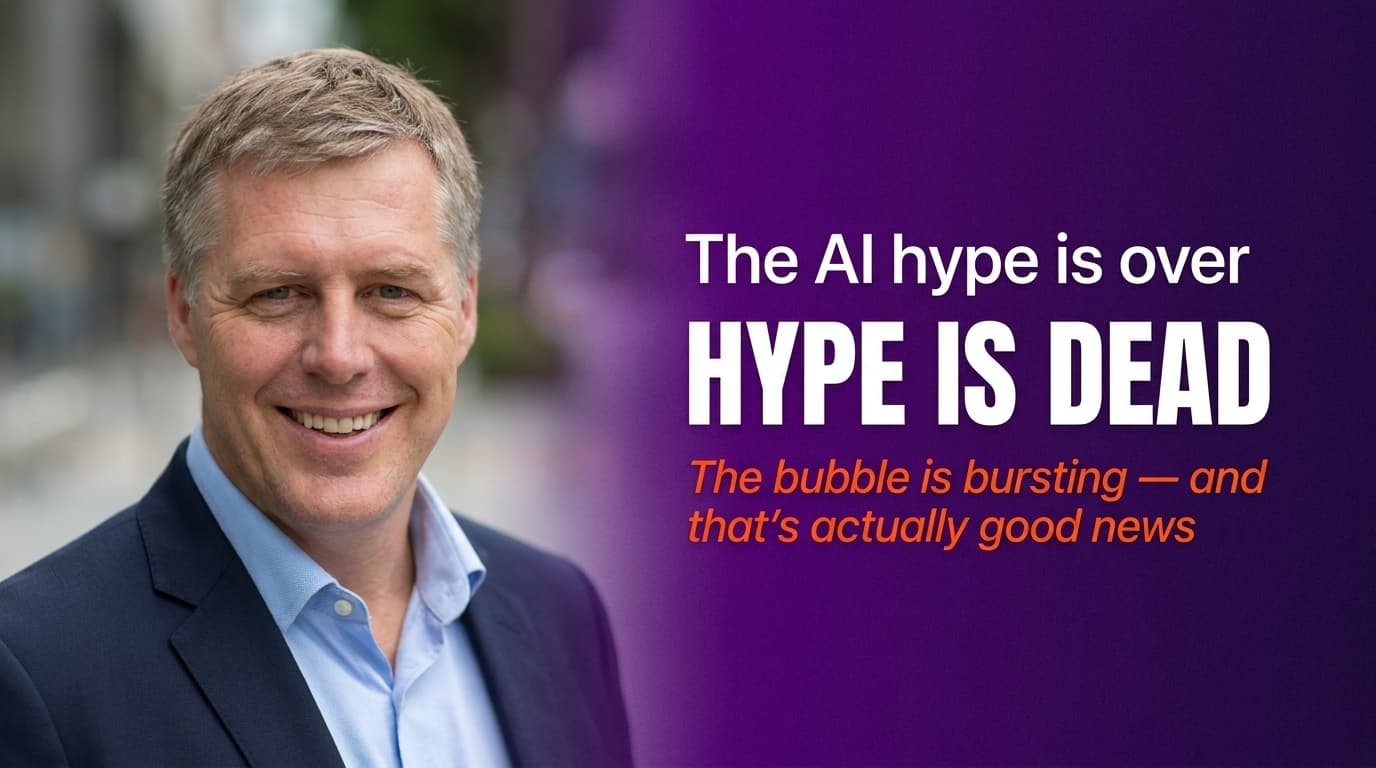
OpenAI has quietly shelved Sora, and Microsoft has begun pulling Copilot back from parts of Windows. The AI hype bubble, the over-inflated promise of technology that could do everything, everywhere, is deflating. For SMEs, this is not a crisis. It is permission to stop chasing shiny objects and start building AI strategy on solid, commercial ground. The value cycle is beginning, and those who act deliberately now will be the ones who win.
Why did OpenAI kill Sora?
Sora was a technical marvel. The demos were undeniably impressive, fluid, cinematic video generated from a single text prompt, capturing the world's imagination and sending creative industries into a frenzy. Disney was apparently ready to commit a billion dollars. Then, almost as quickly as it appeared, the plug was pulled.
The reason is straightforward: the commercial case was never there. The sheer computational power required to run Sora at scale was astronomical, making it prohibitively expensive. It was a classic case of a solution desperately looking for a problem.
When a corporate giant like Disney quietly rescinds a billion-dollar commitment, you know the emperor has no clothes.
The 'wow' factor doesn't pay the bills. Speculative technology without a clear path to profit is a luxury no one can afford, not even OpenAI.
Why is Microsoft pulling back Copilot?
Microsoft went all-in on AI with the subtlety of a sledgehammer. They tried to wedge Copilot into every conceivable corner of their ecosystem, core applications like Word and Excel, peripheral utilities like Notepad and the Photos app. The vision was an AI companion everywhere you looked, a constant presence in your digital life.
The reality was what many are now calling "AI bloat." Users weren't asking for it. In many cases it slowed machines and cluttered workflows. The backlash from their user base was significant enough that Microsoft has started the quiet, embarrassing process of scaling it back.
The lesson every business owner needs to absorb: just because you can inject AI into something doesn't mean you should. It has to solve a real user problem. It has to be implemented thoughtfully. Otherwise, it's just expensive noise.
Is this the end of AI, or just the end of the hype cycle?
The end of the hype cycle, and they are not the same thing. The relentless, testosterone-fuelled race to build the biggest, most spectacular models regardless of commercial utility is slamming into the hard, unforgiving wall of reality. The bills are due, and the people writing the cheques are finally asking the questions that should have been asked from the start.
A recent Pew Research study found that half of adults are now more concerned than excited about AI, a sharp increase from just a few years ago. Meanwhile, companies including Atlassian, Block, and Meta have laid off tens of thousands of employees to "self-fund" their expensive pivot to AI. The initial awe is wearing off. Markets, both consumer and commercial, are demanding real, tangible value.
What is the UK AI Power Wall?
The challenge isn't just commercial, it's physical. In the UK, the demand for electricity from new, power-hungry data centres is so immense that the national grid simply can't keep up. Grid connection queues are now cited as the single biggest blocker to expanding the UK's AI capacity.
Think about what that means. We are no longer limited by the ambition of the models, we are limited by the physical constraints of power grids and the real-world cost of energy. The bleeding edge of technology is proving to be a place where you just bleed money. The major players are being forced to accept that the focus must shift from spectacular, energy-guzzling demos to sustainable, efficient, and genuinely profitable applications. The future isn't about raw power. It's about useful work per watt.
See where AI fits in your business. Free.
A 45-minute audit. We map the highest-value automations and what they're worth in time and money. No pitch, no pressure.
What is the AI Productivity Paradox, and does it affect your business?
The hype suggested generative AI would deliver a massive, immediate productivity leap across the board. In some narrow, specific cases it has, a developer writing code faster is the clearest example. But what businesses are discovering is that this often creates an "illusion of velocity."
More lines of code per hour just shifts the bottleneck downstream, to testing, quality assurance, and integration. The overall time to deliver a finished, reliable, secure product doesn't necessarily change. Slapping a flashy AI tool on top of a broken or inefficient process doesn't fix the process. The real, sustainable wins come from AI that improves the entire workflow end to end, not just one isolated step.
Where is the smart money going now?
Away from model makers and towards companies already embedded in real enterprise workflows. As one Goldman Sachs report noted, investment is moving away from the OpenAIs and Anthropics of the world and flowing towards companies that make existing business processes faster, better, or cheaper, with a tangible return on investment, not just a return on astonishment.
This is a return to fundamental business principles. And it is the clearest possible signal that the market is ready for practical, integrated AI, the kind SMEs can actually use and actually afford.
Why does the 92% figure matter for UK and Australian businesses?
In the UK, 92% of non-technical job listings still make no mention of AI skills. That is not a competitive advantage waiting to be unlocked, it is a ticking liability. The real bottleneck for AI adoption isn't a lack of tools. It's a lack of skills.
Compare that with Singapore, which is embarking on a national mission to train 100,000 workers and help 10,000 businesses adopt AI, even offering free premium AI tool subscriptions to citizens. That is what serious, long-term AI strategy looks like.
The biggest, most durable competitive advantage you can build right now is an AI-literate workforce. The technology is available. The question is whether your people know how to use it, and whether you're investing in making that happen.
What about data sovereignty, should SMEs care?
Yes, and urgently. Look at what the Australian government is doing as a template for your own business. They've put a leash on Big Tech's data centres, tying approvals to national interest criteria including renewable energy use, water management, and tangible contributions to the domestic economy. They're asking: what's in it for Australia?
You should be asking the same tough questions for your business. Where is your customer data being stored? Who controls it? Is the provider compliant with local privacy laws, Australia's upcoming Privacy Act amendments or the EU's stringent GDPR? In an era of increasing geopolitical instability and data nationalism, prioritising partners who give you control, transparency, and data sovereignty isn't just good practice. It's a critical business resilience strategy.
What to do this week
1. Stop chasing shiny objects. The fact that OpenAI and Microsoft are scaling back their most hyped products is the ultimate permission to be more deliberate. You haven't missed the boat, you've wisely waited for the storm to pass and for the viable shipping lanes to become clear.
2. Reframe the question. Stop asking "How can I use AI in my business?" It's a terrible starting point that leads to expensive mistakes. Start asking "What is my biggest, most persistent business problem, and is there a proven, practical AI tool that solves it?" Problem first. Solution second.
3. Demand integrated tools with measurable ROI. The winning tools are already inside the software your team uses every day, not standalone demos. Look for clear, demonstrable, and measurable return on investment before committing budget. If you can't measure it, don't buy it.
4. Ask hard questions about data sovereignty. Where is your customer data stored? Who controls it? Is the provider compliant with local privacy laws? Apply the same rigour to your technology partners that the Australian government is applying to data centres.
5. Invest in your people, not just your tools. The AI gold rush is over. Now is the time for farming, carefully cultivating efficiency, methodically training your team, and solving real-world business challenges with proven, reliable technology. The next wave of success won't go to the businesses that adopt the most AI. It will go to the businesses that adopt the smartest AI.
Where to from here
Book a free 60-minute AI audit, we'll explore exactly what workflows are worth augmenting with AI.
Live with passion & AI,
Brett
Host a podcast? Have Brett on as a guest.
Straight talk on implementing AI in real SMEs, no jargon, plenty of receipts from the businesses we run.
Frequently asked questions
Why did OpenAI shut down Sora?
+
Sora was shelved because the commercial case was never there. Despite its technical brilliance, the computational cost of running it at scale was astronomical. Disney was reportedly ready to commit a billion dollars but ultimately walked away, a clear signal the 'wow' factor doesn't pay the bills.
Why is Microsoft pulling back Copilot from Windows?
+
Microsoft embedded Copilot across its entire ecosystem, Word, Excel, Notepad, the Photos app, but users experienced it as 'AI bloat' that slowed machines and cluttered workflows. The user backlash was significant enough to force a quiet, embarrassing retreat.
What is the AI Productivity Paradox?
+
The AI Productivity Paradox describes the gap between expected and actual productivity gains from generative AI. Speeding up one step, like writing code, just shifts the bottleneck downstream to testing, quality assurance, and integration, leaving overall delivery time largely unchanged.
What is the UK AI Power Wall?
+
The UK AI Power Wall refers to the strain that new, power-hungry AI data centres are placing on the national grid. Grid connection queues are now cited as the single biggest blocker to expanding the UK's AI capacity.
What percentage of UK job listings mention AI skills?
+
92% of non-technical UK job listings still make no mention of AI skills, a significant gap between the pace of AI development and actual workforce readiness.
What is Singapore doing differently on AI adoption?
+
Singapore has launched a national mission to train 100,000 workers and help 10,000 businesses adopt AI, including offering free premium AI tool subscriptions to citizens, a level of strategic commitment that stands in sharp contrast to the UK's 92% skills gap.
What should SMEs focus on now that the AI hype cycle is ending?
+
SMEs should stop chasing frontier demos and instead identify their most persistent business problems, then find proven, integrated tools with a clear and measurable return on investment. Building an AI-literate workforce is the single most durable competitive advantage available right now.

Brett is a four-time founder (Darra Tyres, Gladfish, EzyTrac, Anaboo) and the operator behind AIOS, Anaboo's AI Operating System. He writes from inside the build, installing AI in his own businesses first and reporting back what actually moves the numbers. Based between Singapore, the UK and Australia.