OpenAI's superapp and Anthropic's $14 billion revenue signal the end of tactical AI
TL;DR
OpenAI is merging ChatGPT, Codex, and an AI-powered browser into a single desktop superapp designed to become the central operating system for knowledge workers. Anthropic has hit $14 billion in annual revenue by making governance and reliability the foundation of enterprise AI. NAB is running a network of 3,500 AI models, a "customer brain" spanning 90% of the bank. If your AI strategy still ends at summarising meeting notes, you are not using a different tool from these organisations; you are playing a fundamentally different game.
Is OpenAI just building a better chatbot?
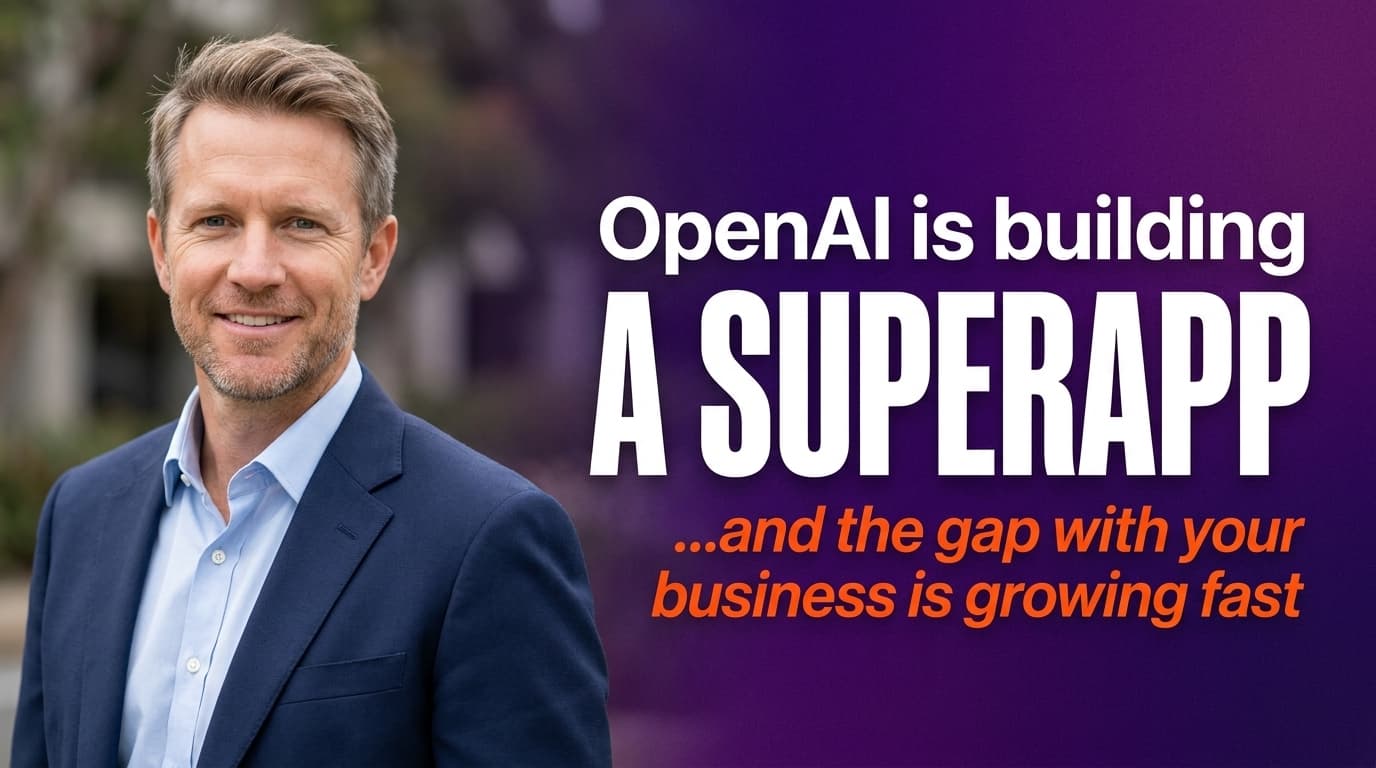
No, and the difference matters enormously. OpenAI's forthcoming superapp merges ChatGPT, the Codex coding assistant, and an AI-powered browser into a unified desktop environment. The goal is not a faster way to write emails. The goal is to become the central nervous system of the workday: a platform that anticipates what you need, retrieves information before you ask for it, and handles low-value work so you can stay at the strategic level.
The real players are thinking five moves ahead, they're building an entire ecosystem, not a better chatbot.
For knowledge workers, the implications are significant. Rote information retrieval becomes obsolete. The skills that matter, critical thinking, synthesis, and knowing what questions to ask, move to the centre. For businesses, this means rethinking workflows from the ground up, not bolting a chatbot onto an existing process.
What does Anthropic's $14 billion revenue run rate actually signal?
Anthropichas reached a $14 billion annual revenue run rate by targeting the enterprise and making responsibility and governance a cornerstone of its platform. This is not a consumer trend. It is a corporate arms race, and the biggest companies in the world are funding it, not because AI is fashionable, but because they know it is the future of their competitive position.
What that number signals is straightforward: the real value of AI is not in novelty. It is in solving complex business problems at scale in a way that is reliable, secure, and auditable. The enterprises writing the big cheques are not buying a product; they are buying a partnership and a moat.
Multi-billion dollar enterprise investments in AI are not a sign of the times, they are a declaration of intent.
Why did Google have to teach its own users how to use Gemini?
Google introduced a "Discover" tab for Gemini, built specifically to teach people how to use the product they already had access to. The company had to create tutorials and prompt guides because most users had no idea how to harness what was sitting in front of them.
That is the knowledge gap in plain sight. The capability of the technology is well ahead of the average user's ability to deploy it effectively. Paying for access to a powerful AI tool and using it for basic summaries is the equivalent of owning a Formula 1 car and never leaving first gear.
This is a business problem, not a user problem. If your team is not AI-literate, not just as users but as strategic thinkers, you are not getting a return on your investment. The fix is not more training videos. It is building a culture of curiosity, experimentation, and continuous learning. The pace of change in this space means that what is cutting-edge today will be obsolete tomorrow.
See where AI fits in your business. Free.
A 45-minute audit. We map the highest-value automations and what they're worth in time and money. No pitch, no pressure.
What does NAB's "customer brain" look like in practice?
National Australia Bank (NAB) has built what it calls a "customer brain", not a single AI model, but a network of 3,500 models working together across 90% of the bank. This is mature, strategic AI implementation delivering measurable value. NAB is not automating a few isolated tasks; it is building a system that understands its customers at a fundamental level and acts proactively on that understanding.
The practical outputs are concrete:
- Identifying a customer who is a potential churn risk and proactively offering a better deal
- Recognising when a customer is saving for a property and offering a mortgage at the right moment
- Shifting from reactive customer service to proactive relationship management at scale across 90% of operations
That is strategic AI. Tactical AI makes individual tasks a little faster. Strategic AI fundamentally rethinks how the business operates, and creates a competitive advantage that compounds over time.
NAB did not bolt AI onto its existing processes. It rebuilt its processes around AI. That shift, from reactive to proactive, from isolated to systemic, is what separates the leaders from the laggards.
What is the real difference between tactical and strategic AI?
| Approach | What it looks like | Outcome |
|---|---|---|
| Tactical | Summarising emails, generating copy snippets, automating a single workflow | Marginal time saving |
| Strategic | Rebuilding processes around AI, creating systems that learn from data, integrating across the customer journey | Compounding competitive advantage |
Most businesses are taking the tactical approach. They pick the low-hanging fruit, automate a few tasks, generate some content, and call it an AI strategy. That is not a strategy. That is a starting point. The real opportunity is to build something more intelligent, more agile, and more customer-centric than your existing operation, not just something faster.
The companies that thrive will be those that can seamlessly integrate this new generation of AI tools into their operations, empowering their people to work at a level of productivity and creativity that was previously out of reach. The ones that do not will find themselves not standing still, but actively moving backwards.
Can you delegate AI strategy to your IT department?
No. This is a strategic imperative that needs to come from the top of the organisation. It requires a mindset shift: from seeing technology as a cost centre to seeing it as a strategic enabler. The questions are not technical. They are: What are our biggest challenges? Where are our biggest opportunities? How can AI address them in a way that creates durable competitive advantage?
You do not need to become an expert overnight. But you do need to own the direction. Finding a trusted partner to navigate the landscape, identify the right tools, and develop a roadmap is legitimate. What is not legitimate is treating AI as an IT project while your competitors treat it as a business transformation.
What to do this week
Audit your current AI use. List every way your team uses AI right now. How many of those use cases are tactical (faster tasks) versus strategic (better decisions, new capabilities, new revenue streams)?
Identify one high-value use case. Pick a single problem, reducing customer churn, improving response times, optimising a costly process, where solving it would have measurable business impact. That is your starting point, not your entire strategy.
Assess the knowledge gap on your team. Can your people do more than basic prompting? If not, build a structured and ongoing path to AI literacy, not a one-off training session but a continuous practice.
Take the enterprise signals seriously. OpenAI's superapp and Anthropic's $14 billion run rate are directional signals about where knowledge work is heading. The companies building moats around AI right now are not waiting for the technology to mature. They have decided it already has.
Where to from here
Book a free 60-minute AI audit, we'll explore exactly what workflows are worth augmenting with AI.
Live with passion & AI,
Brett
Host a podcast? Have Brett on as a guest.
Straight talk on implementing AI in real SMEs, no jargon, plenty of receipts from the businesses we run.
Frequently asked questions
What is OpenAI's superapp?
+
OpenAI is building a unified desktop superapp that merges ChatGPT, its Codex coding assistant, and an AI-powered browser into a single work environment. The goal is to make it the central productivity platform for knowledge workers, anticipating needs, retrieving information, and handling low-value work automatically.
What is Anthropic's annual revenue run rate?
+
Anthropic has reached a $14 billion annual revenue run rate. The company achieved this by focusing on enterprise clients and making reliability, security, and governance the foundation of its platform rather than chasing consumer novelty.
What is NAB's customer brain?
+
National Australia Bank (NAB) built a 'customer brain', a network of 3,500 AI models working together across 90% of the bank. It allows NAB to understand customers at a deep level and act proactively, such as identifying churn risk or recognising when a customer is saving for a property and offering a mortgage at the right moment.
What is the AI knowledge gap?
+
The AI knowledge gap is the distance between what a tool is capable of and what the average user actually knows how to do with it. Google acknowledged this publicly by adding a 'Discover' tab to Gemini specifically to teach users how to use a product they already had access to.
What is the difference between tactical and strategic AI?
+
Tactical AI makes individual tasks slightly faster, email summaries, copy snippets, single-workflow automation. Strategic AI fundamentally rethinks how a business operates: it builds systems that learn from data, integrate across the customer journey, and create compounding competitive advantage over time.
How should a business start building a strategic AI approach?
+
Start by identifying a single high-value use case, one specific problem whose solution would have a measurable impact on the business. Build from there rather than attempting to transform everything at once, and treat it as a leadership priority, not an IT project.
Why are large companies investing billions in AI right now?
+
Major corporations are investing in AI not because it is fashionable but because they are building competitive moats, efficiencies and capabilities that are difficult for smaller players to match with traditional methods. Anthropic's $14 billion run rate is direct evidence of this corporate arms race playing out at scale.

Brett is a four-time founder (Darra Tyres, Gladfish, EzyTrac, Anaboo) and the operator behind AIOS, Anaboo's AI Operating System. He writes from inside the build, installing AI in his own businesses first and reporting back what actually moves the numbers. Based between Singapore, the UK and Australia.