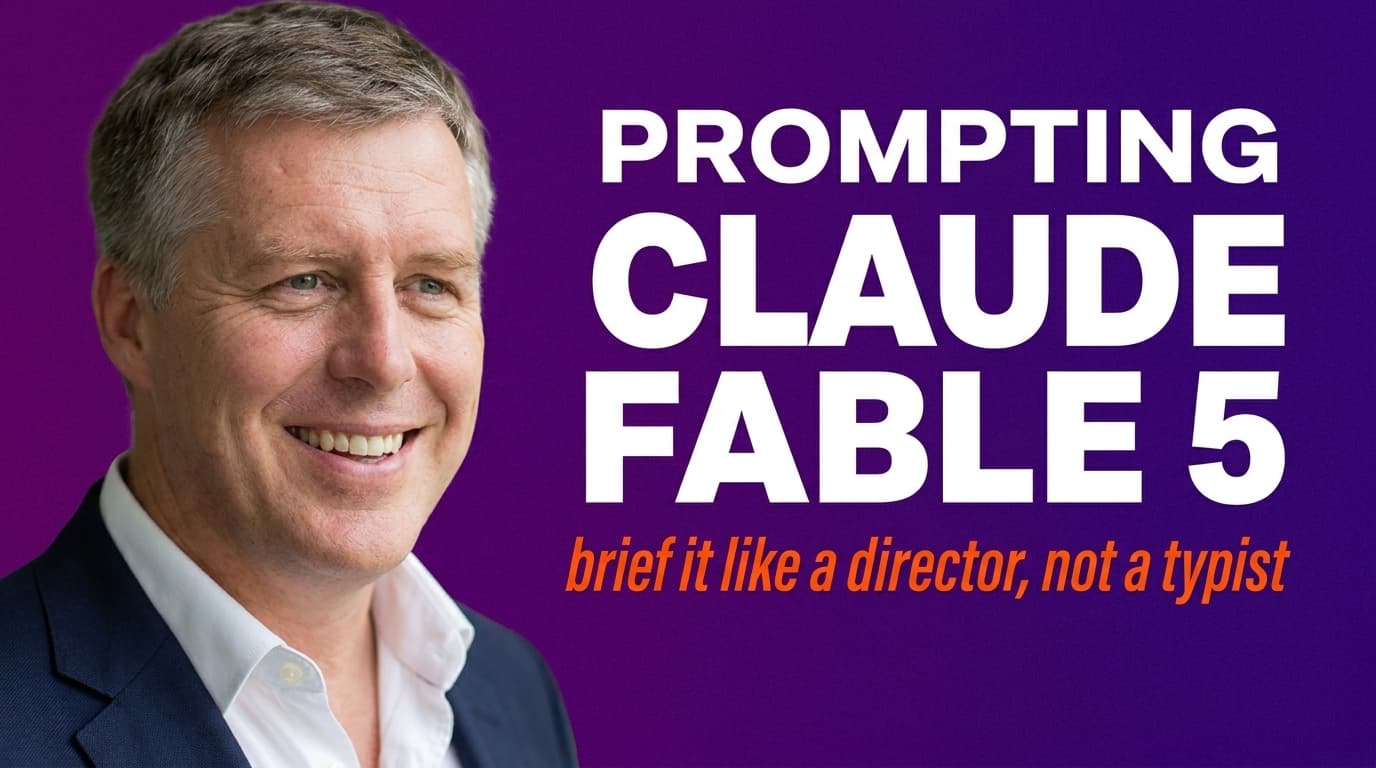
Prompting Claude Fable 5: Brief It Like a Director, Not a Typist
The new Claude doesn't want a prompt. It wants a brief.
Anthropic has released Claude Fable 5, the first of the Claude 5 family and the most capable model they've ever shipped. I've been running it inside my own businesses since it landed, and here's the thing nobody tells you in the launch posts: the biggest change isn't what it can do. It's what it expects from you.
The old models were brilliant typists. You gave them a paragraph, they gave you a page. Fable 5 is closer to a senior hire. Give it a proper brief and it will go away, sometimes for a long while, and come back with finished work. Give it the same lazy one-liner you've been using since 2024 and you'll get a fraction of what you paid for.
So this is the new playbook. Seven shifts, in plain English, no code required.
Give it the job you thought was too big
Anthropic's own guidance says it straight: teams testing Fable 5 only on simple workloads undersell it. The model is built for work that takes a person hours, days, or weeks. Multi-step, ambiguous, end-to-end jobs.
Most owners do the opposite. They test a new model with the same small tasks the old one did, see a similar answer, and conclude nothing's changed. Wrong test.
Pick the job you'd assign to a good operations manager, not a temp. "Go through these twelve months of supplier invoices, find where we're being overcharged, and draft the renegotiation emails." That's a Fable 5 brief. "Summarise this invoice" is a waste of the engine.
Start with your worst task. The big one. The one you've been putting off because it felt too messy for AI.
Let it work
Here's the adjustment that catches everyone: Fable 5 takes longer per turn. On hard problems it gathers context, builds, and checks its own work before it reports back. A single response can run for many minutes. Autonomous runs can stretch for hours.
The ducks-paddling crowd will hate this at first. We've been trained to expect instant answers, and a model that goes quiet for ten minutes feels broken.
It isn't. It's working. You wouldn't stand over a new hire's shoulder asking "done yet?" every ninety seconds. Same rule here. Delegate, walk away, review the result.
Give the reason, not just the request
This one's worth the price of the article on its own. Fable 5 performs measurably better when it knows why you're asking.
Not just: "Write a follow-up email to this customer."
Instead: "I'm trying to win back lapsed customers before our quiet season in August. This one spent well with us for three years then went silent. Write a follow-up email."
Same task. Different brief. The second version lets the model connect the job to everything else it knows, rather than guessing at your intent. It's the difference between telling a staff member what to do and telling them what you're trying to achieve. The second one gets you an employee who can think.
See where AI fits in your business. Free.
A 45-minute audit. We map the highest-value automations and what they're worth in time and money. No pitch, no pressure.
Set the boundaries out loud
A more capable model is a more confident model, and occasionally Fable 5 will do something you didn't ask for. Draft an email when you wanted an opinion. Fix a thing when you wanted a diagnosis.
The fix is one sentence in your brief: "I'm asking for your assessment, don't change anything yet." Or the reverse: "Don't ask me for permission along the way, do the whole job end to end and show me the result."
You set the line between advise and act. Say it explicitly, every time it matters. That's not babysitting the AI. That's management.
Make it show its receipts
If you're running AI on long jobs, add this instruction: "Only report work you can point to evidence for. If something isn't verified yet, say so."
Anthropic tested this and it nearly eliminated fabricated progress reports, even on tasks designed to bait them. Think of it as the CYA rule for your AI. No claim without a receipt. Any manager who's been burned by a "yeah it's nearly done" from a contractor knows exactly why this matters.
Strip back your old prompts
Counterintuitive, this one. If you've built up long, detailed prompt templates over the past couple of years, lists of rules, tone guides, step-by-step instructions, some of them are now hurting you.
Fable 5 follows instructions well enough that one clear sentence often beats ten prescriptive ones. Anthropic's own advice is to review old prompts and skills and consider deleting instructions, because the model's default behaviour is frequently better than the workaround you wrote for its predecessor.
Your prompt library is part of your context layer, and like any layer of your AIOS it needs maintenance. A model upgrade is the trigger to audit it. Keep the intent, cut the scaffolding.
Give it a memory
Fable 5 shines when it can write down what it learns and read it back next time. A folder of plain notes is enough. One lesson per file, corrections and confirmed approaches alike, with a line on why each one mattered.
Do this and the model stops repeating last month's mistakes. Skip it and every session starts from zero. This is the same principle behind the whole AI Operating System: the intelligence isn't in the model, it's in the context you wrap around it. The model just got smarter. Your context is what makes it yours.
The quiet conclusion
Here's the truth under all seven shifts: prompting was never engineering. It was always delegation. Every upgrade since has just made the delegation more real.
Inside my own AIOS we've now gone a step further and put a gateway in front of the model: before a big job runs, the AI checks the brief itself, asks the clarifying questions a good hire would ask, and only then starts work. Two minutes of questions up front beats an hour of rework. You can build the habit manually with one line at the end of every brief: "Ask me whatever you need until you're 95% sure what I want, then start."
The owners who win with Fable 5 won't be the ones with the cleverest prompts. They'll be the ones who learned to brief like a director.
If you want to see what a properly briefed AI could take off your plate, we run a free AI audit. A straight look at your business, no jargon, no pressure. What's the one thing draining you right now?
Live with passion & AI,
Brett
Want this installed in your business?
Bespoke AI implementation across your operations: strategy, build, rollout, and ongoing drift maintenance.
Frequently asked questions
What is Claude Fable 5?
+
Claude Fable 5 is Anthropic's most capable generally available AI model, the first in the Claude 5 family. It sits above Claude Opus and is built for long, complex, end-to-end work, the kind that takes a person hours or days, not just quick questions and answers.
Do I need to change my prompts for Claude Fable 5?
+
Probably, but in the direction of less. Fable 5 follows instructions well enough that one short, clear sentence usually beats a long list of rules. Prompts written for older models are often too prescriptive and can actually degrade the output. Strip them back and re-test.
Why does Claude Fable 5 take longer to respond?
+
On hard tasks it gathers context, builds, and checks its own work before reporting back, so a single turn can run for many minutes. That's a feature, not a fault. You're trading a fast shallow answer for finished work.
How do I stop an AI agent making up progress reports?
+
Tell it to ground every claim in evidence. A line like 'only report work you can point to evidence for, and if something isn't verified yet, say so' nearly eliminates fabricated status updates in long runs.

Brett is a four-time founder (Darra Tyres, Gladfish, EzyTrac, Anaboo) and the operator behind AIOS, Anaboo's AI Operating System. He writes from inside the build, installing AI in his own businesses first and reporting back what actually moves the numbers. Based between Singapore, the UK and Australia.