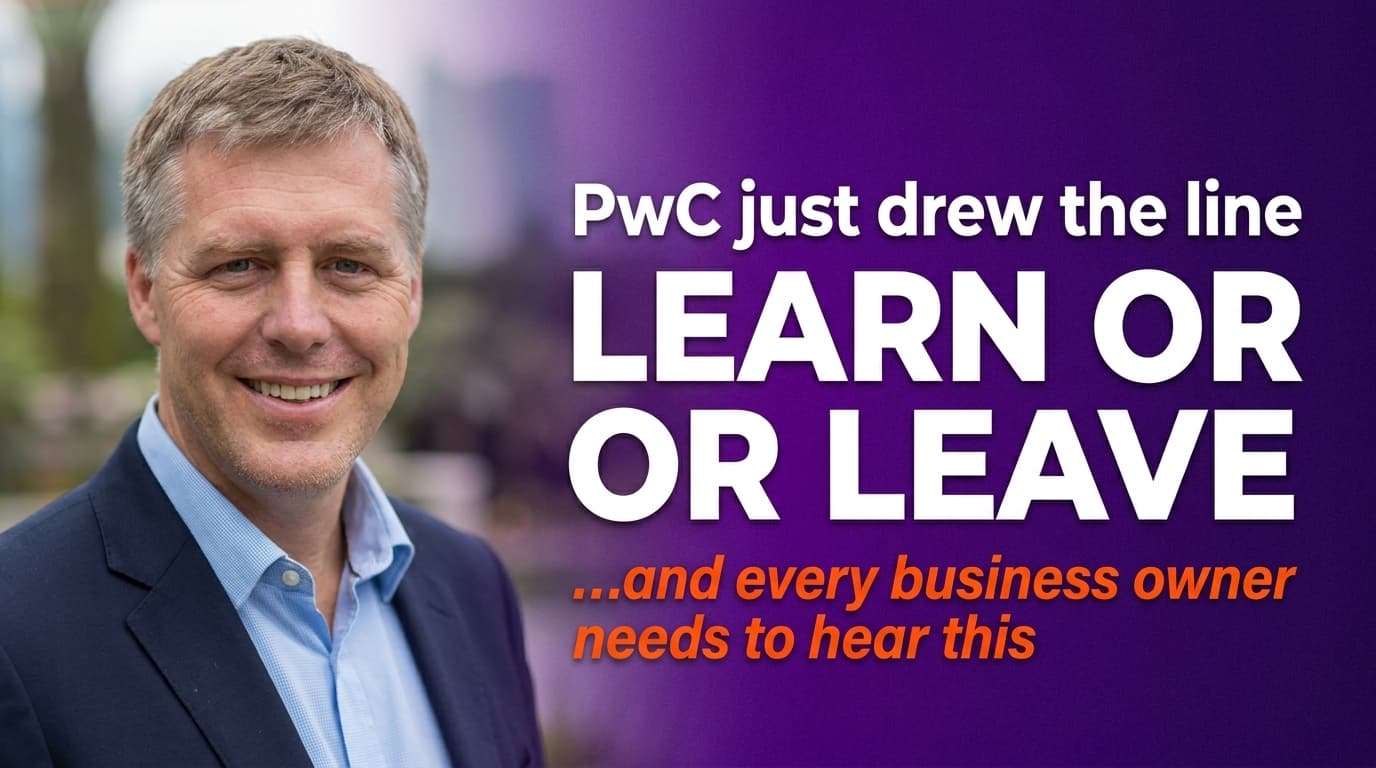
PwC told partners to learn AI or get replaced, your business is next
TL;DR
PwC has mandated an eight-week executive AI coaching programme, run through the Kellogg School of Management, for every partner and managing director in the firm. US boss Paul Griggs told the Financial Times that senior members who avoid AI will "soon be replaced." EY and McKinsey are making parallel moves. While the Big Four retool from the top down, most SMEs are still locked in meetings debating whether to write an AI policy. The window to catch up is closing.
What did PwC actually announce?
PwC Australia has overhauled its entire professional development structure around artificial intelligence. Every new graduate now attends a week-long residential AI immersion programme from their very first week on the job, trained to think AI-first before they have met a single client.
At the senior level, every partner and managing director is completing an eight-week executive AI coaching course through the Kellogg School of Management, one of the world's top business schools. More than half of the firm's local leaders have already finished, including nearly all of its consulting division. The rest are expected to complete it within months. Every director is also participating in tailored AI masterclasses.
PwC has also established a local AI centre of excellence, launched new generative AI tools for businesses, and begun offering pre-packaged agentic AI professional services through the AWS marketplace. This is not a PR exercise. They are rebuilding the entire firm around AI, from the graduate intake to the partner suite.
Why did PwC's US boss use the word 'replaced'?
This was not accidental language. Paul Griggs, PwC's US chief, told the Financial Times that senior members who wished to avoid AI would "soon be replaced." No softening. No wiggle room.
Ro Antao, PwC's advisory lead who came from the firm's Silicon Valley office, framed the goal plainly in the Australian Financial Review:
"If you are going to be serving our clients going forward, you've got to think on how you accomplish that with an AI-first lens."
CEO Kevin Burrowes described the knowledge business as "ripe for transformation." He is not wrong. The consulting model, smart people with deep expertise, billing by the hour, does not just become inefficient when AI can analyse a dataset in seconds that would take a team a week. It becomes indefensible.
Is this just a PwC story?
No. EY has launched an external AI training academy for Australian organisations. McKinsey has built a generative AI chatbot for internal research discovery. The Big Four are not just adopting AI for themselves, they are positioning as the navigators for everyone else.
They are building infrastructure to profit from the AI revolution twice: once by using it internally to slash their own costs, and again by selling their AI expertise to other businesses at premium rates. Every month you delay your own AI capability is a month you become more dependent on paying them for it.
What is the SME blind spot, and is your business in it?
Most small and medium-sized businesses across Australia, the UK, and Singapore are paralysed. The concerns are familiar:
- Fear of embarrassing mistakes from incorrect AI outputs
- Data security and compliance exposure
- Cost uncertainty around tools and training
- Internal debates over AI policies that never get finalised
- No clear direction from leadership, so nothing moves
Meanwhile, the team is not idle. They see the headlines every day. They know the world is changing. And with no guidance from above, they go underground, using free, public versions of ChatGPT and Claude to do their work, often pasting sensitive company data, client information, and financial details into systems the business has no control over and no visibility into.
This is the shadow AI problem. It is already inside your business. You just do not know it is happening.
See where AI fits in your business. Free.
A 45-minute audit. We map the highest-value automations and what they're worth in time and money. No pitch, no pressure.
What happens if you keep waiting?
The gap between firms like PwC and most SMEs is not a gap. It is a chasm, and it widens every single day.
While PwC invests millions in executive coaching and immersive training, most SMEs have not written an AI policy. While PwC graduates are trained AI-first from week one, most new hires are told to "just figure it out."
The UK's Competition and Markets Authority has already published new guidance on complying with consumer law when using AI agents in customer-facing contexts. It is legally binding. Ignorance is not a defence. The regulatory environment is moving whether your business is ready or not.
What did PwC say about human skills, and why does it matter?
Here is where the story gets counterintuitive. PwC stated explicitly that the benefits of AI will only ever be realised with human oversight, and that AI actually creates a greater need for softer skills: adaptability, relationship-building, critical thinking, and creative problem-solving.
The AI does not replace the human. It amplifies the human. But only if the human knows what they are doing.
This reframes the entire conversation. The existential threat is not AI itself. It is being an AI-unaware human in a world where your competitors are AI-amplified. The skill gap is not technical. It is leadership.
How do you build an AI upskilling programme without a Kellogg School budget?
You do not need to send your team to an eight-week programme at a world-ranked business school. But you do need three things, and they need to be structured, not ad hoc.
Practical skills
Teach your team how to use specific AI tools relevant to their roles. Not abstract theory, hands-on application that makes their working lives better today. How does your sales team use AI to generate better leads and personalise outreach? How does finance use it to automate reconciliations and spot data anomalies? How does customer service use it to handle routine enquiries and free up time for complex problems? Start there.
Responsible AI
Train your people on the ethical and legal implications of using AI. Data privacy rules. Copyright. How to avoid biased outputs. The UK's Competition and Markets Authority guidance on AI agents is not optional for any business using AI in a customer-facing capacity. Create a clear, simple set of guidelines that everyone understands and follows, not a 40-page legal document, a one-pager.
Critical thinking
The most important skill in the age of AI is the ability to question the AI's outputs, identify its limitations and biases, and use it as a co-pilot rather than an autopilot. This is precisely what PwC is training its partners to do through the Kellogg programme. It is the difference between AI making your team stronger and AI making your team sloppy.
This starts with you as the leader
You cannot delegate this to your IT department and hope for the best. Culture flows from the top. If you, as the leader, are not seen to be engaging with AI, your team will treat it as optional, or they will keep hiding their usage from you.
Get your hands dirty. Use it in a meeting. Share what you learned. Make it normal. If PwC's most senior partners, people who bill out at thousands of dollars an hour and have spent decades at the top, are sitting through eight weeks of AI coaching, the excuse that you are too busy does not hold.
The message from PwC is not a threat. It is a gift. A glimpse into the future of work, delivered with unusual corporate candour. The corporate giants are making their move. They are building a generation of AI-native leaders. The question is whether your business will be ready to work with them, or be outcompeted by them.
What to do this week
- Audit your shadow AI exposure. Ask your team, honestly and without blame, which AI tools they are already using. The answer will surprise you.
- Pick one role-specific use case. Do not try to transform everything at once. Find a single workflow, a report, a client email, a reconciliation, and run an AI pilot this week.
- Write a one-page AI policy. Not a legal document. One page: what is permitted, what is not, and how outputs must be reviewed before going to clients or customers.
- Lead from the front. Use AI visibly, in a team setting. Share what worked and what did not. Normalise experimentation.
- Set a completion deadline for your leadership team. PwC gave its partners a structured programme with a finish date. You can do the same at your scale, it does not need to be Kellogg to be effective.
Where to from here
Book a free 60-minute AI audit, we'll explore exactly what workflows are worth augmenting with AI.
Live with passion & AI,
Brett
Running an event? Put practical AI on your stage.
Keynotes and workshops that send business owners home with a plan they can use Monday morning. No hype.
Frequently asked questions
What AI training programme has PwC introduced for its partners?
+
PwC Australia has launched an eight-week executive AI coaching course through the Kellogg School of Management for all partners and managing directors. More than half of local leaders have already completed it, including nearly all within the consulting division, with the remainder expected to finish within months.
Did PwC actually say partners would be replaced if they don't learn AI?
+
Yes. PwC's US boss Paul Griggs told the Financial Times that senior members who wished to avoid AI would 'soon be replaced.' Ro Antao, PwC's advisory lead, reinforced this in the Australian Financial Review, stating that serving clients going forward requires thinking with 'an AI-first lens.'
What is shadow AI and why is it a problem for SMEs?
+
Shadow AI refers to employees using unauthorised, public AI tools, such as free versions of ChatGPT or Claude, to do their work, often pasting sensitive company data, client information, and financial details into systems the business cannot monitor or control. It is a data security and compliance risk that is already widespread in most organisations, whether leadership knows it or not.
What are EY and McKinsey doing with AI?
+
EY has launched an external AI training academy for Australian organisations. McKinsey has built a generative AI chatbot for internal research discovery. The major consulting firms are investing heavily in AI both to reduce their own costs and to sell AI advisory services to other businesses at premium rates.
What three areas should an SME AI upskilling programme cover?
+
The article points to three essentials: practical skills, role-specific AI tool use for sales, finance, marketing, and customer service; responsible AI, data privacy, copyright, and compliance with guidance such as that from the UK's Competition and Markets Authority; and critical thinking, how to evaluate and challenge AI outputs rather than treating them as infallible.
Does AI replace the need for human skills?
+
No. PwC explicitly stated that the benefits of AI will only be realised with human oversight, and that AI creates a greater need for softer skills including adaptability, relationship-building, critical thinking, and creative problem-solving. The AI amplifies the human, but only if the human knows what they are doing.
What is the UK Competition and Markets Authority's stance on AI agents?
+
The UK's Competition and Markets Authority has published new guidance on complying with consumer law when using AI agents in customer-facing contexts. This guidance is legally binding for any business using AI in a customer-facing capacity, and ignorance of it is not a legal defence.

Brett is a four-time founder (Darra Tyres, Gladfish, EzyTrac, Anaboo) and the operator behind AIOS, Anaboo's AI Operating System. He writes from inside the build, installing AI in his own businesses first and reporting back what actually moves the numbers. Based between Singapore, the UK and Australia.