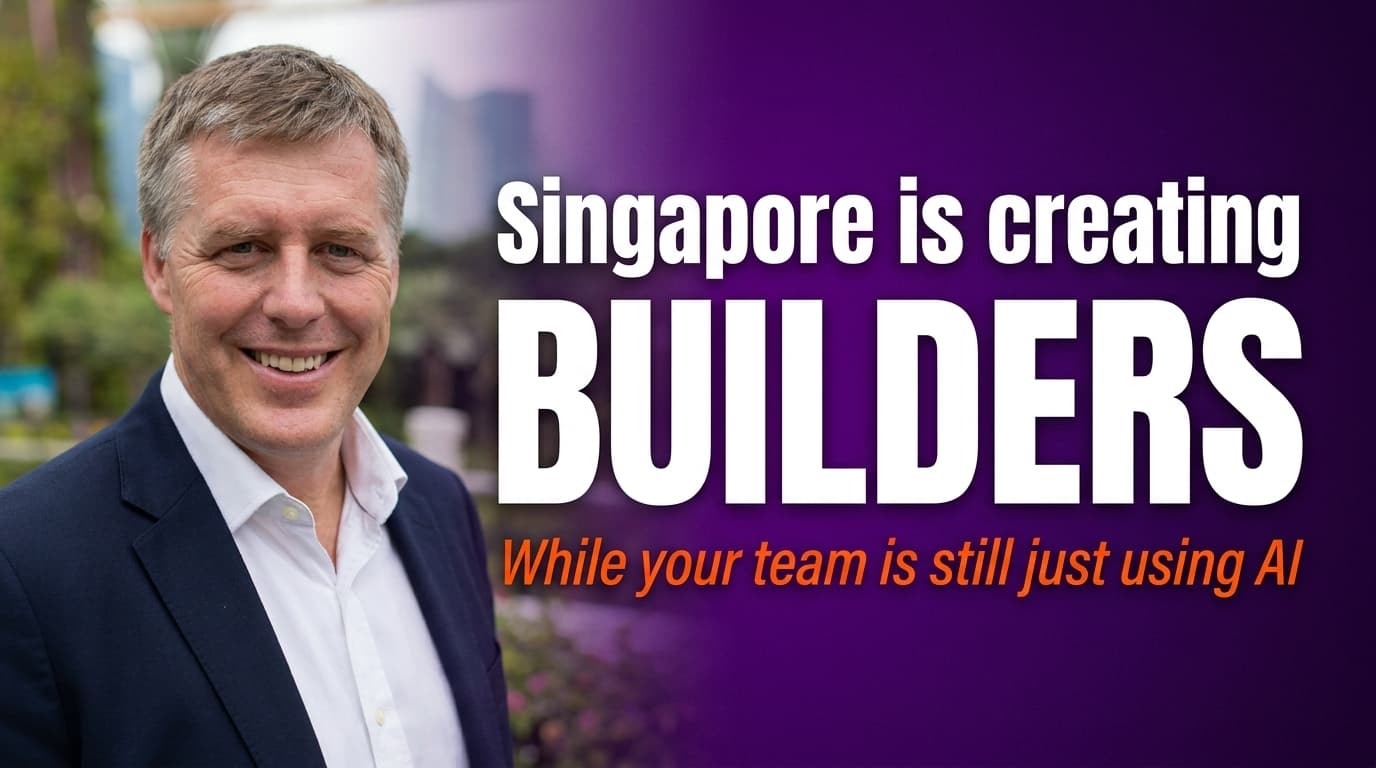
Singapore is building AI builders, and your business is falling behind
TL;DR
Singapore has committed over a billion dollars to AI talent and research, and top officials are publicly worried it's not enough, because the risk is producing a generation of certified users rather than builders. The same gap is splitting the business world in two. Using ChatGPT to write emails is now the floor, not the ceiling. The companies that will own the next decade are building proprietary AI solutions, not subscribing to someone else's.
What Singapore figured out that most businesses haven't
Singapore has built its modern identity on being five steps ahead. They don't follow trends, they dissect them and build national strategy around them. Right now, they are pivoting hard from creating AI users towards the far more ambitious goal of creating AI builders.
They've already committed over a billion dollars to AI talent and research. But here's the striking part: their own top officials are publicly stating that this approach risks producing a generation of certified users when what they desperately need are builders. They've looked at the data, including a decline in graduate employment, and correctly identified that being a skilled consumer of technology is not a secure long-term strategy.
When anyone can use a tool, the value of being a user plummets. The real, sustainable value lies in being able to create, customise, and integrate that tool in ways nobody else can.
Singapore isn't just training people to use the latest model from Silicon Valley. It's building a workforce that can create proprietary AI solutions, integrate AI into manufacturing lines, and build AI-powered financial products. They've realised that true sovereignty in the 21st century is about technological independence. They're not just playing the game, they're building their own version of it.
Are you building an AI-bilingual workforce, or just better prompt engineers?
The concept you need to get your head around fast is the AI-bilingual workforce. This isn't about turning every employee into a machine learning researcher. It's about creating a team fluent in two languages: their professional domain, finance, marketing, logistics, law, and AI.
An AI-bilingual employee looks like this:
- A marketing director who doesn't just ask ChatGPT for campaign ideas but can conceptualise how a custom AI model could analyse customer data to predict churn with 95% accuracy
- A logistics manager who can work with a technical team to design an AI-powered system that optimises delivery routes in real-time, saving millions in fuel costs
- A financial analyst who can help build a proprietary AI tool to detect fraudulent transactions far more effectively than any off-the-shelf software
These people are the bridge. They're the translators between the business's problems and the AI's potential solutions. They can spot integration opportunities that a pure-tech person would never see and that a pure-business person would never know is possible.
If you're only training your team on how to write better prompts, you're training them for a job that will be automated out of existence in the next 18 months. The value isn't in asking the question, it's in knowing what to build to answer it permanently.
See where AI fits in your business. Free.
A 45-minute audit. We map the highest-value automations and what they're worth in time and money. No pitch, no pressure.
Why the AI-bilingual team has an unfair advantage
The true power of an AI-bilingual workforce goes beyond identifying projects. It fundamentally changes your company's metabolism.
A marketing team with this capability can prototype a new customer segmentation model in a week, test it, and refine it based on real results. A traditional team has to write a brief, send it to an external agency or an overloaded IT department, and wait months. By the time the solution arrives, the market has moved on.
The AI-bilingual team isn't just faster, it's more agile, more responsive, and more deeply connected to what the business actually needs.
There's also a compounding effect. As domain experts become more fluent in AI, they get better at spotting opportunities. As technical teams gain exposure to business nuance, they build more relevant solutions. This virtuous cycle of innovation is almost impossible to replicate by buying off-the-shelf AI products.
You're not just building tools; you're building a culture of continuous, AI-driven improvement. And that's a capability you can't buy, you have to build it.
Where the smart money is already going
The market is moving decisively towards builders, and the numbers are already there.
- Anthropic is investing $100 million into a partner network specifically to help companies build solutions on top of their Claude platform. Their long-term success isn't in selling individual subscriptions, it's in becoming the foundational layer for a new generation of AI-powered businesses.
- Coursera has seen a near-doubling of enrolments in AI courses, and this isn't individuals tinkering on their own. The surge is driven by corporate demand. Businesses are investing in comprehensive training covering machine learning, data science, and AI integration.
The hype over the past year has centred on user-facing applications. The sophisticated players are now looking at the next level. The real, defensible moat isn't built by being a power user of someone else's technology. It's built by owning the intellectual property, the customised workflows, and the unique data insights that come from building your own AI-driven solutions.
While you're renting a tool, your competitors are building an arsenal.
Are you stuck in the user trap?
Your team has probably gotten decent at using ChatGPT or Claude for everyday tasks, faster emails, summarised documents, on-demand brainstorming. That's fine. But it's the starting line, not the finish line.
Ask yourself honestly:
- Is your team building new, efficient workflows that are unique to your business?
- Are they actively integrating AI into your existing software stack?
- Are they creating AI-powered products or services that open new revenue streams?
- Is your AI usage creating a defensible competitive advantage, or are you just doing the same thing as everyone else, slightly faster?
If the answers are "not really, " you are stuck in the user trap. You need to make a conscious, strategic decision to shift your focus and your budget.
Stop spending all your training money on basic prompting workshops. Invest in deep, domain-specific AI integration training. Find the people in your organisation with bilingual potential, experts in their field who have an aptitude for technology, and give them the skills to become your first generation of AI builders.
This is not a technical issue. It's a leadership issue. It's about having the foresight to see where the world is going and making the tough decisions to get there ahead of your competition.
What to do this week
Run an AI audit. Map where AI is currently used in your business. Then identify the three biggest pain points that could be solved with a custom AI solution, not a chatbot, an actual integrated workflow.
Find your bilingual candidates. Look for people who combine deep domain expertise with genuine interest in technology. These are your first-generation AI builders. Give them time, budget, and permission to experiment.
Cancel one prompting workshop, fund one build project. Redirect the budget from generic AI training into a small, high-impact internal build. Get a win on the board and build momentum.
Set a builder KPI. Track the number of custom AI integrations your team ships per quarter, not just how many people "use AI." The metric you track determines the behaviour you get.
Start small, move fast. Pick one workflow, one process, one product line, and build something proprietary. Then repeat.
Where to from here
Book a free 60-minute AI audit, we'll explore exactly what workflows are worth augmenting with AI.
Live with passion & AI,
Brett
Need an AI operator inside your team?
Place a Chief AI Officer, an AI Officer, or embed an Anaboo Forward Deployed Engineer for 3–6 months.
Frequently asked questions
What is an AI-bilingual workforce?
+
An AI-bilingual workforce is made up of people fluent in both their professional domain, finance, marketing, logistics, law, and in AI. They act as the bridge between business problems and AI solutions, spotting integration opportunities that neither a pure-tech nor a pure-business person would see alone.
How much has Singapore invested in AI?
+
Singapore has committed over a billion dollars to AI talent and research. Despite this, top officials have publicly stated they're worried their current approach risks producing a generation of certified AI users rather than the AI builders the economy actually needs.
Why is being an AI user no longer a competitive advantage?
+
When anyone can use a tool, the value of being a user plummets. Off-the-shelf AI for basic tasks is now table stakes, the equivalent of knowing how to use Microsoft Word. Defensible competitive advantage comes from building proprietary AI solutions that competitors cannot simply subscribe to.
What is Anthropic investing $100 million in?
+
Anthropic is investing $100 million into a partner network specifically to help companies build solutions on top of their Claude platform. The investment signals that long-term value lies in becoming the foundational layer for AI-powered businesses, not in selling individual subscriptions.
What has happened to Coursera AI enrolments?
+
Coursera has seen a near-doubling of enrolments in AI courses, driven largely by corporate demand. Businesses are investing in comprehensive training covering machine learning, data science, and AI integration, not just basic prompting skills.
What is the first step to moving from AI user to AI builder?
+
Start with an audit. Map where AI is currently used in your business, then identify the biggest pain points that could be solved with a custom AI solution. Find employees who combine deep domain expertise with an aptitude for technology, these are your first-generation AI builders.
What is the difference between an AI strategy and an AI subscription?
+
If your entire AI strategy relies on a third-party app, you have a subscription, not a strategy. A real strategy involves building proprietary workflows, integrating AI into existing systems, and creating unique data insights that competitors cannot easily replicate.

Brett is a four-time founder (Darra Tyres, Gladfish, EzyTrac, Anaboo) and the operator behind AIOS, Anaboo's AI Operating System. He writes from inside the build, installing AI in his own businesses first and reporting back what actually moves the numbers. Based between Singapore, the UK and Australia.