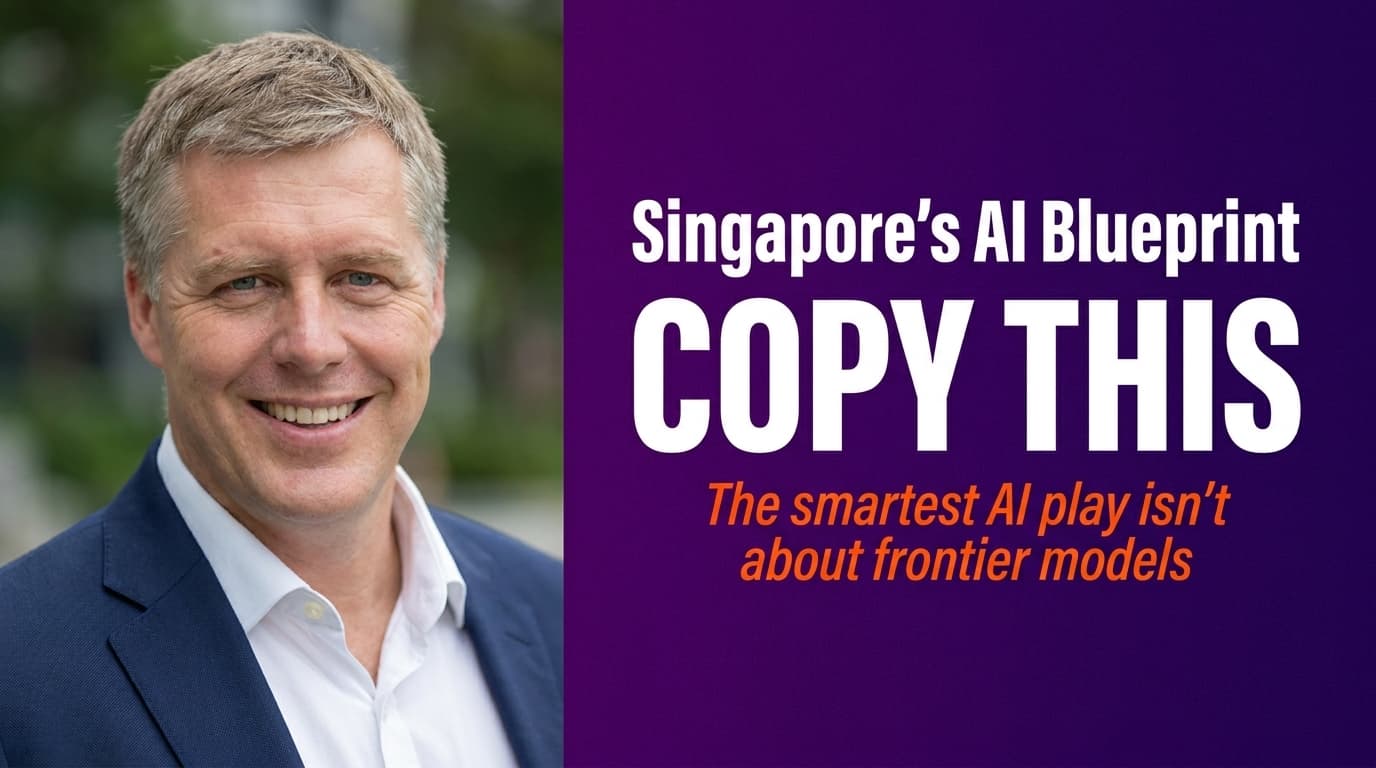
Singapore's ESR AI blueprint: what SMBs should copy right now
TL;DR
Singapore's Economic Strategy Review, a national blueprint of 32 recommendations, puts practical, trusted AI adoption at the centre of the country's economic future. The city-state is not chasing Silicon Valley or Beijing on frontier model scale. It is building the most enabling environment for AI use. For SMB owners, that reframe is the whole lesson: stop waiting for perfect AI, start building the conditions where targeted AI delivers measurable results in your business today.
What is Singapore's Economic Strategy Review and why does it matter?
Singapore has just released its Economic Strategy Review, a comprehensive national blueprint containing 32 recommendations aimed at securing long-term growth. One of its most significant thrusts: positioning Singapore as a trusted global hub for AI solutions.
This is not a document about academic research or state-funded compute clusters. It is a strategic plan for a nation of businesses to become smart, confident, and ethical users of AI. That framing, practical adoption over frontier development, is precisely what most SMB owners need to hear.
Isn't AI strategy just for governments and tech giants?
That is exactly the wrong conclusion to draw, and it is the mindset holding most business owners back.
The ESR is explicit: Singapore is not trying to out-muscle Silicon Valley or Beijing in building the most complex AI models. It is not chasing the largest AI data centres. Instead, it is focused on creating what the review calls the "most enabling environment" for AI adoption and innovation. The goal is businesses that can use AI effectively and ethically, not just the ones building it.
For a business owner running a 20 to 500-person operation, that is the precise playbook you need.
What does "enabling environment" actually mean for your business?
In practice, it means stopping the search for a grand AI transformation and starting to identify specific pain points where targeted AI delivers immediate, measurable improvement.
This is not about raw power. It is about smart application.
That might look like:
- Automating repetitive administrative tasks to free up your team
- Improving data analysis to make faster, more confident decisions
- Enhancing customer interactions through AI-assisted service tools
- Optimising supply chain visibility to reduce costs and improve delivery times
- Personalising marketing campaigns to lift conversion rates and strengthen loyalty
None of those require you to build a model. They require you to choose tools wisely and implement them with intent.
What does it mean to be a "Champion of AI"?
Singapore's ESR specifically uses the phrase "Champions of AI" to describe local firms it wants to support. The implication is clear: AI leadership is not reserved for AI developers. It belongs to any business leader who understands how to strategically deploy AI within their industry.
You become an AI champion by:
- Educating yourself and your team on what AI can and cannot do
- Experimenting with tools that address real operational problems
- Building a culture where iteration and adaptation are normal
- Being the example your industry peers are watching
You do not need a PhD in machine learning. You need the willingness to lead.
See where AI fits in your business. Free.
A 45-minute audit. We map the highest-value automations and what they're worth in time and money. No pitch, no pressure.
Why is trust the real competitive advantage in an AI-driven market?
The ESR's goal of being a trusted hub is not marketing language. It reflects a hard commercial truth: in an AI-saturated market, the businesses that survive long term are the ones customers and partners trust to use AI responsibly.
For your business, trust translates directly into governance:
- Data privacy policies that are clear and enforced
- Transparency with customers about how AI influences their experience
- Ethical guardrails that prevent AI from producing harmful or biased outputs
- A clear understanding of your tools' limitations before you deploy them
Customers are watching. Regulators are watching. Getting this right now is considerably cheaper than cleaning it up later.
What happens if you wait for "more clarity" before acting?
Your competitors are not waiting.
Right now, the more agile businesses in your market are applying AI to supply chains, marketing, customer service, and market analysis, not all at once, but one targeted improvement at a time. Each small gain compounds. The business that applies ten modest AI improvements over the next twelve months will look dramatically more efficient, more responsive, and more profitable than the one that waited for the perfect solution.
Waiting for clarity is a luxury you can no longer afford. The world is moving, and if you are not actively seeking out and implementing practical AI solutions, you are not standing still, you are falling behind.
This is not about chasing every new tool. It is about being deliberate enough to pick proven technologies that solve real problems, and moving before the gap widens.
What support should you be actively seeking right now?
Singapore's ESR includes explicit commitments to upskill the workforce and support local firms in AI adoption. Equivalent programs exist in most developed economies, grants, industry associations, government-backed pilot programs, and subsidised training.
Most SMB owners leave these resources on the table because they are too busy reacting to go looking. Make it someone's job to find them.
Beyond government programs: engage with peer communities, attend events focused on practical AI application, and share experiences openly. The collective intelligence of your industry peers is a chronically underused resource.
What to do this week
- Name one process in your business that is repetitive, time-consuming, and rule-based. That is your first AI candidate, not because it is glamorous, but because it is solvable.
- Research two or three tools built specifically for that use case, not general AI platforms, but purpose-built solutions with a track record.
- Appoint an internal AI champion, one person responsible for tracking what you are testing, what results you are seeing, and what to try next.
- Review your data governance, before you connect AI to any customer-facing process, confirm your data privacy policies are current, clearly communicated, and actually enforced.
- Find one local program or grant supporting AI adoption for SMBs in your region and make an enquiry this week, not next quarter.
Singapore is not trying to be the biggest player in AI. It is trying to be the most prepared. That is the only AI strategy that makes sense for a business your size, too.
Where to from here
Book a free 60-minute AI audit, we'll explore exactly what workflows are worth augmenting with AI.
Live with passion & AI,
Brett
Host a podcast? Have Brett on as a guest.
Straight talk on implementing AI in real SMEs, no jargon, plenty of receipts from the businesses we run.
Frequently asked questions
What is Singapore's Economic Strategy Review (ESR)?
+
The ESR is a comprehensive national blueprint containing 32 recommendations aimed at securing Singapore's long-term economic growth. A key thrust of the review is positioning Singapore as a trusted global hub for AI solutions, with a focus on practical adoption over frontier model development.
How is Singapore approaching AI differently from the US and China?
+
Rather than competing to build the largest frontier AI models or data centres, Singapore is focused on creating what the review calls the 'most enabling environment' for AI adoption and innovation. The strategy prioritises smart, ethical application over raw compute scale.
What does 'Champions of AI' mean in the ESR?
+
Singapore's ESR uses the phrase 'Champions of AI' to describe local firms it wants to support in strategic AI deployment. You do not need to build AI to qualify, you need to lead its adoption effectively within your industry or business function.
Why is trust central to Singapore's AI strategy?
+
Singapore's goal of becoming a trusted hub reflects a hard commercial truth: in an AI-saturated market, businesses that demonstrate responsible and ethical AI use earn lasting loyalty from customers and partners. Trust is positioned as a competitive asset, not just a compliance requirement.
Can SMBs with 20–500 employees realistically apply Singapore's AI approach?
+
That is precisely the audience the ESR logic addresses. The focus on targeted, practical AI improvements, rather than grand transformation, is designed for businesses of all sizes. Identify one specific operational pain point and apply a focused AI solution to it.
What government support should SMBs look for when adopting AI?
+
Singapore's ESR includes explicit commitments to upskill the workforce and support local firms. Most developed economies offer equivalent programs, grants, subsidised training, and industry association initiatives. Most SMB owners leave these resources on the table simply by not looking.
What is the real cost of waiting for more clarity before adopting AI?
+
Competitors who apply targeted AI to supply chain, marketing, customer service, and market analysis are compounding incremental advantages over time. Waiting for a perfect or complete AI solution is not a neutral position, it is a decision to fall behind.

Brett is a four-time founder (Darra Tyres, Gladfish, EzyTrac, Anaboo) and the operator behind AIOS, Anaboo's AI Operating System. He writes from inside the build, installing AI in his own businesses first and reporting back what actually moves the numbers. Based between Singapore, the UK and Australia.