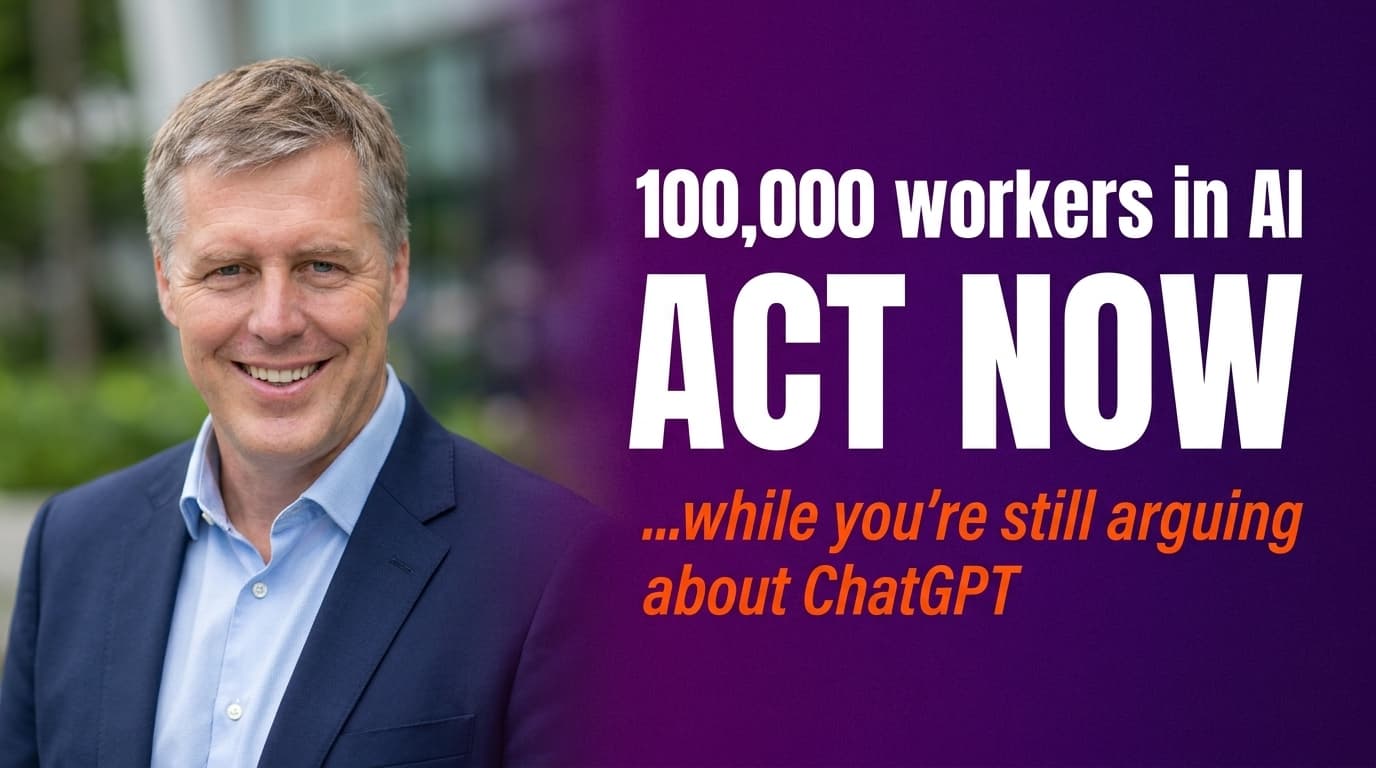
Singapore is training 100,000 workers in AI while you debate ChatGPT
TL;DR
Singapore has launched a national mission to train 100,000 workers and directly support 10,000 enterprises in AI adoption, all within three years. The UK and Australia remain comparatively inert: 92% of non-technical job listings in the UK contain no mention of AI skills. Your team is almost certainly already using AI without your knowledge, creating real data security exposure and no shared framework. The question is no longer whether your business adopts AI. It is how well and how fast you lead through the transition.
What is Singapore's National AI Impact Programme actually doing?
The centrepiece is the National AI Impact Programme, a fully-funded, three-year national mobilisation with two clear targets: train 100,000 workers and directly support 10,000 enterprises. This is not a cohort of machine learning PhDs at a handful of tech firms. Through the TechSkills Accelerator (TeSA), Singapore is pushing AI literacy deep into traditionally non-tech sectors: legal, accountancy, manufacturing. Minister Josephine Teo set the tone plainly: "We want to encourage those who haven't started to take the first step."
Supporting programmes include Champions of AI and the Digital Leaders Accelerator Bootcamp (DLAB), designed to produce organisational leaders who can drive transformation from the inside. The physical anchor is the Kampong AI park in the one-north tech hub, a dedicated centre of gravity for AI innovation. This is not about using AI. It is about building a pervasive national culture of AI, and executing it with a level of precision that is simply in a different league.
How is Singapore backing the strategy with actual money?
The financial architecture is serious:
- 400% tax deduction on AI-related business expenses, not a modest rebate, a structural incentive that makes AI investment the economically rational choice
- Free six-month subscriptions to premium AI tools for anyone who enrols in a SkillsFuture AI course
- Direct enterprise support for 10,000 businesses through the National AI Impact Programme
This is a deliberately engineered ecosystem. Non-adoption becomes the irrational option. That is not a coincidence, it is the point.
Why is the UK falling behind on AI adoption?
The UK has the stated ambition, G7 AI leadership, sovereign AI conversations, all the right rhetoric. The execution is a different story. The most concrete bottleneck is the "AI Power Wall": data centres cannot get connected to the national grid quickly enough, and the resulting queue is strangling AI capacity before it can scale. It is a grand vision undone by a failure on the fundamentals.
The strategic blind spot compounds the problem. Government and media remain fixated on frontier AI models, the large, headline-grabbing systems, while the businesses that employ most people go largely unaddressed. The numbers speak plainly:
- 92% of non-technical job listings in the UK make no mention of AI skills
The national conversation is not reaching the average worker or the average business. There is plenty of talk. There is not much action.
What is Australia doing, and why is it not enough?
Australia is stirring, but it reads like a third hit of the snooze button. Government moves are overwhelmingly reactive. The new national framework for data centre approvals, tying them to national interest criteria including renewable energy use and water management, is a necessary step toward digital sovereignty. But it is a policy of control, not empowerment. Regulating Big Tech's footprint does nothing to unleash Australian businesses.
The corporate picture reinforces the concern. Atlassian and Block have shed thousands of staff in what they describe as self-funding their AI pivots. That is not forward-looking strategy. It is a costly, painful scramble to close a gap that should not exist. Singapore is methodically building skilled, confident workforces from the ground up. Australia is making defensive layoffs. That is a fundamental difference in mindset, and it is a dangerous one.
See where AI fits in your business. Free.
A 45-minute audit. We map the highest-value automations and what they're worth in time and money. No pitch, no pressure.
What is "shadow AI" and why is it your biggest business risk right now?
Your team is already using AI. They are drafting emails, summarising reports, analysing spreadsheets, writing code, today, without your knowledge, without your framework. Shadow AI is what happens when people adopt powerful tools outside any official permission or guardrails.
The risks are specific:
- Data security: sensitive company information pasted into public-facing models with no data governance
- No shared best practice: every person reinventing their own inconsistent approach
- No accountability: no audit trail, no policy, no protection if something goes wrong
Shadow AI is not a sign of rogue behaviour. It is a sign your team wants these tools and your business has not given them a safe, structured path. That is a leadership gap, not a technology problem.
What does the Singapore gap mean for your business?
You cannot wait for the government to build a national AI strategy that reaches your doorstep in time. The gap between companies actively building AI capability and those still deliberating is no longer a gap, it is a chasm, and it widens every week.
Start by dragging the conversation out of the shadows. Call an all-hands meeting. Be transparent about the uncertainty, your team is reading the same alarming headlines you are. Then reframe it directly: the biggest risk to their jobs is not AI. It is working for a company that fails to adapt to an AI-driven world. Frame what is coming as augmentation, not replacement, giving people superpowers, making them faster and smarter, freeing them from the drudgery that burns them out.
The biggest risk to your team's jobs isn't AI, it's working for a company that fails to adapt.
How do you build your own version of Singapore's SkillsFuture?
You do not need a government-sized budget. Four practical moves that create real momentum:
- Bottleneck audit: gather your team leaders and map your core business processes. Where are the repetitive, low-value tasks consuming hours? Is it accounts payable manually keying in invoice data? Sales writing generic follow-up emails? HR sifting through hundreds of irrelevant CVs? Identify three to five high-impact, low-complexity processes where AI can deliver a fast, visible win.
- Focused pilot: select one department, define clear KPIs before you choose a tool, for example, "Reduce average customer response time by 30% within 60 days" or "Increase marketing campaign ROI by 15% by end of quarter", measure everything, and celebrate wins publicly. The pilot becomes your internal proof point and the case study that drives wider adoption.
- Micro-training programme: a weekly "AI Power Hour" where one team member shares a tool or technique they have discovered. Fund a handful of subscriptions to prompt engineering or AI for business courses. Run reverse mentoring, let your younger, digitally-native staff help train senior leadership in a safe, collaborative setting.
- Lead from the front: use AI visibly yourself. Show your team how you are summarising board papers, drafting strategic communications, analysing competitors. Your personal example will outweigh any top-down mandate.
An investment in training your people in AI is the single highest-return investment you can make in the future of your company.
What to do this week
- Monday: book a 45-minute all-hands, not to announce a finished strategy, but to open the conversation honestly; acknowledge the uncertainty, then reframe the opportunity
- Tuesday–Wednesday: run a bottleneck audit with your team leaders; list three to five processes where AI could save meaningful hours per week
- Thursday: name one department for a focused 60-day AI pilot; write down the KPI before you touch a single tool
- Friday: run the first "AI Power Hour", ask one person to show the team what they are already using
- This month: fund at least two people in prompt engineering or AI skills training; treat it as infrastructure investment, not a discretionary training budget line
Singapore has drawn the blueprint for what is possible when a nation commits to AI with precision and urgency. The gap between the prepared and the unprepared is no longer a gap. It is a chasm, and it is widening.
Where to from here
Book a free 60-minute AI audit, we'll explore exactly what workflows are worth augmenting with AI.
Live with passion & AI,
Brett
Want this installed in your business?
Bespoke AI implementation across your operations: strategy, build, rollout, and ongoing drift maintenance.
Frequently asked questions
What is Singapore's National AI Impact Programme?
+
The National AI Impact Programme is a fully-funded, three-year national mobilisation to train 100,000 workers in AI and directly support 10,000 enterprises in their AI adoption journey. It operates through initiatives like the TechSkills Accelerator (TeSA) and reaches traditionally non-tech sectors including legal, accountancy, and manufacturing.
What financial incentives does Singapore offer businesses for AI adoption?
+
Singapore offers a 400% tax deduction on AI-related business expenses, making AI investment the economically rational choice. Individuals who enrol in a SkillsFuture AI course receive free six-month subscriptions to premium AI tools.
What is the 'AI Power Wall' blocking the UK?
+
The AI Power Wall refers to the UK's national electricity grid bottleneck: data centres face queues so long to connect to the grid that the country's AI infrastructure capacity is being strangled before it can scale. It is a grand national AI vision undone by a failure on the fundamentals.
What percentage of UK job listings mention AI skills?
+
A recent analysis found that 92% of non-technical job listings in the UK make no mention of AI skills, indicating the national AI conversation is not translating into action for the average business or worker.
What is shadow AI and why is it a business risk?
+
Shadow AI is the informal, unsanctioned use of AI tools by employees without official permission, policy, or framework. It creates data security risks when sensitive information is pasted into public models, generates no shared best practices, and leaves businesses with no audit trail or accountability.
What is the Kampong AI park in Singapore?
+
Kampong AI is a dedicated AI innovation park located in Singapore's one-north tech hub. It serves as the physical centre of gravity for AI development within the national strategy.
How can a business start its own AI upskilling programme without a large budget?
+
Practical starting points include a bottleneck audit to identify three to five high-impact, low-complexity AI use cases, a focused 60-day pilot in one department with defined KPIs, a weekly AI Power Hour for peer learning, and funding a handful of prompt engineering or AI for business courses.
Brett is a four-time founder (Darra Tyres, Gladfish, EzyTrac, Anaboo) and the operator behind AIOS, Anaboo's AI Operating System. He writes from inside the build, installing AI in his own businesses first and reporting back what actually moves the numbers. Based between Singapore, the UK and Australia.