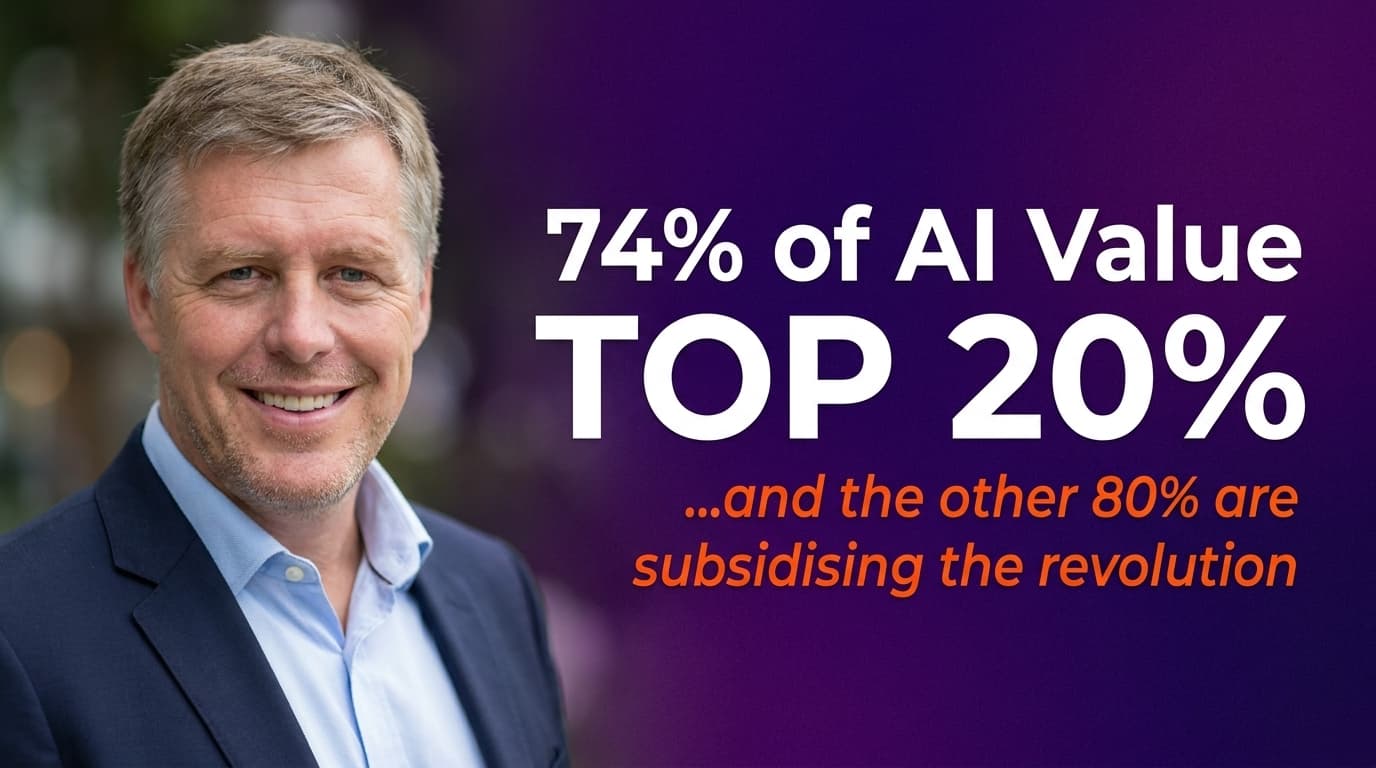
Three-quarters of AI value is going to just 20% of businesses
TL;DR
PwC's 2026 AI Performance Study confirms it: 74% of all economic value generated by AI is being captured by just 20% of companies. The divide is no longer a crack, it is a canyon. The top performers are not simply cutting costs; they are using AI to build entirely new revenue streams, redesign operations from scratch, and automate real decisions within proper governance frameworks. If your business is in the 80%, you are subsidising this revolution while your competitors bank the returns.
What does the PwC 2026 AI Performance Study actually show?
PwC surveyed more than 1,200 senior executives across twenty-five sectors globally. The headline finding is stark: nearly three-quarters of all AI-generated economic value is being captured by just one in five companies. These are not exclusively Silicon Valley tech giants with bottomless budgets and armies of data scientists. They are traditional businesses across every sector, manufacturing, financial services, healthcare, retail, that have figured out how to deploy AI for measurable financial return.
"A stark and widening divide.", PwC 2026 AI Performance Study
The remaining 80% of companies are fighting over 26% of the value, mostly stuck in endless pilot programmes that never scale, proof-of-concept projects that never reach production, and AI tools that sit on desktops gathering digital dust.
Why are the top 20% pulling ahead, and what are they actually doing differently?
The instinctive assumption is that the leaders have better tech, bigger budgets, or smarter developers. The reality is more fundamental than that. The companies winning the AI race are treating it as a growth engine, not just a productivity hack.
According to the PwC study, the top performers are:
- 2–3× more likely to use AI to identify and pursue entirely new growth opportunities
- 2× more likely to redesign their workflows from the ground up rather than bolt an AI tool onto a broken legacy process
- 2.8× more likely to increase the number of decisions made without human intervention, within defined governance guardrails
PwC describes the growth angle as "industry convergence", a logistics company using AI to offer financial services to its supply chain, a healthcare provider using AI to enter the wellness and insurance space, a retailer using AI to become a media company. The winners are fundamentally changing how their businesses operate and make money. The losers are doing the exact same things they have always done, just slightly faster.
Cost-cutting will only get you so far. Growth is where the real separation happens.
What is the 'AI proof gap' and why does it matter to your board?
Grant Thornton has named the phenomenon well: the "AI proof gap", the growing disconnect between the massive amounts being spent on AI and the absence of accountability for actual results.
Two trillion dollars is being spent on AI globally in 2026. CFOs are increasing IT and digital transformation spending to the highest level in twenty-one quarters of tracking, 68% plan to increase spending this year. But boards and investors are no longer writing blank cheques. They want to see the receipts.
The era of blank cheques for AI experimentation is ending.
Grant Thornton's survey of 950 C-suite leaders found that organisations with fully integrated AI are nearly four times more likely to see measurable performance gains than those still running disconnected pilots. Four times. That is not a marginal difference, that is a completely different category of outcome.
The proof gap shows up across four critical dimensions: governance, strategy, workforce readiness, and agentic AI risk. If you cannot demonstrate progress across all four, your AI budget will come under serious pressure.
See where AI fits in your business. Free.
A 45-minute audit. We map the highest-value automations and what they're worth in time and money. No pitch, no pressure.
Who is getting left behind inside your own organisation?
The workforce gap is where most AI strategies quietly collapse. Grant Thornton found that frontline employees (37%) and middle managers (30%) are the people who need the most support to implement AI effectively. Yet in most organisations, they are the ones receiving the least investment in training and change management.
The distance between what leadership expects and what the workforce can actually deliver is where AI programmes go to die.
Is technical debt killing Australian AI ambitions?
The IDC research report commissioned by MongoDB paints a confronting picture for Australian businesses specifically:
- 58% of Australian organisations say their existing architecture makes it impossible to build new applications without extensive modernisation, too rigid, too costly, too slow for today's requirements
- 96% of organisations have already experienced failed modernisation initiatives
- The number-one reason AI projects fail in Australia is siloed and poor-quality data
- IDC predicts organisations failing to address this technical debt will face 50% higher failure rates for their AI initiatives by 2027
That 2027 deadline is eighteen months away.
You cannot put a Ferrari engine in a broken-down chassis and expect to win the race.
The good news buried in the same report: the Australian leaders who have addressed this are generating nearly three times more digital revenue, 68% compared to 24% for their mainstream peers. They treat technical debt reduction not as a one-off project but as a continuous discipline. These are the businesses that will be in the top 20% PwC identified.
Your AI model is only as good as the data you feed it. If that data is scattered across disconnected systems, riddled with inconsistencies, and locked behind legacy interfaces, your AI will produce garbage. Fixing technical debt is no longer an IT housekeeping issue. It is a critical business survival imperative.
What does 'redesigning workflows' actually mean in practice?
It does not mean buying a chatbot subscription and pointing it at your existing customer service queue. The leaders are completely reimagining how customer interactions work from first contact to resolution. They are not using AI to speed up old reporting processes; they are building entirely new decision-making frameworks where AI handles the analysis and humans focus on strategy.
And critically, they are doing this inside proper governance structures, responsible AI frameworks, cross-functional oversight boards, defined guardrails. They are automating with confidence because they have built the trust infrastructure to support it. That combination, ambitious automation plus serious governance, is what separates the 20% from the field.
They built the right foundations, focused on growth, and demanded measurable results at every step. None of that happened by accident.
What to do this week
- Audit your technical debt honestly. Can your systems share data cleanly? Is your data siloed, inconsistent, or locked behind legacy interfaces? The IDC data is unambiguous, if the answer is yes, your AI initiatives will fail regardless of budget.
- Shift your AI mandate from cost-cutting to revenue. Ask where AI can help you enter adjacent markets or build new product lines, not just where it can trim operational spend. The 20% are growing; the 80% are just shrinking costs.
- Map your proof chain. For every AI initiative running in your business, draw a straight line from the project to a measurable outcome, new revenue, a quantified efficiency gain, or a demonstrable competitive advantage. If you cannot draw that line, your project is living in the proof gap.
- Invest in the middle layers. Frontline employees and middle managers are where AI implementation lives or dies. If they are not trained, equipped, and bought in, your strategy will not survive contact with reality.
- Treat modernisation as a discipline, not a project. The Australian organisations generating 68% digital revenue did not do a one-off data cleanup. They built ongoing modernisation into how they operate as a business.
The gap between the leaders and the laggards is widening every quarter. The cost of catching up is increasing every day.
Where to from here
Book a free 60-minute AI audit, we'll explore exactly what workflows are worth augmenting with AI.
Live with passion & AI,
Brett
Host a podcast? Have Brett on as a guest.
Straight talk on implementing AI in real SMEs, no jargon, plenty of receipts from the businesses we run.
Frequently asked questions
What percentage of AI economic value is captured by the top 20% of companies?
+
According to PwC's 2026 AI Performance Study of more than 1,200 senior executives across 25 sectors, 74% of all economic value generated by AI globally is being captured by just 20% of companies. The remaining 80% of businesses are sharing the leftover 26%.
What is the AI proof gap?
+
The 'AI proof gap' is a term coined by Grant Thornton to describe the growing disconnect between the massive amounts being spent on AI and the absence of accountability for measurable results. Their survey of 950 C-suite leaders found that organisations with fully integrated AI are nearly four times more likely to see measurable performance gains than those running disconnected pilots.
Why do AI projects fail in Australia?
+
According to IDC research commissioned by MongoDB, the number-one reason AI projects fail in Australia is siloed and poor-quality data. 58% of Australian organisations say their existing architecture makes it impossible to build new applications without extensive modernisation, and 96% have already experienced failed modernisation initiatives.
How much more likely are AI leaders to redesign their workflows?
+
PwC found that top-performing companies are twice as likely to redesign their workflows from the ground up to incorporate AI, rather than bolting an AI tool onto an existing broken process. They are also 2.8 times more likely to increase the number of decisions made without human intervention, within defined governance guardrails.
What does IDC predict for companies that ignore technical debt by 2027?
+
IDC predicts that organisations failing to address technical debt will face 50% higher failure rates for their AI initiatives by 2027, roughly 18 months away from the time of publication.
How much more digital revenue are Australia's AI leaders generating?
+
Australian organisations that have invested in strategic, ongoing modernisation programmes are generating nearly three times more digital revenue, 68% compared to 24% for their mainstream peers, according to the IDC report commissioned by MongoDB.
Which employees need the most AI support but receive the least?
+
Grant Thornton's survey found that frontline employees (37%) and middle managers (30%) need the most support to implement AI effectively, yet in most organisations they receive the least investment in training and change management.

Brett is a four-time founder (Darra Tyres, Gladfish, EzyTrac, Anaboo) and the operator behind AIOS, Anaboo's AI Operating System. He writes from inside the build, installing AI in his own businesses first and reporting back what actually moves the numbers. Based between Singapore, the UK and Australia.