UK's £500 million AI bet won't save businesses without a strategy
TL;DR
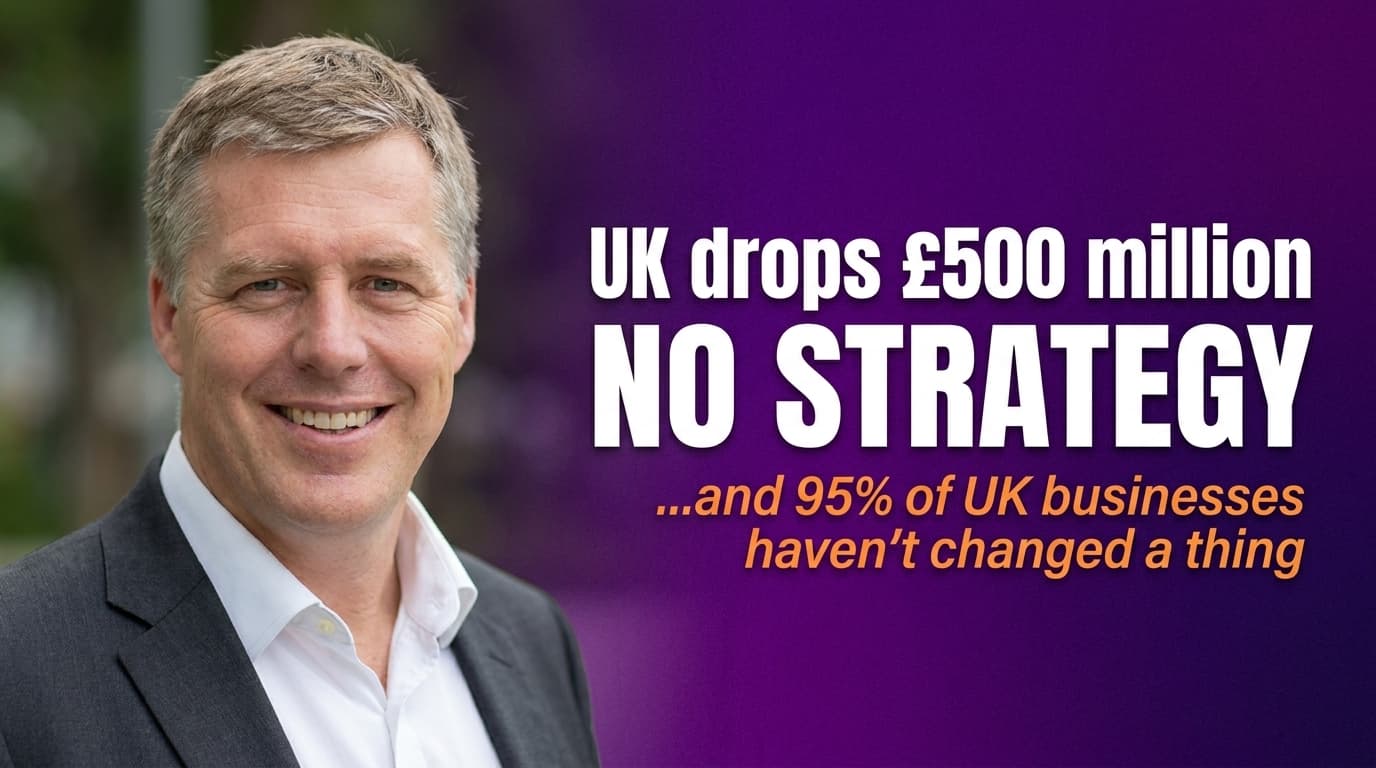
The UK government has committed £500 million to AI infrastructure and AI Growth Zones, positioning Britain as a global AI leader. But 54% of UK SMEs "using AI" have changed almost nothing, 95% haven't cut a single job and 86% report no change in roles or responsibilities. Fewer than half hold a written AI strategy. Without one, the government's investment is a starting gun for a race most businesses don't know they're running.
Is the UK's £500 million AI investment actually going to work?
The headline is genuinely impressive. Half a billion pounds into a Sovereign AI fund. AI Growth Zones to fast-track data centres. The kind of signal that tells the world the UK is serious about being a global player.
But there is a gap between building the airport and teaching the airlines to fly. The government is creating the conditions, clearing the runway, laying the infrastructure. What it is not doing is helping businesses figure out what to build once they land.
I saw the same pattern in the dot-com boom. Governments built fibre optic infrastructure, declared the future had arrived, and businesses rushed in. The ones that won had a plan. The ones without a plan spent a fortune and got nothing. The government can build an environment. It cannot build your strategy. The money is a starting gun, not a destination.
What do the UK AI adoption numbers actually mean?
Fifty-four per cent of UK SMEs are now using AI in some form, up from 35% just the previous year. On paper, that looks like a revolution. It is not.
Look at what sits beneath the number:
- 95% of businesses that have "adopted" AI have not cut a single job
- 86% report that roles and responsibilities are completely unchanged
That is not transformation. That is augmentation. Businesses are using ChatGPT to write emails and AI-powered software to schedule social media posts. It is like buying a Formula 1 car and only ever driving it to the shops, using a fraction of its capability, doing the same things in a slightly different way, and calling it innovation.
Real transformation means asking: if we were starting from scratch today, with all the power of AI at our disposal, how would we actually run this business? That is a hard question. Most businesses are not asking it. They are buying subscriptions, ticking the AI box, and redecorating a house that needs demolishing and rebuilding.
The adoption numbers look impressive. They are masking a complete lack of ambition. It is the difference between using a calculator to do your sums a bit faster and using a spreadsheet to completely revolutionise your financial modelling. One is a small improvement; the other is a game-changer. Too many UK businesses are stuck in the calculator phase.
Why is the strategy gap the single biggest problem?
Less than half of the companies supposedly using AI have a clear, written-down strategy for it.
They are spending money, changing workflows, and investing time, with no plan. It is a builder arriving at a construction site with bricks, cement, and a full team, but no blueprint. The result is predictable: an expensive mess.
An AI strategy is not a fluffy corporate document that sits on a shelf gathering dust. It is a roadmap, a living plan that identifies:
- Which processes in your business, not tasks, processes, can be fully redesigned
- What success looks like, with specific measurable outcomes
- What data you need to power the new processes
- What skills your team will need, and how you will acquire them
Without that blueprint, all the government funding in the world changes nothing. You are buying tools with no idea what you are building. I watched a company spend a fortune on a state-of-the-art CRM with all the bells and whistles. The sales team hated it. The marketing team couldn't extract the data they needed. It became a very expensive address book. Best tool on the market, made useless by the absence of a plan.
See where AI fits in your business. Free.
A 45-minute audit. We map the highest-value automations and what they're worth in time and money. No pitch, no pressure.
How does Singapore's approach compare to the UK's?
Singapore is running an organised campaign. The UK is handing weapons to a mob.
Singapore has established a National AI Council to oversee strategy at the national level. They are running a Digital Leaders Accelerator Bootcamp to train 2,000 leaders in how to actually use this technology. They have built a comprehensive AI Risk Management Toolkit for their most critical sectors. Every move is deliberate, methodical, and tied to a unified vision.
The UK's approach is chaotic by comparison, every business for itself, no coordinated training infrastructure, no shared destination. Singapore is not just building an airport; it is operating a world-class airline with trained pilots, a clear flight plan, and a destination in mind.
There is a cultural dimension to this as well. Singapore has a long tradition of long-term strategic planning. Small country, limited resources, it has to be deliberate. The UK has a more laissez-faire, individualistic culture that can be a powerful engine for entrepreneurship but struggles with large-scale coordination. That is showing right now.
What is Australia doing that the UK isn't?
Even Australia, which is often a bit behind the curve on these things, is taking a more considered approach. The Australian government has committed nearly AUD $30 million to an AI Safety Institute and is building a 'Guardrails for AI' framework to provide governance and safety structures across sectors. Not as coordinated as Singapore, but at least engaging with the big picture.
The UK, in its rush to be seen as a leader, appears to be skipping these steps entirely. So focused on the destination that it has forgotten to check the map.
Does your business actually have an AI strategy?
You are a UK business owner. You have read the headlines, felt the pressure, and probably bought a ChatGPT subscription for the team. Maybe some AI-powered marketing tools. You feel like part of the 54%. You feel like you are doing the right thing.
Here are the questions that actually matter:
- Do you have a written AI strategy, something you can show your team, your investors, your bank?
- Do you know with absolute clarity what you want to achieve with AI in the next 12, 24, or 36 months?
- Have you identified the specific processes, not tasks, in your business that can be completely redesigned, not just tweaked?
- Have you mapped the data you will need to power those processes and how you will get it?
- Have you planned the new skills your team will need and how to build them?
If the answer to any of those is no, or even sort of, you are tinkering. You are burning cash, wasting time, and, worst of all, falling behind while believing you are in the game. You are in the stands watching the real players on the field. The ones with a strategy are the ones building the next generation of great businesses. The rest are accumulating expensive, useless bricks.
Technology does not save businesses. Strategy does. Right now, the UK is a country full of businesses with access to extraordinary technology and no strategy in sight. It is a massive, historic opportunity being squandered one ChatGPT subscription at a time.
What to do this week
- Write a one-page AI strategy. Not a 40-slide deck, one page. What problem, which processes, what outcome, what metric. Start there.
- Audit your current AI usage. List every tool and subscription. For each one, ask honestly: is this transforming a process, or just speeding up a task?
- Identify one process in your business that, if redesigned from scratch with AI, would meaningfully change your output or cost base. Put all your focus there first.
- Set a 90-day measurable goal. Not "use AI more", something specific: response time reduced by X%, cost per lead down by £Y, Z hours saved per week.
- Stop tinkering. The government's £500 million is a signal that the race has started. The question is whether you know which direction you are running.
Where to from here
Book a free 60-minute AI audit, we'll explore exactly what workflows are worth augmenting with AI.
Live with passion & AI,
Brett
Need an AI operator inside your team?
Place a Chief AI Officer, an AI Officer, or embed an Anaboo Forward Deployed Engineer for 3–6 months.
Frequently asked questions
How much has the UK government invested in AI?
+
The UK government has committed £500 million to a Sovereign AI fund and is creating AI Growth Zones to fast-track data centre development across the country.
What percentage of UK SMEs are using AI?
+
54% of UK SMEs are now using AI in some form, up from 35% the previous year, though the data behind that number tells a very different story about what 'using AI' actually means.
Have UK businesses actually transformed with AI?
+
The evidence says no. Of businesses that have adopted AI, 95% have not cut a single job and 86% report no change in roles or responsibilities, indicating augmentation, not transformation.
Why does an AI strategy matter more than AI tools?
+
Fewer than half of businesses using AI have a written strategy. Without identifying which processes to transform, what success looks like, and what skills are needed, investment in AI tools produces expensive noise rather than results.
How does the UK's AI approach compare to Singapore's?
+
Singapore has established a National AI Council, is running a Digital Leaders Accelerator Bootcamp training 2,000 leaders, and has built a comprehensive AI Risk Management Toolkit for critical sectors. The UK has infrastructure spending and no equivalent coordinated programme.
What has Australia committed to AI governance?
+
Australia has committed nearly AUD $30 million to an AI Safety Institute and is building a 'Guardrails for AI' framework to provide governance and safety structures across sectors.
What is the difference between AI augmentation and AI transformation?
+
Augmentation means using AI to speed up existing tasks slightly, writing emails faster, scheduling posts. Transformation means redesigning processes from the ground up, asking how you would run the business if you were starting today with AI at the centre.

Brett is a four-time founder (Darra Tyres, Gladfish, EzyTrac, Anaboo) and the operator behind AIOS, Anaboo's AI Operating System. He writes from inside the build, installing AI in his own businesses first and reporting back what actually moves the numbers. Based between Singapore, the UK and Australia.