UK AI security gap: 76% of adopters have no formal security protocols
TL;DR
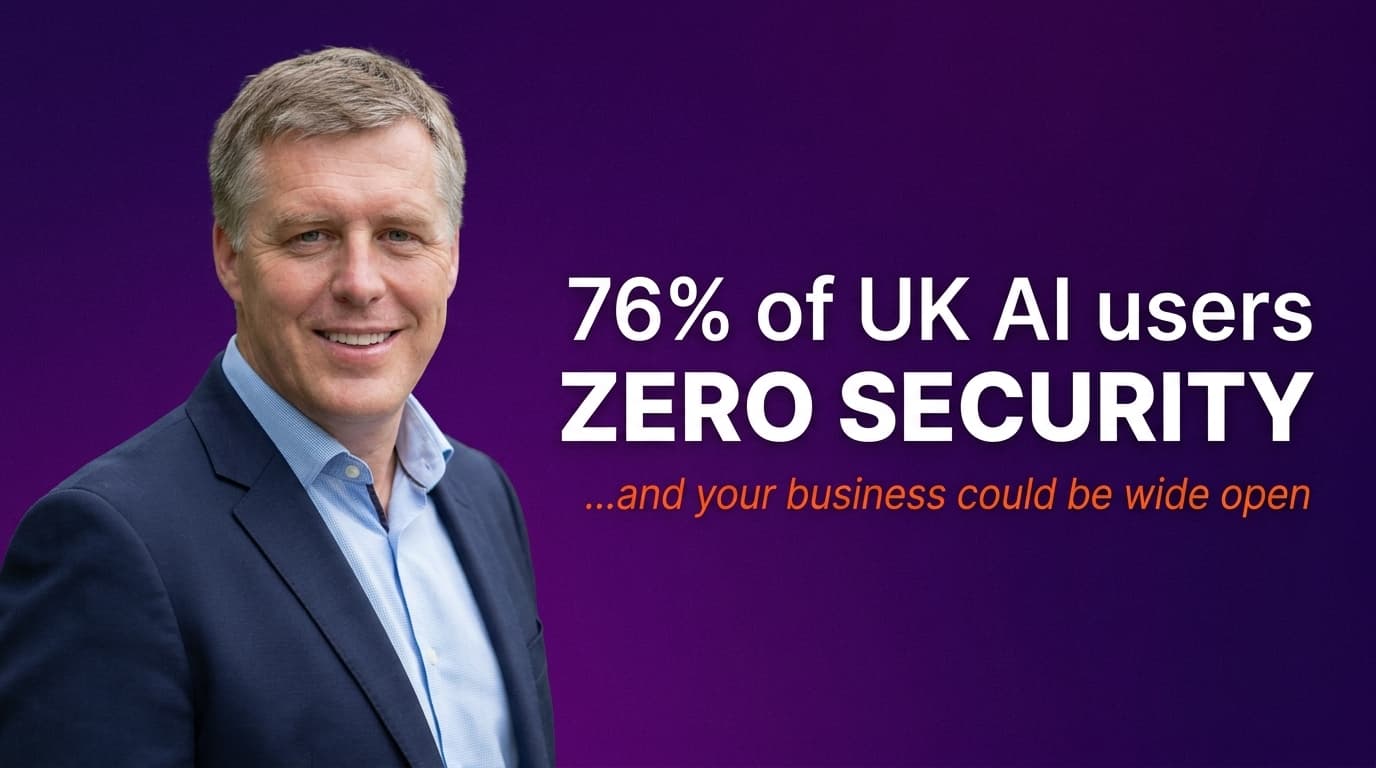
A UK business survey found that 31% of firms have adopted AI, but 76% of those adopters have no formal security practices in place. That is not a minor oversight, it is a catastrophic operational risk. Shadow AI, prompt injection attacks, and data leakage are live threats that traditional cybersecurity tools are not equipped to handle. The fix starts with policy, training, and governance, in that order.
Why is the UK AI security gap so alarming?
The numbers are stark. While 31% of UK firms have now integrated AI into their operations, 76% of those adopters have implemented no formal security practices or protocols to govern its use.
Nearly three-quarters of businesses using AI are flying blind on cybersecurity.
This is not a slow-burn risk. Every day those businesses operate without AI security governance, they are exposed to data leaks, prompt injection attacks, and unauthorised AI use by their own employees. The speed of AI adoption has outpaced the speed of security preparedness, and that gap is widening.
What exactly is shadow AI, and how bad is the problem?
Shadow AI is the unauthorised use of AI tools by employees without organisational knowledge or oversight. Employees keen to be more productive are using public AI tools, ChatGPT, Copilot, and others, to draft emails, summarise confidential documents, and write code, often with zero formal guidelines in place.
Every time an employee pastes sensitive company data into a public AI, that data is potentially exposed. The business has no visibility, no control, and no audit trail. The problem is not bad intent, it is the complete absence of any policy to channel good intent safely.
What is a prompt injection attack and why can't you detect it the usual way?
A prompt injection attack is when a malicious actor crafts inputs designed to manipulate an AI system into doing something it should not. That might mean:
- Tricking a customer service AI into revealing sensitive customer information
- Getting an internal AI to generate biased or false reports
- Injecting malware into code generated by a development AI
This is not a hack in the traditional sense. It is a manipulation of the AI itself. Conventional security tools were never built to detect it, which is precisely what makes it so dangerous and so underestimated.
What are the real business consequences of unsecured AI?
The consequences fall across four categories:
- Data leakage, Confidential client lists, financial records, and product designs potentially exposed through unsecured AI usage
- Compliance failures, GDPR, CCPA, and HIPAA violations carry significant fines and legal exposure
- Reputational damage, Being known as the company that leaked customer data through lax AI security is a fast way to lose clients and trust
- Intellectual property loss, Competitive advantages and unique innovations can be siphoned off through AI vulnerabilities
The financial and reputational cost of a single major incident will dwarf the investment required to prevent it.
See where AI fits in your business. Free.
A 45-minute audit. We map the highest-value automations and what they're worth in time and money. No pitch, no pressure.
Is your existing cybersecurity enough to protect against AI risks?
No. This is one of the most dangerous assumptions a business owner can make right now. Traditional cybersecurity was designed for traditional attack vectors. AI introduces entirely new categories of risk, prompt injection, model manipulation, data leakage through third-party AI tools, that your existing defences were not built to handle.
You can have best-in-class antivirus, firewalls, and endpoint protection and still be completely exposed on the AI front. The tools are different. The threats are different. The defences need to be different.
How do you close the AI security gap? Start with policy.
The first step is an AI usage policy. Before anything else, businesses need clear written guidelines specifying:
- Which AI tools are approved for use
- What data can and cannot be fed into AI systems
- Confidentiality requirements and data handling procedures
- Consequences for using unapproved tools
This directly addresses shadow AI. When employees know what is and is not permitted, and why, the risk of unauthorised use drops immediately. Make it mandatory reading, not an optional attachment that disappears into an onboarding folder.
Why is AI-specific security training non-negotiable?
Your employees are simultaneously your biggest vulnerability and your strongest line of defence. Untrained, they create risk without realising it. Trained, they become active participants in your security posture.
AI-specific training should cover:
- How prompt injection works and how to recognise suspicious interactions
- Data privacy risks when using AI tools, including public models
- The importance of verifying AI outputs before acting on them
- How to report concerns or anomalies through a clear channel
Knowledge is the cheapest security investment you will ever make, and an informed workforce is a secure workforce.
What does an AI governance framework actually look like?
AI governance means assigning clear ownership and accountability for AI risk across the organisation. That means answering:
- Who approves new AI tools before they enter the business?
- Who monitors ongoing AI usage and how?
- Who conducts security audits and on what schedule?
- Who is accountable when something goes wrong?
Governance is not bureaucracy for its own sake. It is the mechanism that turns a policy document into lived practice. Without it, the policy sits in a folder and nobody reads it.
Do you need AI-native security solutions?
For businesses with AI integrated into core workflows, yes. Traditional cybersecurity tools are often insufficient for AI-specific risks. AI-native security solutions are designed to:
- Monitor AI usage patterns and detect anomalous behaviour
- Identify prompt injection attempts in real time
- Scan AI-generated code for vulnerabilities before it is deployed
- Ensure data privacy within AI model interactions
Regular AI security audits and penetration testing, including ethical hackers probing your AI applications specifically, should also be scheduled proactively. Do not wait for an incident to discover your weaknesses.
What to do this week
- Audit your current AI exposure. List every AI tool in use across your business, including the ones your employees are using without formal approval. That list is your baseline risk register.
- Draft an AI usage policy. Even a one-page document specifying approved tools and prohibited data-sharing behaviours is better than nothing. Start there and build from it.
- Run a team briefing on AI security. A 30-minute session covering shadow AI, prompt injection, and data handling basics can shift behaviour immediately and cost almost nothing.
- Assign AI governance ownership. Nominate one person, not a committee, responsible for AI tool approvals and security oversight.
- Assess whether your current security stack covers AI-specific risks. If it does not, add AI-native monitoring to your next procurement review.
Where to from here
Book a free 60-minute AI audit, we'll explore exactly what workflows are worth augmenting with AI.
Live with passion & AI,
Brett
Running an event? Put practical AI on your stage.
Keynotes and workshops that send business owners home with a plan they can use Monday morning. No hype.
Frequently asked questions
What is the UK AI security gap?
+
The UK AI security gap describes the dangerous mismatch between the pace of AI adoption and the absence of security measures governing it. A survey found that 31% of UK firms have integrated AI, yet 76% of those adopters have no formal security practices or protocols in place.
What is shadow AI and why is it a business risk?
+
Shadow AI is the unauthorised use of AI tools by employees without organisational knowledge or oversight. When employees paste sensitive company data into public tools like ChatGPT, that data is potentially exposed, and the business has zero visibility, control, or audit trail over it.
What is a prompt injection attack?
+
A prompt injection attack is when a malicious actor crafts inputs designed to manipulate an AI system into revealing sensitive data, generating false outputs, or injecting malware into AI-generated code. Unlike conventional hacks, it exploits the AI itself rather than underlying infrastructure, making it extremely difficult to detect with traditional security tools.
How do I create an AI usage policy for my business?
+
An AI usage policy should specify which tools are approved, what data can and cannot be fed into AI systems, confidentiality requirements, and consequences for using unapproved tools. It should be mandatory reading for all staff and directly address shadow AI by setting explicit boundaries before problems arise.
What does an AI governance framework involve?
+
An AI governance framework assigns clear ownership for AI risk, who approves new AI tools, who monitors ongoing usage, and who conducts security audits. It turns a policy document into lived practice by ensuring accountability exists at every stage of the AI lifecycle.
Are traditional cybersecurity tools enough to handle AI risks?
+
No. Traditional tools were designed for traditional attack vectors. AI introduces entirely new risk categories, prompt injection, model manipulation, and data leakage through third-party AI tools, that conventional defences were never built to detect or prevent. AI-native security solutions are required.
What compliance risks come with unsecured AI use?
+
Unsecured AI use can put businesses in breach of GDPR, CCPA, and HIPAA depending on the data involved. Non-compliance carries significant fines, legal exposure, and reputational damage that far exceeds the cost of implementing proper AI security protocols from the outset.

Brett is a four-time founder (Darra Tyres, Gladfish, EzyTrac, Anaboo) and the operator behind AIOS, Anaboo's AI Operating System. He writes from inside the build, installing AI in his own businesses first and reporting back what actually moves the numbers. Based between Singapore, the UK and Australia.