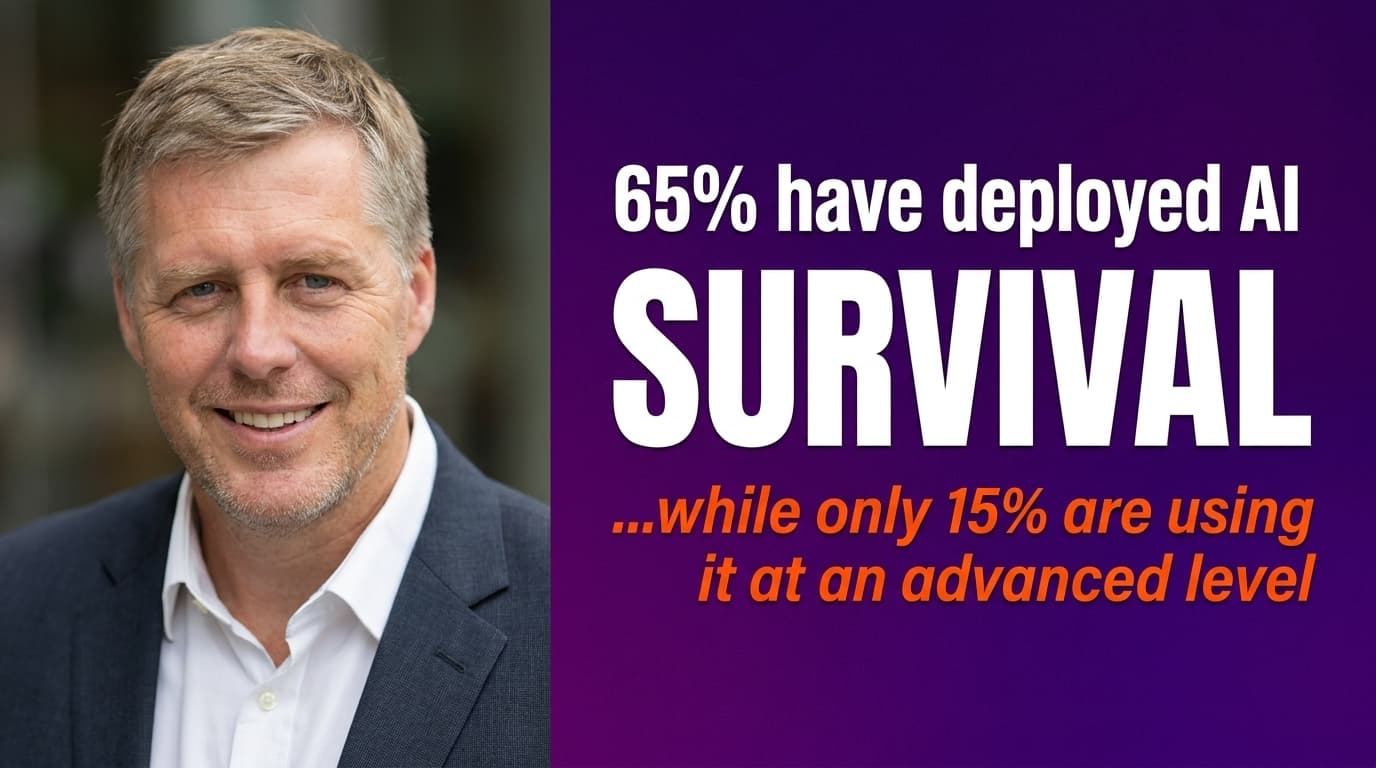
UOB 2026: 65% of businesses deploy AI to survive rising costs
TL;DR
The UOB Business Outlook Study 2026 reports that 65% of regional businesses in Asia have deployed AI, not out of enthusiasm for technology, but out of economic necessity. Energy management is a top priority for 8 in 10 of those businesses. Only 15% have reached "advanced" AI capabilities, meaning most adoption is practical and immediate: customer support automation (39%) and payments/invoicing (34%). The real barriers are data readiness, funding, and talent gaps, and the businesses solving those first are pulling ahead.
What does the UOB Business Outlook Study 2026 actually tell us?
Singapore has a track record of reading business trends early. The UOB Business Outlook Study 2026 is worth paying attention to precisely because it captures what's happening on the ground across the region, not what consultants wish were happening.
The headline number: 65% of regional businesses have deployed AI. That's not pilot programmes or proof-of-concept experiments. That's deployment. And the primary driver isn't growth ambition, it's cost pressure. With energy costs squeezing margins and global economic uncertainty making every operational dollar count, businesses are turning to AI as a practical efficiency tool, not a vanity project.
8 in 10 businesses now cite energy management as a top priority, and AI is their primary answer.
Why are most businesses stuck at basic AI?
Here's the inconvenient data point buried in that headline figure: only 15% of businesses have implemented what the study classifies as "advanced" AI capabilities. The majority are using AI for practical, immediate applications:
- Customer support automation, 39% of businesses
- Payments and invoicing, 34% of businesses
This isn't a failure. It's a signal. Most businesses are deploying AI where it delivers fast, measurable returns, not where it looks impressive in a press release. The problem is that staying at basic eventually becomes its own competitive liability.
What are the real barriers to AI adoption?
The UOB study is direct about where businesses are hitting walls. The three major blockers are:
- Data and system readiness, AI needs clean, organised, accessible data. Most businesses don't have it.
- Funding, Initial AI investment feels like a gamble when margins are already tight.
- Talent gaps, Without people who can implement and maintain AI tools, deployment stalls.
These aren't new problems. But knowing they're the blockers changes how you should prioritise your AI strategy. You don't start with a sophisticated AI deployment if your data infrastructure is a mess, you fix the infrastructure first.
See where AI fits in your business. Free.
A 45-minute audit. We map the highest-value automations and what they're worth in time and money. No pitch, no pressure.
Is the energy crisis actually accelerating AI adoption?
Counterintuitively, yes. Rising energy costs create pressure to optimise operations, which pushes businesses toward automation. AI becomes less of a "nice to have" and more of a cost-management imperative when your utility bills are eating into your margins.
The UOB study's finding that 8 in 10 businesses name energy management as a top priority is significant. It means AI adoption is being pulled forward by economic necessity rather than technology enthusiasm. Businesses using AI to predict energy usage patterns, identify inefficiencies, and optimise consumption across operations are building a structural cost advantage that compounds over time.
What happens if your competitors are using AI and you're not?
Businesses that have deployed AI, even basic applications, are getting leaner faster than those that haven't. Customer support automation means lower call volumes and round-the-clock coverage without proportional headcount costs. Automated invoicing means faster cash flow and fewer errors. Real-time operational data means faster, better-informed decisions.
The market doesn't reward stagnation, especially in turbulent times.
None of these applications require cutting-edge AI research. They require the willingness to implement and the infrastructure to support it. If you're still running manual processes in customer support and invoicing, you're paying a premium for inefficiency that your competitors are no longer paying.
How should a 20–500 employee business approach this?
The UOB study's findings point to a clear sequence for businesses that aren't yet in the 65%:
1. Start where the money is. Customer support and invoicing/payments automation are the two highest-adoption use cases for a reason, they have clear, measurable ROI and relatively low implementation complexity. Start there.
2. Fix your data before you fix your AI. Data and system readiness is the number-one implementation blocker in the study. Clean data, organised in accessible systems, is a prerequisite, not an afterthought.
3. Upskill before you hire. Singapore's programme to train 40,000 AI professionals reflects how seriously the talent gap is being taken at a national level. You don't need AI scientists on staff; you need existing people who can work confidently with AI tools.
4. Find available funding. Government grants and industry-specific programmes exist specifically to reduce the financial barrier to AI adoption. Research what's available in your region before assuming you need to fund this entirely from your own pocket.
5. Build incrementally. Full AI deployment on day one is neither realistic nor necessary. Each working implementation teaches you something useful and builds the internal confidence and organisational readiness for the next one.
What to do this week
- Pull your last three months of energy and operational cost data. Identify your single biggest controllable cost line.
- Map which manual processes in customer support or invoicing are consuming the most staff hours, these are your first AI targets.
- Research government AI adoption grants available in your region. They exist and most businesses don't use them.
- Audit data quality in the two or three systems you'd need to connect to an AI tool. Flag the gaps before you start any vendor conversation.
- If you haven't read the UOB Business Outlook Study 2026, read it. It's one of the most grounded regional AI adoption datasets currently available.
Where to from here
Book a free 60-minute AI audit, we'll explore exactly what workflows are worth augmenting with AI.
Live with passion & AI,
Brett
Want this installed in your business?
Bespoke AI implementation across your operations: strategy, build, rollout, and ongoing drift maintenance.
Frequently asked questions
What does the UOB Business Outlook Study 2026 say about AI adoption?
+
The study found that 65% of regional businesses in Asia have deployed AI, primarily driven by cost pressures rather than innovation ambition. Only 15% have implemented advanced AI capabilities, with most businesses using it for customer support automation (39%) and payments/invoicing (34%).
Why is energy management linked to AI adoption in the UOB study?
+
8 in 10 businesses surveyed cited energy management as a top priority. Rising energy costs are squeezing margins, making operational efficiency tools like AI a necessity rather than a luxury for many regional businesses.
What are the main barriers to AI adoption for businesses?
+
The UOB study identifies three main blockers: data and system readiness, funding constraints, and talent gaps. Addressing data infrastructure first is critical, no AI deployment succeeds on messy, inaccessible data.
What percentage of businesses use AI for customer support automation?
+
According to the UOB Business Outlook Study 2026, 39% of regional businesses use AI for customer support automation, making it the most common AI application, ahead of payments and invoicing at 34%.
How many AI professionals is Singapore planning to train?
+
Singapore has committed to training 40,000 AI professionals, reflecting the scale of the talent gap and the seriousness with which the region is treating AI capability building.
Should a small business invest in AI during an economic downturn?
+
The UOB study suggests yes. AI adoption is being driven by economic necessity, not growth optimism. Businesses using AI to automate customer support and invoicing are reducing costs and improving cash flow precisely when margins are tightest.
How should a business start with AI if it has limited resources?
+
Start with high-ROI, low-complexity applications: customer support automation and invoicing. Fix data quality issues first, upskill existing staff rather than hiring AI specialists, and explore government grants before assuming you need to self-fund the entire investment.

Brett is a four-time founder (Darra Tyres, Gladfish, EzyTrac, Anaboo) and the operator behind AIOS, Anaboo's AI Operating System. He writes from inside the build, installing AI in his own businesses first and reporting back what actually moves the numbers. Based between Singapore, the UK and Australia.