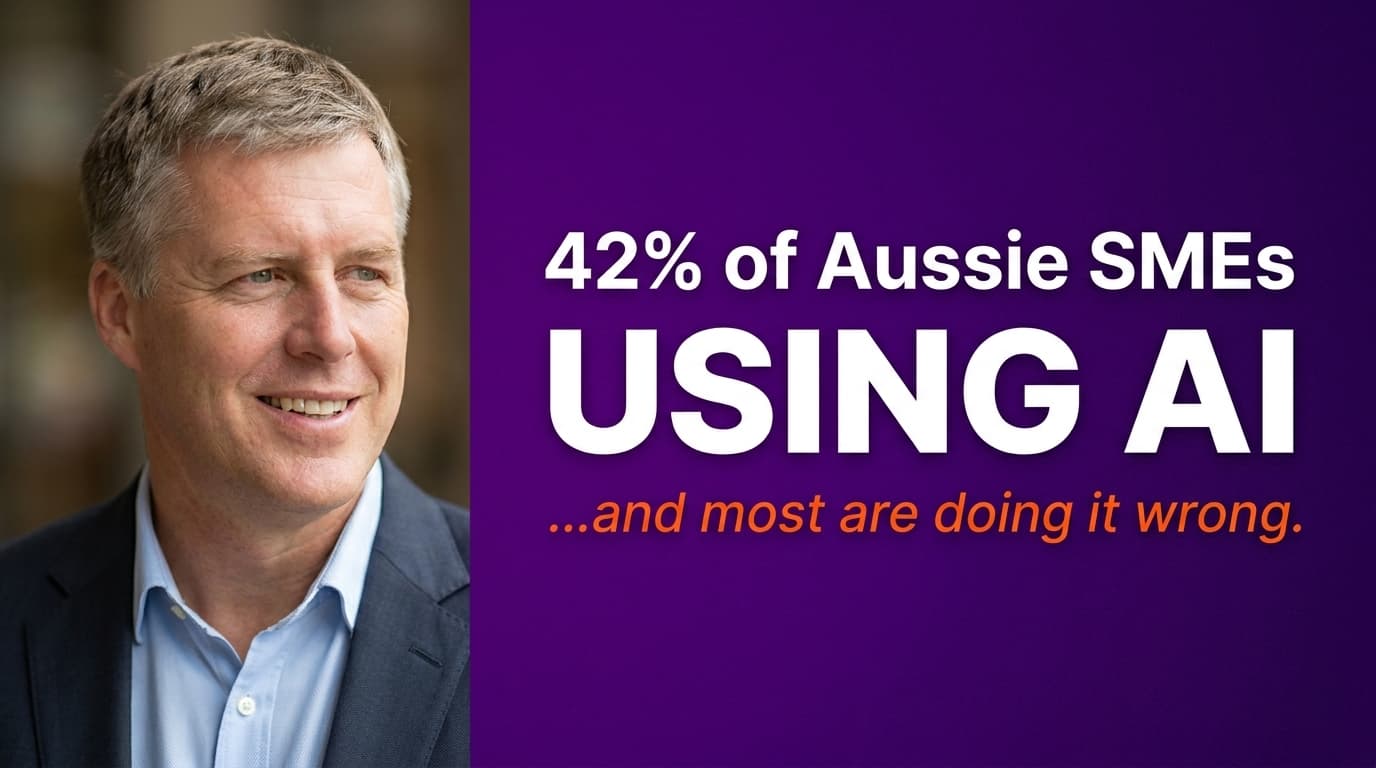
Why 42% of Australian SMEs Are Using AI Wrong (And What the Successful Few Do Differently)
TL;DR
42% of Australian SMEs are using AI, but most are getting it wrong. They're using it to do bad processes faster, writing more mediocre marketing copy, answering customer emails slightly quicker, while enterprise data shows that 80% of AI projects deliver no measurable value. The minority who win are not automating tasks. They are redesigning work. This piece breaks down the NAB Economics data, the enterprise failure rates, the skills gap, and what an SME should actually do this quarter.
How widespread is AI adoption in Australian SMEs in 2026?
42% of Australian SMEs are actively using AI in daily operations right now. Another 14% are in planning stages. That puts well over half the SME sector either in the game or about to jump in, according to brand new, embargoed data from NAB Economics.
The use cases are predictable. Fifty-one percent are running AI in marketing and sales, drafting emails, social media posts, generating copy. Thirty-nine percent are applying it to operations and logistics. Twenty-five percent are using it for customer-service chatbots and support triage.
The perceived benefits are exactly what you'd expect: 35% say the biggest win is automating repetitive tasks; 31% point to marketing improvements; 23% claim better decision-making.
Pete Steel, Group Executive at NAB, summed it up: "We're seeing a clear shift from curiosity to practical use."
On the surface, this looks like good news. Why isn't it?
It looks like Australian small businesses are agile, forward-thinking, and rapidly modernising. But when you overlay this SME adoption data with what is actually happening at the enterprise level, where companies have vastly more resources and dedicated data teams, a much darker picture emerges.
The vast majority of those 42% are almost certainly getting it wrong. They are falling into the same traps currently destroying billion-dollar enterprise AI initiatives.
What does the enterprise AI failure rate tell us about SMEs?
A massive new RAND Corporation study found that 80.3% of enterprise AI projects deliver no measurable business value. MIT looked specifically at generative AI, the exact type SMEs are using, and found 95% of pilots never scale beyond a basic demo.
Why are huge companies failing so spectacularly? Not because the tech is flawed. Because of:
- Leadership misalignment, 84% of enterprise failures driven by lack of clear strategy from the top.
- Bad data readiness, 60% of projects abandoned because the underlying data is a fragmented mess.
Now ask yourself: if a corporation with a dedicated Chief Data Officer and a $10m IT budget can't get their data clean enough to run a successful AI project, what chance does a mid-sized logistics firm in Melbourne or a marketing agency in Sydney have of doing it accidentally?
Close to zero.
What's the difference between tactical AI adoption and strategic transformation?
What we're seeing in the SME sector is not strategic AI adoption. It is tactical desperation.
Business owners are buying off-the-shelf generative AI tools and handing them to marketing coordinators or admin assistants with a vague instruction to "make us more efficient." They are treating AI like a spell-checker or a piece of accounting software. They are plugging it into broken, inefficient processes and expecting magic.
When you use AI to automate a bad process, you do not fix the process. You just do the wrong thing much faster.
Why does Australia lead in AI governance but lag in AI value capture?
KPMG data highlights a paradox. Australian organisations are world-leading on AI governance, 31% are prioritising it, against a global average of 26%.
But on value capture, they're dead last. Only 35% of Australian businesses are prioritising AI-driven productivity (global average 42%). Only 38% are using advanced analytics.
Australian businesses have built the guardrails. They are terrified to drive the car. They are so focused on compliance and not breaking anything that they have completely lost sight of how to redesign their business to be more productive.
That same instinct is playing out in the SME sector. They are using AI for the safest, lowest-impact tasks possible, writing a blog post, drafting a polite email to a frustrated customer. They are using a Formula One engine to drive to the corner shop.
See where AI fits in your business. Free.
A 45-minute audit. We map the highest-value automations and what they're worth in time and money. No pitch, no pressure.
Is AI already disrupting the Australian labour market?
A University of Sydney analysis of US labour data shows the early signs of AI job disruption are already here. The sharpest declines are in routine information-processing roles, customer support, administration, basic IT services.
- Entry-level graduate unemployment has spiked to 5.6%, well above the 4% economy-wide average.
- 42.5% of recent graduates are underemployed, working in jobs that don't require their degree.
- Finance, consulting, and management hiring has stalled.
This is not a forecast. It is happening now. AI is hollowing out the middle and bottom of the white-collar workforce.
How is AI changing the cybersecurity threat to SMEs?
IBM's latest data shows a 44% year-over-year surge in AI-driven cyberattacks targeting public-facing applications. Anthropic, one of the most advanced AI companies in the world, was itself breached by attackers who used AI to scan its source code for vulnerabilities.
If they can be hacked, so can you. Every AI tool you deploy without proper governance and security controls is another door you have left wide open.
What are the successful SMEs doing differently?
The successful minority, the ones actually seeing massive productivity gains and revenue growth, are doing something entirely different. They are not automating tasks. They are redesigning work.
They understand that the real value of AI is not replacing a human who writes an email. The real value is fundamentally changing how the business operates.
Take Bella Manufacturing, highlighted in the NAB report. Director Andrew Blair: "The real value isn't the technology. It's the time it gives back."
Or Tim Gauci, owner of Design and Diplomacy. He was initially deeply sceptical of AI. He didn't buy a ChatGPT subscription for the marketing team. He integrated AI into his financial analysis, his quoting process, and his client onboarding. He restructured the operational flow of his business.
That is the difference between tactical adoption and strategic transformation.
What is the AI skills gap costing Australian SMEs?
Global IDC data shows over 90% of organisations face severe AI skills shortages. 93% of employees say underdeveloped skills are hindering company progress. Yet only half have received any formal AI training.
The cost of not training is staggering. Recent research shows that for every 10 hours saved by AI, 4 hours are lost to reworking errors and fixing what researchers now call "workslop", mediocre, AI-generated output that creates more problems than it solves.
In an SME, where every hour counts, that 40% rework burden is not an inconvenience. It is a productivity killer that can wipe out every cent of value the AI was supposed to deliver.
Is it better to not use AI at all than to use it badly?
Here's the uncomfortable truth nobody in the AI industry wants to say: the 44% of Australian SMEs not using AI at all might be in a better position than the ones using it badly.
At least they're not burning cash on tools that produce garbage. At least they're not creating a false sense of innovation while their processes remain fundamentally broken.
The worst position to be in is the one where you think you are making progress, but you are actually just accumulating technical debt and training your team to accept mediocrity.
What should your business do this quarter?
If you are part of the 42% currently using AI:
- Run a brutal, honest audit of what you are actually achieving.
- Are you generating more mediocre content, or measurably impacting your bottom line?
- Are you paying for subscriptions that make your team feel innovative, or are you redesigning operations?
If you are part of the 44% not yet using AI:
- You are running out of time.
- The companies figuring out how to use this technology strategically will accelerate away from you at a speed you can't comprehend.
- They will quote faster, deliver cheaper, and operate on a margin structure you can't compete with.
Either way, stop treating AI as an IT project or a marketing gimmick. Treat it as a fundamental redesign of your business model.
- Clean up your data.
- Align your leadership team on the specific financial metrics AI is supposed to improve.
- Train your people in AI literacy, how to prompt, how to verify, how to catch hallucinations.
- Map your customer journey. Identify the friction points. Deploy AI specifically to eliminate those bottlenecks.
- Measure outcomes in dollars, hours, and error rates, not in how many blog posts the AI wrote this month.
Gartner's latest research shows organisations with successful AI initiatives invest up to four times more in their data and analytics foundations than those that fail. The highest-maturity organisations are achieving 65% greater business outcomes. The gap between leaders and laggards isn't closing. It's accelerating.
Where to from here
This is what we do at Anaboo. We help businesses move past the hype and the failed pilots. We identify the specific operational bottlenecks where AI can deliver measurable value, and we help you restructure your processes to capture that value safely.
Don't be part of the 80% that fails. Don't be part of the 42% playing with toys.
Book a free 60-minute AI audit, we'll explore exactly what workflows are worth augmenting with AI.
Live with passion & AI,
Brett
Need an AI operator inside your team?
Place a Chief AI Officer, an AI Officer, or embed an Anaboo Forward Deployed Engineer for 3–6 months.
Frequently asked questions
What percentage of Australian SMEs are using AI in 2026?
+
42% of Australian SMEs are actively using AI in daily operations, according to embargoed data from NAB Economics. A further 14% are in the planning stages, meaning more than half of the SME sector is either using AI or about to.
What are Australian SMEs actually using AI for?
+
51% use AI for marketing and sales (writing emails, social posts, copy), 39% for operations and logistics, and 25% for customer service chatbots and support triage.
Why are so many SME AI projects failing?
+
They are applying AI to existing broken processes, lacking clear strategy from leadership, and skipping team training. RAND Corporation found 80.3% of enterprise AI projects deliver no measurable business value, and MIT found 95% of generative AI pilots never scale, the exact traps SMEs are walking into.
What is the difference between tactical and strategic AI adoption?
+
Tactical adoption automates existing tasks, writing an email faster, generating a marketing post. Strategic transformation redesigns how the business operates: integrating AI into financial analysis, quoting, client onboarding, and the full customer journey.
How much productivity is lost to AI rework in SMEs?
+
For every 10 hours saved by AI, roughly 4 hours are lost to fixing AI-generated errors, what researchers now call workslop. That 40% rework burden can wipe out every cent of value the AI was supposed to deliver.
What is the AI skills gap in Australian businesses?
+
IDC data shows over 90% of organisations face severe AI skills shortages. 93% of employees say underdeveloped skills are hindering company progress, yet only 50% have received any formal AI training.
How should a small Australian business actually start with AI?
+
Audit current usage against bottom-line impact, clean your data, align leadership on the specific financial metrics AI must improve, train your team in AI literacy, and identify operational bottlenecks where AI can deliver measurable value, not just faster email.
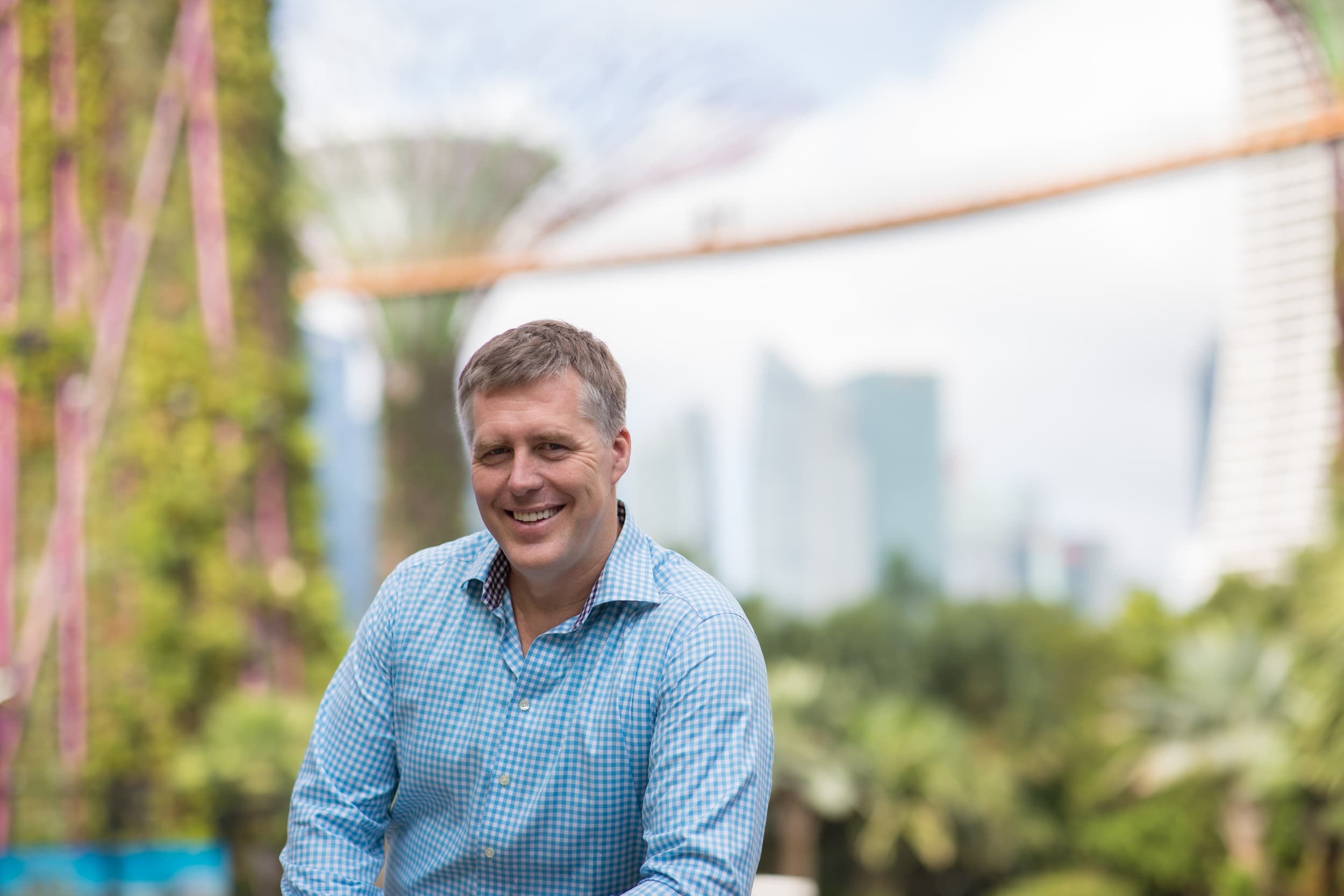
Brett is a four-time founder (Darra Tyres, Gladfish, EzyTrac, Anaboo) and the operator behind AIOS, Anaboo's AI Operating System. He writes from inside the build, installing AI in his own businesses first and reporting back what actually moves the numbers. Based between Singapore, the UK and Australia.