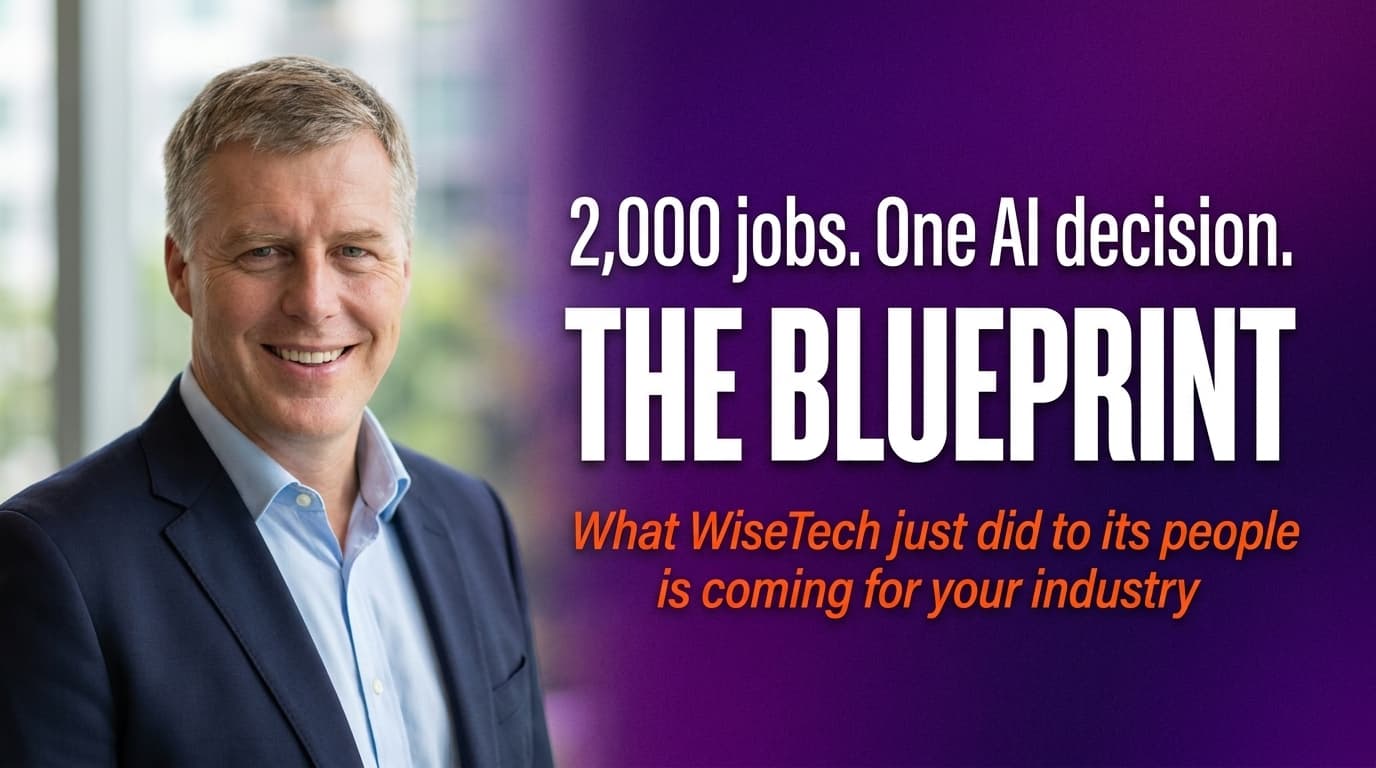
WiseTech's 2,000 AI layoffs are the blueprint every Australian business owner must read
TL;DR
WiseTech Global axed 2,000 workers, nearly a third of its workforce, and CEO Richard White declared the era of writing code "over." The Australian government responded by disbanding its own AI advisory body after spending 15 months and nearly $200,000 establishing it. WiseTech is simultaneously shifting from fixed per-seat licensing to transaction-based pricing, making software costs volatile across entire supply chains. Goldman Sachs and Harvard Business Review data confirm this is a pattern, not an anomaly, and it is already reshaping every industry.
What exactly happened at WiseTech Global?
WiseTech Global, one of Australia's most celebrated tech success stories and a global logistics software leader, cut approximately 2,000 roles in what CEO Richard White framed as an AI-driven strategic pivot. These were not peripheral roles. The affected employees included developers, customer service staff, and project managers: people who had spent years building the very platform that made the company a global powerhouse.
Richard White summed up the corporate logic in one line:
"The era of manually writing code as the core act of engineering is over."
An analyst described the event as a "cost structure reset." The 2,000 people who lost their jobs would probably describe it differently.
Is "the era of writing code is over" just corporate spin?
Largely, yes. What White is actually saying is that AI can now produce code at a fraction of the cost of a human developer. The "craft is over" framing obscures the real decision: shareholder value was placed above the people who built the company.
Think of a master watchmaker told his intricate, handcrafted work is irrelevant because a machine can now stamp out a thousand cheap plastic watches an hour. The function is the same. The craftsman is out of a job. And in this case, the craftsman is also out of a mortgage payment.
Where is the Australian government on AI workforce disruption?
Absent. At precisely the moment WiseTech was making headlines, the Australian federal government quietly scrapped its national AI advisory body, after spending 15 months and nearly $200,000 of taxpayer money establishing it.
Professor Toby Walsh, one of Australia's leading AI researchers, has warned that the country is "dangerously unprepared" for the impact of unregulated AI. That assessment looks understated right now. We are flying blind into the biggest technological storm in a century, and the people paid to install the navigation equipment just sent everyone home.
What is Singapore doing that Australia isn't?
Singapore has established a National AI Council chaired by the Prime Minister. It is proactively investing billions into AI skills, building ethical frameworks, and driving a national strategy to ensure AI serves society rather than purely the bottom line of individual corporations.
The contrast is not subtle. One government is shaping the transition. The other disbanded the committee that was supposed to think about it. This regulatory vacuum in Australia creates a wild west environment where companies are free to make massive, society-altering decisions with zero oversight and zero accountability.
See where AI fits in your business. Free.
A 45-minute audit. We map the highest-value automations and what they're worth in time and money. No pitch, no pressure.
Why does WiseTech's new pricing model matter to your business?
Buried in the announcement was a pricing shift that most commentary missed entirely: WiseTech is moving from per-seat licensing to transaction-based pricing, and this will affect businesses far beyond its direct clients.
Per-seat licensing is simple: ten employees need access, you pay a fixed monthly fee. Predictable. Budgetable. That model is ending.
Transaction-based pricing means you pay for every action the software performs: every invoice raised, every shipment tracked, every report run. There is no ceiling. Your costs fluctuate with your business volume, except the fluctuation is designed to be upward, because the provider has removed the cap.
Other software companies are watching this closely. Your accounting platform, your CRM, your project management tools, they will follow. And when your suppliers face the same volatility in their own software costs, they will have no choice but to pass it on to you.
Is the WiseTech layoff a one-off or an industry-wide blueprint?
It is a blueprint. The data is already showing the pattern:
- Goldman Sachs warns AI-driven displacement could push unemployment as high as 4.5%
- A Harvard Business Review study found 39% of companies surveyed are already cutting headcount as a direct result of their AI initiatives
- WiseTech announced its AI pivot and its job cuts in the same breath, demonstrating that the market will reward this decisiveness
WiseTech has shown every CEO and board that you can eliminate a third of your workforce, call it an AI strategy, and the market, after a brief wobble, will likely reward you. That is the new playbook. It is industry-agnostic. It does not matter whether you are in manufacturing, retail, finance, or professional services. The principles are identical: identify automatable tasks, implement AI, remove headcount, reprice the value you have just created.
Does this affect businesses outside the tech sector?
Directly, yes. Consider your position:
- Your logistics supplier likely uses WiseTech or a competitor. Their cost base is becoming unpredictable, and that instability flows downstream to you in the form of higher, less foreseeable prices.
- Your accountant, solicitor, and marketing agency are all evaluating AI to automate their own workflows. Their headcounts and pricing models are in flux.
- A competitor in your sector adopting an AI-first model and eliminating a significant portion of its labour costs could undercut your pricing before you have had time to respond.
The question is not whether you work in tech. The question is whether you operate in a supply chain, use external services, or compete against companies that will adopt this model. That includes every business in Australia. The ground is shifting beneath your feet, whether you feel it or not.
What to do this week
Audit your software contracts. Identify which tools are on per-seat pricing and find out whether those providers have signalled a move to usage-based or transaction-based models. Do not let a budget surprise catch you off guard.
Map your supply chain exposure. Which of your key suppliers depend on logistics, fulfilment, or enterprise software from WiseTech or comparable platforms? Understand where cost volatility could enter your business before it does.
Have an honest conversation with your team. Not a scaremongering all-hands, but a direct discussion about which tasks in your business are routine and automatable, and which require uniquely human judgement, creativity, and relationships.
Build a reskilling plan. The WiseTech blueprint penalises routine skills and rewards those AI cannot replicate. Invest in the latter. The people who survive this wave will be the ones who made themselves harder to automate.
Monitor your sector actively. If a competitor announces an AI restructure, do not dismiss it as a news item. Read it as a competitive intelligence signal and recalibrate your strategy accordingly.
Ignoring this is not a strategy. It is an abdication of your responsibility as a leader.
Where to from here
Book a free 60-minute AI audit, we'll explore exactly what workflows are worth augmenting with AI.
Live with passion & AI,
Brett
Need an AI operator inside your team?
Place a Chief AI Officer, an AI Officer, or embed an Anaboo Forward Deployed Engineer for 3–6 months.
Frequently asked questions
How many jobs did WiseTech Global cut in its AI restructure?
+
WiseTech Global cut approximately 2,000 roles, nearly a third of its total workforce, as part of a strategic pivot that CEO Richard White linked directly to AI replacing the need for human developers.
What did WiseTech CEO Richard White say about the future of coding?
+
Richard White stated that "the era of manually writing code as the core act of engineering is over, " framing the mass redundancies as a natural consequence of AI capability rather than a cost-cutting decision.
What is transaction-based software pricing and why should businesses care?
+
Transaction-based pricing charges businesses for every action the software performs, every invoice, shipment, or report, rather than a flat fee per user. It removes the cost ceiling, making software budgets unpredictable and likely to scale upward with business activity.
What has the Australian government done about AI-driven workforce disruption?
+
The Australian federal government scrapped its national AI advisory body after spending 15 months and nearly $200,000 of taxpayer money establishing it, leaving the country without formal oversight or policy guidance on AI workforce impacts.
What does the data say about AI-driven layoffs across industries?
+
Goldman Sachs has warned that AI-driven displacement could push unemployment as high as 4.5%. A Harvard Business Review study found that 39% of companies surveyed are already cutting headcount as a direct result of their AI initiatives.
Does the WiseTech AI blueprint apply to businesses outside the technology sector?
+
Yes. The blueprint, automate with AI, cut headcount, shift to transaction-based pricing, is industry-agnostic. Businesses in manufacturing, retail, finance, and professional services face the same disruption through their supply chains, software providers, and competitors.
How is Singapore approaching AI governance compared to Australia?
+
Singapore has established a National AI Council chaired by the Prime Minister, is investing billions in AI skills, and is building ethical frameworks for responsible AI deployment. Australia disbanded its equivalent advisory body during the same period WiseTech's layoffs were making headlines.

Brett is a four-time founder (Darra Tyres, Gladfish, EzyTrac, Anaboo) and the operator behind AIOS, Anaboo's AI Operating System. He writes from inside the build, installing AI in his own businesses first and reporting back what actually moves the numbers. Based between Singapore, the UK and Australia.