80% of your workforce is quietly rejecting AI, and losing 51 days a year
TL;DR
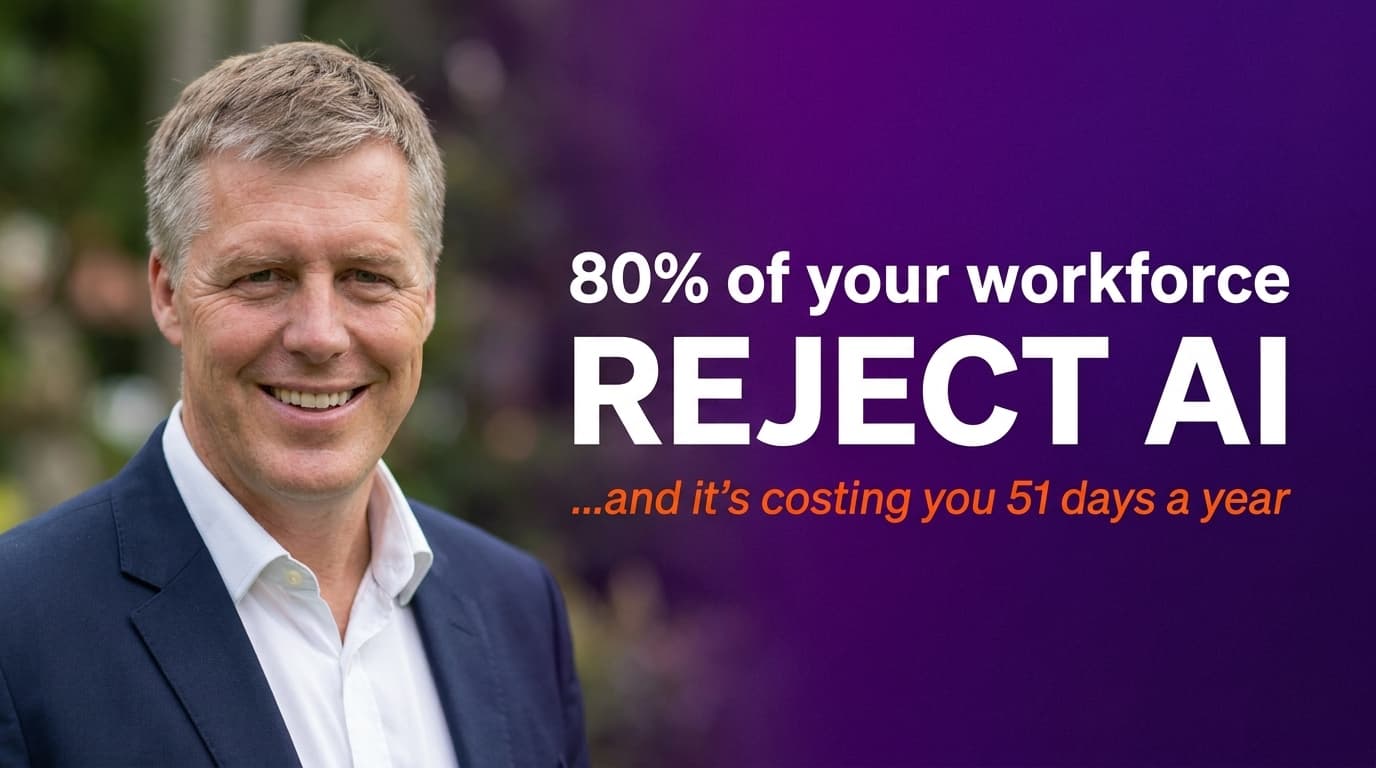
A WalkMe survey of 3,750 executives and employees across 14 countries found that 80% of enterprise workers are actively avoiding or rejecting the AI tools their employers have deployed. Workers are losing 51 working days per year to technology friction, while those using AI correctly are saving 40 to 60 minutes every day. This is not a software problem, it is a leadership and culture problem. And most organisations are still misdiagnosing it.
Why are 80% of your workers rejecting AI?
The WalkMe data is unambiguous. 54% of workers deliberately bypassed their company's AI tools in the past 30 days and completed their work manually instead. Another 33% have not touched AI at all. They knew the tools were there. They knew they were supposed to use them. They chose to do it the hard way anyway.
This is not ignorance. It is a rational response to being handed tools they do not trust, for workflows that were never redesigned, with no clarity on what happens to their role once the system is fully trained.
You are pouring capital into a productivity engine that your workforce is actively sabotaging through sheer indifference.
The sample is not a fringe finding. This is 3,750 people across 14 countries. The pattern holds across industries, geographies, and company sizes.
The 51-day productivity drain
When your team rejects new technology, they do not simply return to the old way of doing things. They create friction. They build workarounds. They spend time fighting the system rather than using it.
The WalkMe research quantifies the cost: workers are losing the equivalent of 51 working days per year to technology friction, incompatible systems, confusing interfaces, and manual workarounds built specifically to avoid the AI tools that were supposed to make their lives easier.
Now contrast that with the upside. Goldman Sachs economists measured what happens when workers actually use the technology correctly: an average saving of 40 to 60 minutes every single day.
The mathematics are symmetrical and brutal:
- Workers using AI effectively: +40 to 60 minutes of output per day
- Workers actively resisting AI: −51 working days per year in friction
- Net effect on a 50-person team with 40 resisters: you are not moving forward, you are being anchored
If your adopters are accelerating and your resisters are entrenching, the internal productivity divide compounds every week. You are running two companies under one roof, one moving into the future, one clinging to 2019.
The generational surprise nobody expected
If you assumed this resistance would come from older workers struggling with new software, you are completely wrong. The resistance is coming from exactly the demographic you expected to lead the charge.
The American Customer Satisfaction Index (ACSI) shows that Generation Z, the cohort that grew up with smartphones in their hands, posts the lowest AI satisfaction score of any generation: a dismal 69 out of 100.
The reason is trust, not fluency. Gen Z spent their formative years watching social media platforms harvest their data, manipulate their attention, and erode their privacy. They are now looking at enterprise AI systems and seeing the exact same playbook. They want transparency. They want to know precisely how their data is being used. A black box that makes decisions for them is not an assistant, it is a threat.
The trust crisis in financial AI
In financial services, the trust deficit is even more acute. The data shows:
- 43% of Americans say their top concern about AI is the loss of human interaction
- 75% say it is critical to know when AI is being used in financial decisions
- 80% believe companies should reimburse them for any mistakes driven by an algorithm
Your employees are also your customers. The scepticism they feel when a bank tries to automate their mortgage application is the exact same scepticism they bring to work when you tell them to use an AI agent to write a client proposal. They do not trust the output, they do not trust the process, and they do not trust that their job will still exist once the system is fully trained.
In Australia, the AICD Director Sentiment Index confirms the tension from the boardroom perspective. More than half of Australian directors now say AI adoption is moving faster than their organisation can keep up with. Almost two-thirds report that AI tools have already delivered productivity benefits, but the gap between what the technology can do and what the workforce is willing to let it do is widening every quarter.
See where AI fits in your business. Free.
A 45-minute audit. We map the highest-value automations and what they're worth in time and money. No pitch, no pressure.
The boardroom illusion: spending is not adoption
So why is there such a massive disconnect between the boardroom and the front line? Because executives are measuring the wrong things.
KPMG's UK market research found that 65% of C-suite executives are no longer measuring traditional return on investment from their AI initiatives. They have declared it a strategic imperative, a cost of doing business in the modern era. 58% of UK organisations plan to invest more than $50 million in AI over the next twelve months, with half of those committing more than $100 million.
They are assuming that deployment equals adoption. It does not.
Deloitte's State of AI Enterprise report confirms this illusion. Only 34% of organisations are genuinely reimagining their business models with AI. The other 66% are bolting a chatbot onto a broken process and calling it digital transformation.
Gartner has put a hard deadline on the consequence: by 2027, 40% of agentic AI projects will fail entirely because companies are trying to automate broken processes instead of redesigning the work itself.
You cannot fix a fundamentally flawed workflow by adding artificial intelligence to it. All you do is make the broken process execute faster, generating more errors at a higher velocity, which your employees then spend hours cleaning up.
No wonder they are rejecting the tools. You are not giving them an assistant; you are giving them a mess-maker.
What the 20% of successful organisations are doing differently
Gartner's research is precise about the blueprint. Organisations reporting successful AI initiatives do not just buy better software. They invest up to four times more capital in foundational areas, data quality, governance, and change management, than their peers.
They treat AI as an operational and cultural problem, not a technology purchase.
Only 39% of technology leaders are currently confident their AI investments will deliver a positive financial impact. But organisations with the highest maturity in data and analytics capabilities are achieving up to 65% greater business outcomes, including revenue growth and severe cost optimisation.
Rita Sallam, Gartner Fellow and Chief of Research, put it plainly: "The future is not about replacing humans, but amplifying their ingenuity."
The winning model is what Gartner calls decision pods, small, cross-functional teams of one technical person and one business person, augmented by AI agents. Not replacing the workforce. Redesigning it from the ground up.
Singapore and Australia: the same story everywhere
HubSpot's Singapore study found 64% of businesses applying AI consistently across daily workflows, yet only 18% are using fully autonomous AI agents. The top barriers: data quality and integration challenges (37%) and trust and reliability concerns (43%). The tools are there. The willingness is not.
In Australia, the AICD data reinforces the same structural tension. The productivity benefits are acknowledged at the top. The workforce adoption is lagging at every level below it. This is not a regional quirk. It is a global pattern that surfaces wherever AI is deployed without the right cultural and data foundations.
What to do this week
1. Audit your data foundations. If you are feeding poor-quality data into an advanced language model, you will get highly articulate garbage out. Your team will see it, lose confidence immediately, and abandon the tools permanently. Invest the time and capital to clean your data, establish rigorous governance, and build outputs your people can actually trust.
2. Redesign the work, not just the task. Do not ask how AI can do the current steps faster. Ask how AI can eliminate the need for those steps entirely. Workflow redesign is the actual intervention. Bolting automation onto a broken process is not transformation, it is acceleration of the wrong thing.
3. Address the fear directly and explicitly. Be clear with your team about what AI means for their future. If the goal is to free them from administrative drudgery so they can focus on high-value strategic work, prove it, through training, support, and demonstrated outcomes. Show them that their value to the business lies in their judgement, not their ability to process spreadsheets. A memo is not proof. Results are.
The companies that get this right will accelerate away from the competition at a pace we have not seen before. The ones that keep forcing broken tools onto a sceptical workforce will keep bleeding 51 days of lost productivity per employee, per year, and wondering why their AI strategy is not delivering.
Where to from here
Book a free 60-minute AI audit, we'll explore exactly what workflows are worth augmenting with AI.
Live with passion & AI,
Brett
Need an AI operator inside your team?
Place a Chief AI Officer, an AI Officer, or embed an Anaboo Forward Deployed Engineer for 3–6 months.
Frequently asked questions
Why are employees rejecting AI tools at work?
+
According to a WalkMe survey of 3,750 executives and employees across 14 countries, 54% of workers deliberately bypassed their company's AI tools in the past 30 days and worked manually instead. The core reasons are distrust of outputs, workflows that were never redesigned, and fear that teaching the system their job will make them redundant.
How many working days per year are lost to AI friction?
+
The WalkMe data found that workers are losing the equivalent of 51 working days per year to technology friction, incompatible systems, confusing interfaces, and manual workarounds built specifically to avoid AI tools.
Which generation is most resistant to AI in the workplace?
+
Contrary to expectations, Generation Z posts the lowest AI satisfaction score of any generation, a 69 out of 100 according to the American Customer Satisfaction Index (ACSI). Their scepticism stems from distrust of data practices, not lack of digital fluency.
What do successful AI organisations invest in differently?
+
Gartner's research found that organisations reporting successful AI initiatives invest up to four times more capital in foundational areas, data quality, governance, and change management, than their peers. The winners treat AI as an operational and cultural problem, not a technology purchase.
Why do agentic AI projects fail?
+
Gartner predicts that by 2027, 40% of agentic AI projects will fail entirely because companies are automating broken processes rather than redesigning the work itself. Adding AI to a flawed workflow makes the broken process execute faster, generating more errors at higher velocity.
What is a 'decision pod' in AI strategy?
+
A decision pod is a model identified by Gartner in which organisations build small, cross-functional teams comprising one technical person and one business person, augmented by AI agents. The intent is workforce redesign, not workforce replacement.
What are the biggest barriers to AI adoption in Singapore?
+
HubSpot's Singapore study found that 37% of respondents cite data quality and integration challenges as their top barrier, while 43% cite trust and reliability concerns. Only 18% of Singaporean businesses are using fully autonomous AI agents despite 64% applying AI consistently across daily workflows.

Brett is a four-time founder (Darra Tyres, Gladfish, EzyTrac, Anaboo) and the operator behind AIOS, Anaboo's AI Operating System. He writes from inside the build, installing AI in his own businesses first and reporting back what actually moves the numbers. Based between Singapore, the UK and Australia.