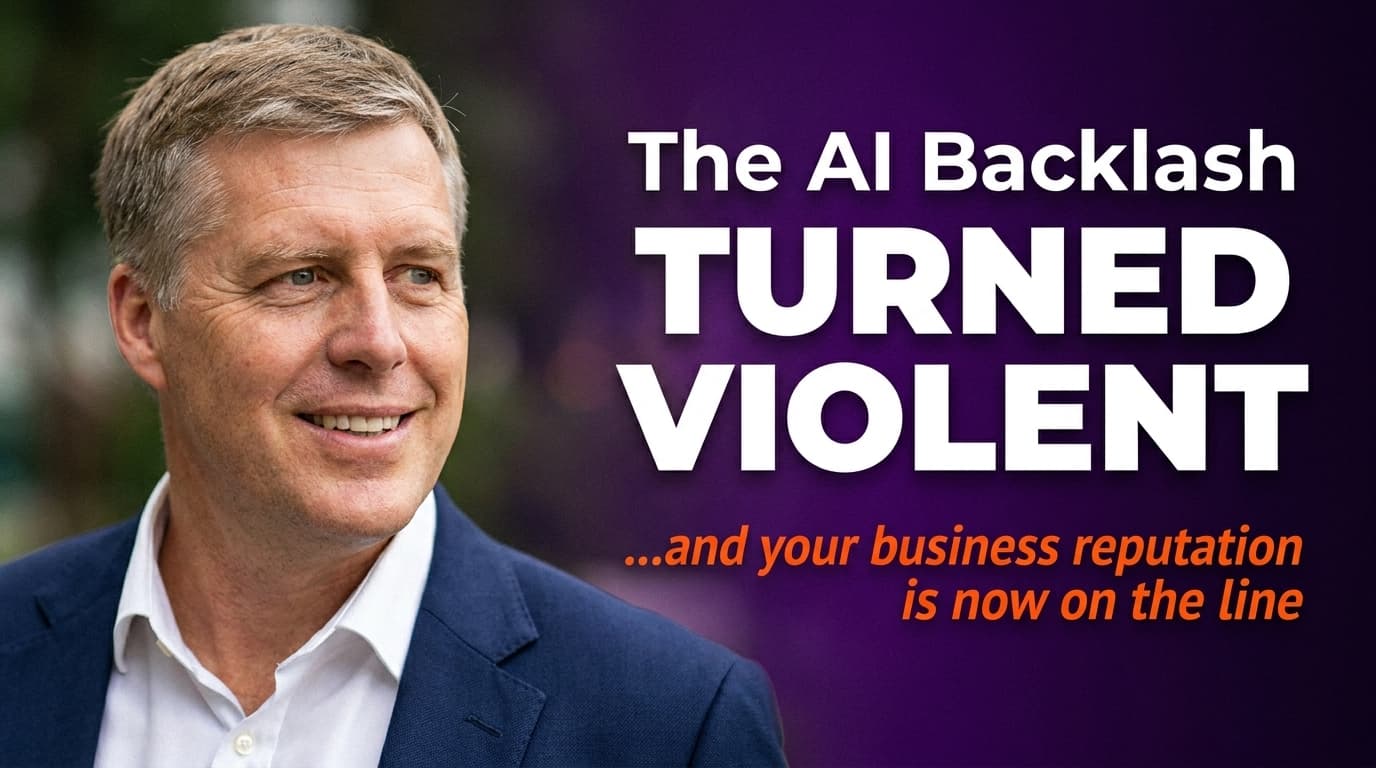
AI backlash turns violent: what every business leader must do now
TL;DR
Sam Altman's home was firebombed. Two more shootings followed within 72 hours. A new Gallup poll shows nearly half of Gen Z is afraid of AI. Meanwhile, nine out of ten companies have employees quietly feeding proprietary data into unsanctioned tools every single day. The AI backlash is no longer a PR nuisance. It is a security risk, a culture crisis, and a board-level issue for every business deploying these tools.
What just happened at OpenAI's front door?
A twenty-year-old named Daniel Moreno-Gama travelled from Spring, Texas, to Sam Altman's $27 million Pacific Heights home and threw an incendiary device at the gate. Approximately an hour later he was arrested outside OpenAI's headquarters, allegedly trying to smash through the building's glass doors with a chair and threatening to burn the facility to the ground. He now faces state charges of attempted murder and federal charges that may include domestic terrorism. Authorities found a manifesto warning of humanity's "extinction" at the hands of AI.
The following day, two more men, aged twenty-three and twenty-five, were arrested for discharging a firearm near the same property. Three attacks in three days.
This is not just isolated extremism. It is the violent tip of a much broader, rapidly growing sentiment that is reshaping how the public views the technology your business depends on.
What does the public actually think about AI right now?
A newly released Gallup poll paints a stark picture:
- Less than a fifth of Gen Z feels hopeful about artificial intelligence
- A full third say the technology makes them actively angry
- Nearly half say it makes them afraid
These are the people you are trying to recruit, sell to, and build products for. The anger is not irrational. It is rooted in brutal economic reality. Bloomberg reports that forty-three percent of young graduates are "underemployed, " meaning they are forced into jobs that require less education than they have. AI was cited as the direct cause of over 55,000 job cuts in the United States last year alone, a twelve-fold increase from just two years prior. Companies are actively using AI as leverage to cut headcount while maintaining output, and Wall Street is rewarding them for it.
Tech leaders like Altman publicly promise a future where "people will barely need to work" and where the economy will be "almost frictionless." Your employees are watching those promises while struggling to pay rent in an economy with stubborn inflation and record-low consumer confidence. The gap between the utopian vision and the lived reality is a tinderbox, and someone just threw a match.
How serious is the data centre rebellion?
The backlash is not only about jobs. It is about the physical infrastructure that AI requires, and communities across the United States and increasingly around the world are pushing back harder than anyone in Silicon Valley anticipated.
According to a comprehensive report from Data Center Watch:
- At least $18 billion worth of data centre projects have been blocked
- A further $46 billion has been delayed over the past two years
- Twenty-five projects were cancelled following community pushback in 2025 alone, four times the number in 2024
- Twenty-one of those cancellations came in the second half of the year as electricity costs escalated
- At least 142 activist groups are now operating across twenty-four US states
- Water use is cited as a top concern in more than forty percent of contested projects
This week, the State of Maine passed the first-in-the-nation legislative ban on new data centres. The concerns driving this resistance are not abstract fears about superintelligence. They are kitchen-table issues: higher utility bills, massive water consumption, noise pollution, impacts on property values, and the destruction of green space.
When you rely on cloud-based AI services, you are implicitly tying your business to an industry facing unprecedented community pushback and regulatory scrutiny. If data centres cannot be built, or if their energy and water usage is taxed or restricted, the cost of running your AI operations will increase significantly. Your operational costs are now linked to political battles being fought in town halls thousands of kilometres away.
See where AI fits in your business. Free.
A 45-minute audit. We map the highest-value automations and what they're worth in time and money. No pitch, no pressure.
What is the shadow AI economy running inside your company?
While the external backlash rages, a different kind of rebellion is happening inside your own business, and most leaders have no idea.
A major study highlighted by the Harvard Business Review reveals the true scale of the problem. While only forty percent of companies have purchased official large language model subscriptions, employees from over ninety percent of those companies report using personal AI tools for work tasks on a regular basis. That is not a typo. Nine out of ten companies have employees feeding proprietary data into public AI models every single day, without enterprise security, without data retention policies, and without any audit trail whatsoever.
Your team is frustrated by clunky corporate systems, slow decision-making, and endless governance committees, so they are bypassing you entirely. They have personal ChatGPT or Claude tabs open right next to your proprietary company data. They are drafting client proposals, analysing financial reports, and summarising confidential meeting notes using tools that have zero enterprise-grade controls.
Banning these tools does not work. It simply drives the behaviour underground and makes it invisible. The companies that succeed will be the ones that acknowledge the demand and provide secure, managed, enterprise-grade alternatives that are genuinely better than what employees can access on their own.
How did BBVA turn shadow AI into a competitive advantage?
BBVA recognised the scale of shadow AI usage and moved aggressively, deploying a secure, exclusive instance of ChatGPT Enterprise across the organisation.
Critically, they did not force it on everyone with a mandate from the CEO. They gave licences to motivated "Champions" within each business unit and built a peer-to-peer support network. The results speak for themselves:
- Scaled from 3,000 to 11,000 active users in under a year
- Eighty-three percent weekly usage rates
- Employees saving an average of two to five hours per week
- Over 4,800 custom internal GPTs built by employees for their specific workflows
They turned a massive security liability into a company-wide productivity engine by meeting their employees where they already were, rather than dragging them somewhere they did not want to go.
Why will the ultimatum approach destroy your culture?
Unfortunately, many leaders are taking the exact opposite approach. A global study of 2,400 leaders and employees found that sixty percent of companies are willing to fire workers who refuse to adopt AI tools. Seventy-seven percent of executives said they would not consider AI-resistant employees for promotions.
This top-down, authoritarian approach to technology adoption is a recipe for cultural disaster.
When you threaten an employee's livelihood over the adoption of a tool they may not understand, trust, or find useful, you do not get genuine productivity. You get performative compliance. People pretend to use the tool to keep their jobs while quietly doing the real work the old way. You breed resentment, anxiety, and exactly the kind of anti-AI sentiment that is fuelling the broader societal backlash. Your own employees become part of the resistance.
Duolingo's CEO learned this the hard way last week, publicly backing away from a policy that evaluated employees based on their AI usage after it generated significant internal pushback. He admitted that forcing AI adoption through performance reviews was counterproductive and that AI-generated code "can be difficult to debug." If one of the most tech-forward companies in the world cannot mandate AI adoption without blowback, what makes anyone think a mid-sized accounting firm or logistics company can?
You cannot mandate innovation. You cannot force people to trust a system they believe might eventually replace them.
What to do this week
1. Acknowledge the anxiety, publicly and internally. Do not dismiss the fears of younger employees or customers as Luddite paranoia. The fear is real, the economic pressure is real, and the anger is real. If you are implementing AI purely as a headcount-cutting mechanism, your team will know, and they will resist. Position AI as a tool that removes drudgery and creates higher-value opportunities for your staff. Say it publicly. Mean it.
2. Audit your shadow AI exposure today. Your people are already pasting sensitive client data into public chatbots. Do not wait for a perfect top-down strategy. The data leakage risk is happening right now, while you read this. Identify which unsanctioned tools are in use and move immediately to provide secure, ring-fenced enterprise alternatives within an environment you control and can audit.
3. Stop issuing mandates. Start building champions. Find the employees in your organisation who are already experimenting with AI and empower them to teach their peers. Adoption happens fastest when it is peer-to-peer, not when it is dictated from the C-suite. Create internal communities of practice, celebrate early wins, and let momentum build organically.
4. Map your AI cost exposure to political risk. If your AI operations rely heavily on cloud infrastructure, model what happens to your costs if data centre expansion is blocked, taxed, or restricted in key jurisdictions. Build that scenario into your planning now, not after the bill arrives.
Where to from here
Book a free 60-minute AI audit and we'll explore exactly what workflows are worth augmenting with AI.
Live with passion & AI,
Brett
Need an AI operator inside your team?
Place a Chief AI Officer, an AI Officer, or embed an Anaboo Forward Deployed Engineer for 3–6 months.
Frequently asked questions
What happened at Sam Altman's home in San Francisco?
+
A twenty-year-old named Daniel Moreno-Gama travelled from Spring, Texas, and threw an incendiary device at Altman's $27 million Pacific Heights home. An hour later he was arrested outside OpenAI's headquarters allegedly trying to smash through the doors with a chair. He faces state charges of attempted murder and potential federal domestic terrorism charges. Two more men were arrested the following day for discharging a firearm near the same property. Three attacks in three days.
What does Gen Z actually think about AI right now?
+
A newly released Gallup poll found that less than a fifth of Gen Z feels hopeful about artificial intelligence, a full third say it makes them actively angry, and nearly half say it makes them afraid. This is the generation businesses are trying to recruit, sell to, and build products for.
How widespread is shadow AI inside companies?
+
A major study highlighted by the Harvard Business Review found that while only forty percent of companies have purchased official large language model subscriptions, employees from over ninety percent of those companies report using personal AI tools for work tasks regularly. Nine in ten companies have employees feeding proprietary data into public AI models every day, with no enterprise security, data retention policies, or audit trail.
How did BBVA handle its shadow AI problem?
+
BBVA deployed a secure, exclusive instance of ChatGPT Enterprise and gave licences to motivated internal Champions rather than issuing a top-down mandate. They scaled from 3,000 to 11,000 active users in under a year, achieved eighty-three percent weekly usage rates, and saw employees save two to five hours per week. Staff built over 4,800 custom internal GPTs for their specific workflows.
What percentage of companies will fire employees who refuse to use AI?
+
A global study of 2,400 leaders and employees found that sixty percent of companies are willing to fire workers who refuse to adopt AI tools. Seventy-seven percent of executives said they would not consider AI-resistant employees for promotions.
How much data centre investment has been blocked or delayed by community opposition?
+
According to Data Center Watch, at least $18 billion worth of data centre projects have been blocked and a further $46 billion delayed over the past two years. Twenty-five projects were cancelled in 2025 alone, four times the number cancelled in 2024, with 142 activist groups now operating across twenty-four US states. Maine became the first US state to pass a legislative ban on new data centres.
Why did Duolingo's CEO walk back its AI adoption policy?
+
Duolingo's CEO publicly reversed a policy that evaluated employees based on their AI usage after it generated significant internal pushback. He admitted that forcing AI adoption through performance reviews was counterproductive and that AI-generated code can be difficult to debug.

Brett is a four-time founder (Darra Tyres, Gladfish, EzyTrac, Anaboo) and the operator behind AIOS, Anaboo's AI Operating System. He writes from inside the build, installing AI in his own businesses first and reporting back what actually moves the numbers. Based between Singapore, the UK and Australia.