Australia's sovereign AI factory ends the data sovereignty excuse
TL;DR
Australia has launched a Sovereign Secure AI Factory built on 1,024 NVIDIA Blackwell Ultra GPUs, housed in NEXTDC data centres, and operated in partnership with Cisco and Sharon AI. Every byte of data stays onshore under Australian law. Sandboxed, pay-as-you-go access means this is not a facility reserved for the big end of town. The data sovereignty excuse is officially dead. The only question now is what you are going to do about it.
What exactly is the Sovereign Secure AI Factory?
This is not a press release padded with corporate jargon. Cisco, Sharon AI, and NVIDIA have partnered to install 1,024 of NVIDIA's Blackwell Ultra GPUs inside NEXTDC data centres on Australian soil. That is more specialised AI computing power concentrated in one place than existed in the entire country just a few years ago. It is high-performance, sovereign, purpose-built infrastructure for the most demanding AI workloads. And it is live.
This is nation-building infrastructure. The kind that changes the economic weather. It will ripple through every sector of the economy for the next decade.
Why has data sovereignty been the perfect excuse?
For years, data sovereignty has been the go-to reason for sitting on the sidelines. Sending sensitive customer data offshore (to servers in California or Frankfurt) was a legitimate blocker, particularly for businesses in finance, healthcare, and government. The concern was real.
It was also enormously convenient. It gave cautious decision-makers a plausible, defensible reason to delay indefinitely. The corporate equivalent of saying the dog ate your homework.
The dog has been put down.
The infrastructure is now onshore, governed by Australian privacy law, and ready to use. That excuse is gone.
What does this mean for finance, healthcare, and government?
For finance: transaction data can now be analysed for fraud detection at scale without a single byte leaving the country. Credit risk models can be built on local economic conditions, sharper and more relevant than any globally-trained model ever could be. You can innovate without privacy concerns as a handbrake.
For healthcare: diagnostic tools built on local patient data, informed by the genetic and environmental factors specific to Australians. Predictive models for disease outbreaks, with all sensitive patient information protected under Australian law and standards.
For government: power grid optimisation, national security operations, predictive public services, all with complete confidence in data integrity.
The risk of sending data offshore was a legitimate blocker. It has been completely and utterly demolished.
What does Deloitte's research say about Australian AI adoption?
A Deloitte report on AI adoption in Australia found that Australian businesses are being "cautious" and "measured" in their approach. While the rest of the world is in a flat-out sprint, we are still tying our shoelaces, checking the weather, and debating which track to run on.
Being "measured" sounds responsible. In the context of a technological revolution, it is just another way of saying you are willing to be left behind. The gap between the leaders and the laggards is about to become a chasm. The view from the bottom of a chasm is not pretty.
The reluctance is not just about awareness. There is a cultural problem at play here: a deep-seated fear of failure, a tendency to wait for someone else to prove a concept before dipping a toe in the water. In AI, the winners are the ones willing to experiment, fail fast, and learn. The cost of inaction is far greater than the cost of a failed experiment.
See where AI fits in your business. Free.
A 45-minute audit. We map the highest-value automations and what they're worth in time and money. No pitch, no pressure.
The logistics MD who is "watching it closely"
Brett spoke with the managing director of a mid-sized logistics company: 20 years running the family business, experienced, sharp. Asked about his AI strategy, the MD gave a wry smile and said: "We're watching it closely. Don't want to jump the gun."
The gun went off two years ago.
Meanwhile, a competitor of his in the US is using AI to predict shipping delays, optimise truck routes in real-time using live traffic and weather data, and slash fuel costs by 15%. They are not watching. They are winning. And now, with sovereign infrastructure onshore, his local Australian competitors have the same tools, probably for a lower cost.
The story repeats across every sector. Retailers are manually managing inventory, completely unaware that AI could predict demand with startling accuracy and save them millions in carrying costs. Professional services firms are drowning in paperwork that AI could summarise and extract in seconds. Caution is no longer a viable strategy. It is a liability.
You do not need to buy the factory: sandboxed environments explained
Here is what matters most for businesses that are not a multinational or a major bank. The Secure AI Factory includes sandboxed environments: isolated, secure computing spaces you can spin up on demand, load with your data, and use to build and test AI models.
You do not buy the factory. You book time in it. Think of it like electricity: you do not need to own a power station to use the grid. You plug in, do your work, and unplug. The AI grid is now live in Australia.
For a fraction of what this capability would have cost just a few years ago, a 50-person business in Wollongong can now access the same level of computing power as a global tech company. The playing field has not just been levelled. It has been completely redrawn.
Sandboxed environments allow rapid iteration: test an idea, see if it works, pivot if it does not, without investing a fortune in hardware. This is how 21st-century innovation operates. It is not about having one big idea; it is about having a hundred small ones and testing them all. The next game-changing AI application could come from a startup in a garage in Wollongong, not a lab in Silicon Valley.
What will your competitors build with this?
This is not a threat. It is a certainty. The smart ones are already on the phone booking their spot. They are going to build systems that make their sales process more efficient, their marketing more targeted, their operations more streamlined, and their customer service more responsive, using Australian data, under Australian law, at lower cost than ever before.
Consider what becomes possible:
- A competitor who knows which of your customers is about to leave and automatically triggers a retention offer before you even notice
- A marketing engine that knows exactly what to offer a customer at exactly the right time
- Operational efficiencies that allow them to undercut your pricing by 10% while holding their margins
- Customer service that responds faster and more accurately than any human team can manage at scale
This is not science fiction. This is what the infrastructure makes possible, right now.
And this is not about replacing your staff with robots. It is about augmenting their capabilities, freeing them from the mundane, repetitive work so they can focus on what they do best: thinking creatively, building relationships, solving complex problems.
What to do this week
The infrastructure is live. The excuses are gone. Here is where to start:
- Pick one problem. Identify one process in your business that is slow, manual, or error-prone. That is your AI pilot. Start there, not everywhere at once.
- Audit your data. What data do you already hold that could feed an AI model? Customer records, transaction history, operational logs: it is probably sitting there unused.
- Explore sandbox access. Reach out to NEXTDC or one of the facility's access partners to understand the cost and process for a sandboxed environment. The entry cost is lower than you think.
- Stop waiting for proof. The Deloitte report says Australian businesses are being cautious. Do not be the case study that validates that finding.
- Move before the window closes. The opportunity to build a meaningful lead over your competitors is open right now. It will not stay open forever.
Where to from here
Book a free 60-minute AI audit and we'll explore exactly what workflows are worth augmenting with AI.
Live with passion & AI,
Brett
Want this installed in your business?
Bespoke AI implementation across your operations: strategy, build, rollout, and ongoing drift maintenance.
Frequently asked questions
What is Australia's Sovereign Secure AI Factory?
+
It is a high-performance AI computing facility built through a partnership between Cisco, Sharon AI, and NVIDIA, housing 1,024 NVIDIA Blackwell Ultra GPUs inside NEXTDC data centres on Australian soil. It is purpose-built for secure, onshore AI workloads at scale.
Who built Australia's sovereign AI infrastructure?
+
The facility is a partnership between Cisco, local operator Sharon AI, and NVIDIA, hosted inside NEXTDC data centres in Australia.
Can small businesses access the Sovereign Secure AI Factory?
+
Yes. The facility offers sandboxed environments (isolated, pay-as-you-go computing spaces) so businesses of any size can build and test AI models without owning any hardware. You book time; you do not buy the factory.
What is a sandboxed AI environment?
+
A sandboxed environment is a secure, isolated computing space you spin up on demand, load with your own data, and use to build or test AI models. You pay for the time you use, not the infrastructure underneath it.
What did the Deloitte report find about AI adoption in Australia?
+
A Deloitte report on AI adoption in Australia found that Australian businesses are being "cautious" and "measured" in their approach, while competitors globally are accelerating. In the context of a technological revolution, cautious is another word for falling behind.
How does onshore AI infrastructure solve the data sovereignty problem?
+
With computing infrastructure inside Australian data centres, data never crosses a border and remains fully under Australian privacy law. That removes the core objection that has kept most local businesses on the sidelines.
Which industries benefit most from Australia's sovereign AI factory?
+
Finance, healthcare, and government stand to gain most immediately. Fraud detection, credit modelling, diagnostic tools, and public service optimisation can all now be built on sensitive local data without any offshore exposure.
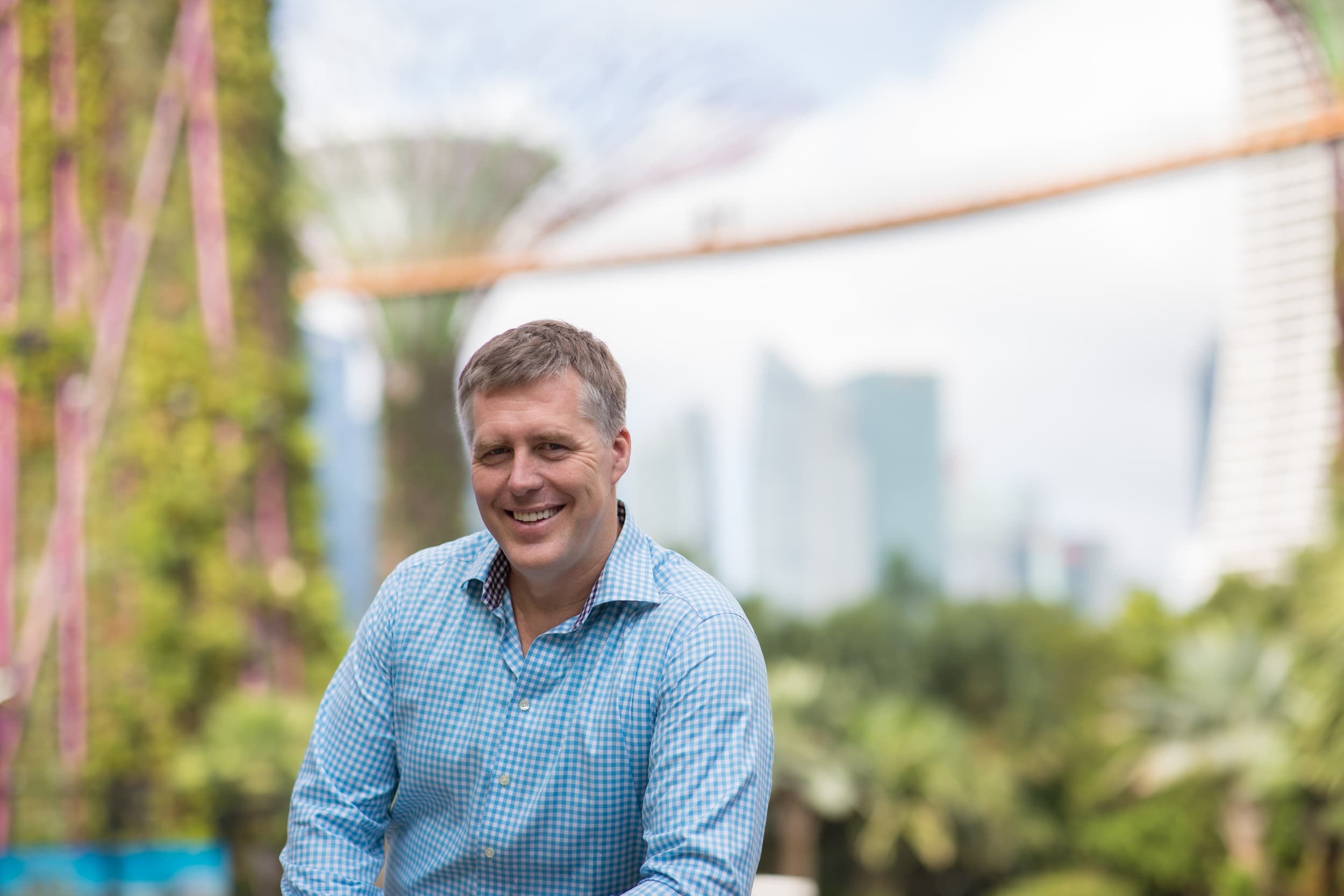
Brett is a four-time founder (Darra Tyres, Gladfish, EzyTrac, Anaboo) and the operator behind AIOS, Anaboo's AI Operating System. He writes from inside the build, installing AI in his own businesses first and reporting back what actually moves the numbers. Based between Singapore, the UK and Australia.