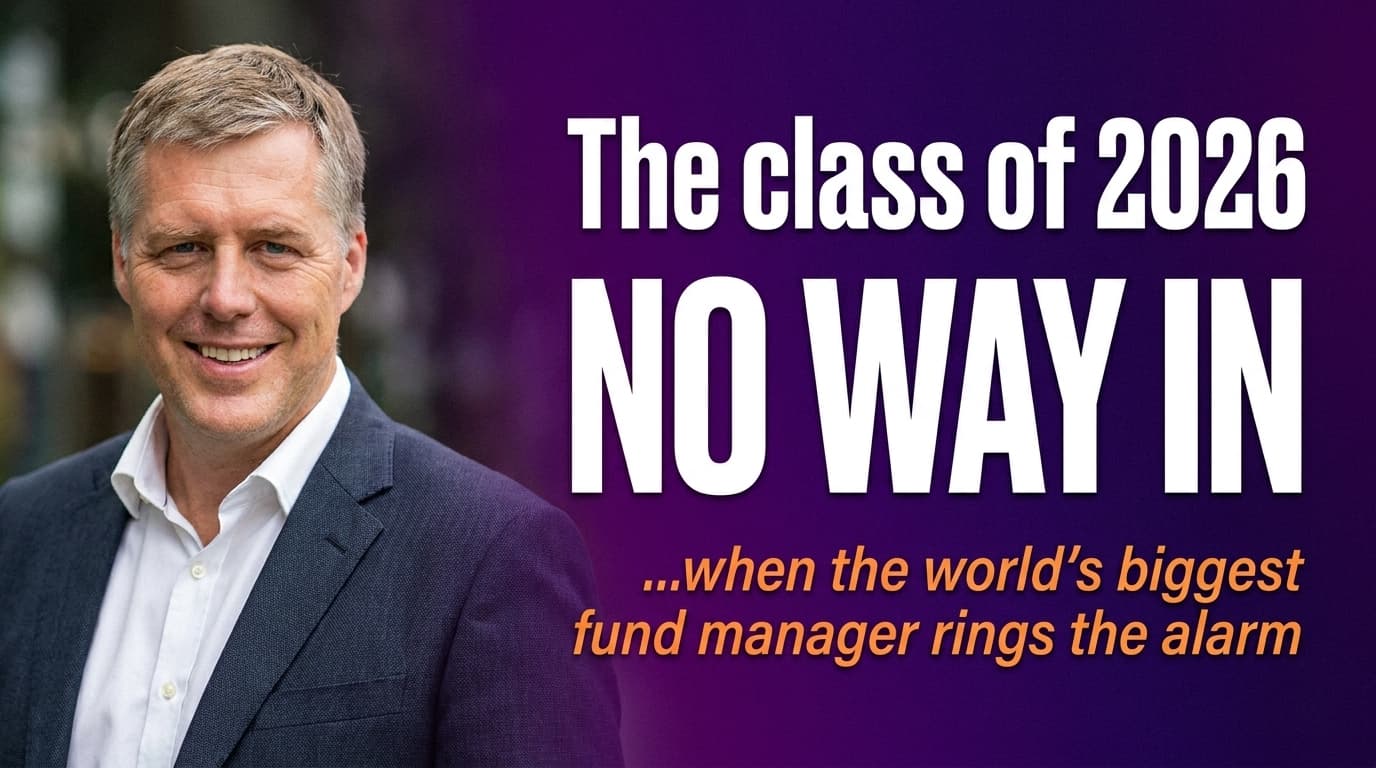
BlackRock's CEO says the entry-level job market is in structural collapse
TL;DR
Larry Fink, CEO of BlackRock, the world's largest asset manager, is warning that the class of 2026 may face the worst graduate job market in decades. This isn't about mass unemployment; it's about the systematic erasure of the first rung on the career ladder. Goldman Sachs estimates 300 million jobs are exposed to AI automation, and the entry-level roles that once trained every junior hire are first in line. The talent pipeline your business has relied on for decades is already seizing up.
Why is Larry Fink worried about the class of 2026?
Larry Fink isn't known for hyperbole. As CEO of BlackRock, the firm managing more assets than any other on earth, when he says the class of 2026 could be staring down the worst job market in decades, the statement carries weight. He's looking at structural data, not sentiment.
The issue isn't a headline collapse in employment. It's subtler and more dangerous: the entry-level job market is being systematically dismantled before most businesses have noticed. The traditional path, degree, graduate role, learn the ropes, work your way up, is breaking.
What does Goldman Sachs say about AI and jobs?
Goldman Sachs estimates that 300 million jobs are exposed to AI automation, not necessarily eliminated outright, but fundamentally changed. The tasks at greatest risk are the repetitive, process-heavy roles: data entry, basic analysis, report generation, the very work businesses have always given to junior hires to build their skills.
Consider what this means in practice. A bright graduate who a few years ago would have walked straight into a junior analyst role now sends out a hundred applications and hears nothing. The grunt work that used to be her training ground has been automated. Companies are now looking for people who can manage the AI doing that work, and that requires experience she simply doesn't have yet.
The pipeline that has fed your business with talent for decades is seizing up.
The result is a no-man's-land: graduates armed with degrees but with no entry point into the professional world.
What is Singapore's experience telling us about the future of work?
Singapore offers the clearest preview of where this leads. The country has invested billions in AI infrastructure, built world-leading capabilities, and cultivated one of the most tech-savvy populations on earth. And yet its graduate employment rate is falling.
The Singaporean government recognised early that their workforce was splitting into two camps: a small elite with in-demand AI skills, and a much larger group whose qualifications were becoming obsolete. Their response, the SkillsFuture initiative, is a massive, nationwide retraining programme designed to re-skill an entire population on the fly. It's a national emergency being treated as such, with investment flowing into vocational training, apprenticeships, and lifelong learning.
The lesson is stark: even a country with Singapore's resources, foresight, and highly educated workforce is struggling. The problem isn't a lack of intelligence or ambition. It's that the skills valuable yesterday are not the skills valuable today, and the pace of change is relentless enough that retraining for one technology is no guarantee of relevance when the next arrives.
See where AI fits in your business. Free.
A 45-minute audit. We map the highest-value automations and what they're worth in time and money. No pitch, no pressure.
Is there really a 56% wage premium for AI-skilled workers?
Yes. Businesses competing for workers with genuine AI skills are paying a premium of over 56%. That's not a rounding error, it's a structural distortion reshaping the labour market.
For a small or medium-sized business, this creates an impossible position:
- Entry-level roles are being automated out of existence
- AI-skilled senior professionals command salaries that most SMEs simply cannot match
- The thin pool of qualified talent is snapped up by large firms before smaller businesses can table an offer
The result is a two-tier economy where the giants get stronger and everyone else competes for scraps. This isn't a skills gap that a better job ad will close. It's a skills chasm, and the only way across is to stop trying to hire your way out of it.
Why can't SMEs compete for AI talent the way large firms do?
Because the game is rigged against you if you play it that way. Searching for a "Machine Learning Engineer" or a "Data Scientist", narrowly defined roles with astronomical salary expectations, puts you directly in competition with organisations that have budgets you cannot match.
The answer isn't to compete on those terms. It's to change the rules of engagement entirely. The businesses that will thrive aren't the ones with the biggest chequebooks, they're the ones that build their own capability pipeline. That means developing AI skills within your existing team, creating a genuine culture of continuous learning, and giving people a visible path forward. That's not a soft HR aspiration; it's a hard strategic necessity.
Why is this a strategic crisis, not an HR problem?
Most businesses make the mistake of treating this as a recruitment challenge and handing it to HR. It isn't. It's a strategic-level threat to the viability of your existing business model.
Your business is facing a pincer movement. At the bottom end, the junior roles that have always been your training ground are being automated out. At the top end, the senior AI talent that could solve your capability problems costs more than you can afford. You're squeezed in the middle, with a business to run, a team to stretch, and no easy path to the talent you need.
The response has to be strategic:
- Stop thinking in terms of roles and start thinking in terms of capabilities
- Shift from consuming talent to producing it, build skills within your existing team
- Create a culture of continuous learning with clear development paths
- Treat your talent pipeline as a product you build, not a resource you purchase
The businesses that build their own talent pipeline, rather than waiting for the market to supply one, are the ones with options. The market isn't going to provide for you in the way it once did.
What to do this week
Audit your entry-level roles. List every task your junior hires spend more than two hours a week on. Flag anything that could be partially or fully automated in the next 12 months. That's your exposure map.
Map your AI capability gap. Don't search for a job title. Ask instead: which decisions in my business would benefit most from better data, prediction, or automation? Who internally is closest to being able to support that?
Study the Singapore SkillsFuture model. Not to copy it directly, but to understand what a serious, organisation-wide commitment to continuous upskilling actually looks like in practice.
Stop waiting for the market to supply candidates. Build one internal AI capability at a time. Identify the most repetitive, high-volume task in your team and find the tool that handles 80% of it, freeing a person to move up a rung on their own ladder.
Read the primary sources. The Goldman Sachs and BlackRock public communications are clear. The businesses acting on this signal now will be the ones with strategic options in 2027.
Where to from here
Book a free 60-minute AI audit, we'll explore exactly what workflows are worth augmenting with AI.
Live with passion & AI,
Brett
Need an AI operator inside your team?
Place a Chief AI Officer, an AI Officer, or embed an Anaboo Forward Deployed Engineer for 3–6 months.
Frequently asked questions
What did BlackRock CEO Larry Fink say about the class of 2026?
+
Larry Fink warned that the class of 2026 could face the worst graduate job market in decades, not because of mass unemployment, but because the entry-level roles that have always been the first rung on the career ladder are being systematically automated out of existence.
How many jobs does Goldman Sachs say are exposed to AI automation?
+
Goldman Sachs estimated that 300 million jobs globally are exposed to AI automation. They are not necessarily eliminated, but fundamentally changed, with repetitive entry-level tasks such as data entry, basic analysis, and report generation at greatest risk.
Why is Singapore's graduate employment rate falling despite its AI investment?
+
Singapore has invested billions in AI infrastructure and cultivated one of the most tech-savvy workforces on earth, yet graduate employment rates are declining because the workforce has bifurcated into a small AI-skilled elite and a much larger group with increasingly obsolete qualifications. The government launched the SkillsFuture initiative as a nationwide response, funding vocational training, apprenticeships, and lifelong learning.
What is the wage premium for workers with AI skills?
+
Workers with genuine AI skills currently command a wage premium of over 56%, making it extremely difficult for small and medium-sized businesses to compete against large corporates for the same talent.
What is the pincer movement facing SMEs in the AI talent market?
+
SMEs face automation eliminating entry-level roles at the bottom of the talent ladder while the 56% AI skills premium prices them out of senior AI talent at the top, leaving them squeezed in the middle with no affordable path to build the capabilities they need.
Why is the graduate jobs crisis a strategic problem, not just an HR issue?
+
The talent pipeline most businesses have depended on for decades is breaking. This isn't a recruitment problem solvable with better job ads; it's a structural shift that requires businesses to stop consuming talent and start producing it, building capabilities internally rather than relying on the market to supply them.
What should businesses do now to prepare for the entry-level job market collapse?
+
The priority is to audit which junior roles are most exposed to automation, map internal AI capability gaps without defaulting to expensive specialist job titles, and begin building a culture of continuous learning. The businesses building their own talent pipelines now will have options in 2027; those waiting for the market to recover may not.

Brett is a four-time founder (Darra Tyres, Gladfish, EzyTrac, Anaboo) and the operator behind AIOS, Anaboo's AI Operating System. He writes from inside the build, installing AI in his own businesses first and reporting back what actually moves the numbers. Based between Singapore, the UK and Australia.