Your graduate hire just lost their job to an AI agent, and senior leaders are next
TL;DR
AI agents are already displacing graduate-level roles, with ServiceNow CEO Bill McDermott warning that graduate unemployment could hit the mid-30s within two years. Anthropic data shows that hiring for junior roles in AI-exposed fields is already slowing. Singapore has committed over a billion dollars to becoming a global AI hub, yet its own AI agency warns it risks producing users, not builders. The corporate talent pipeline, unchanged for fifty years, is structurally broken.
What is actually happening to junior roles right now?
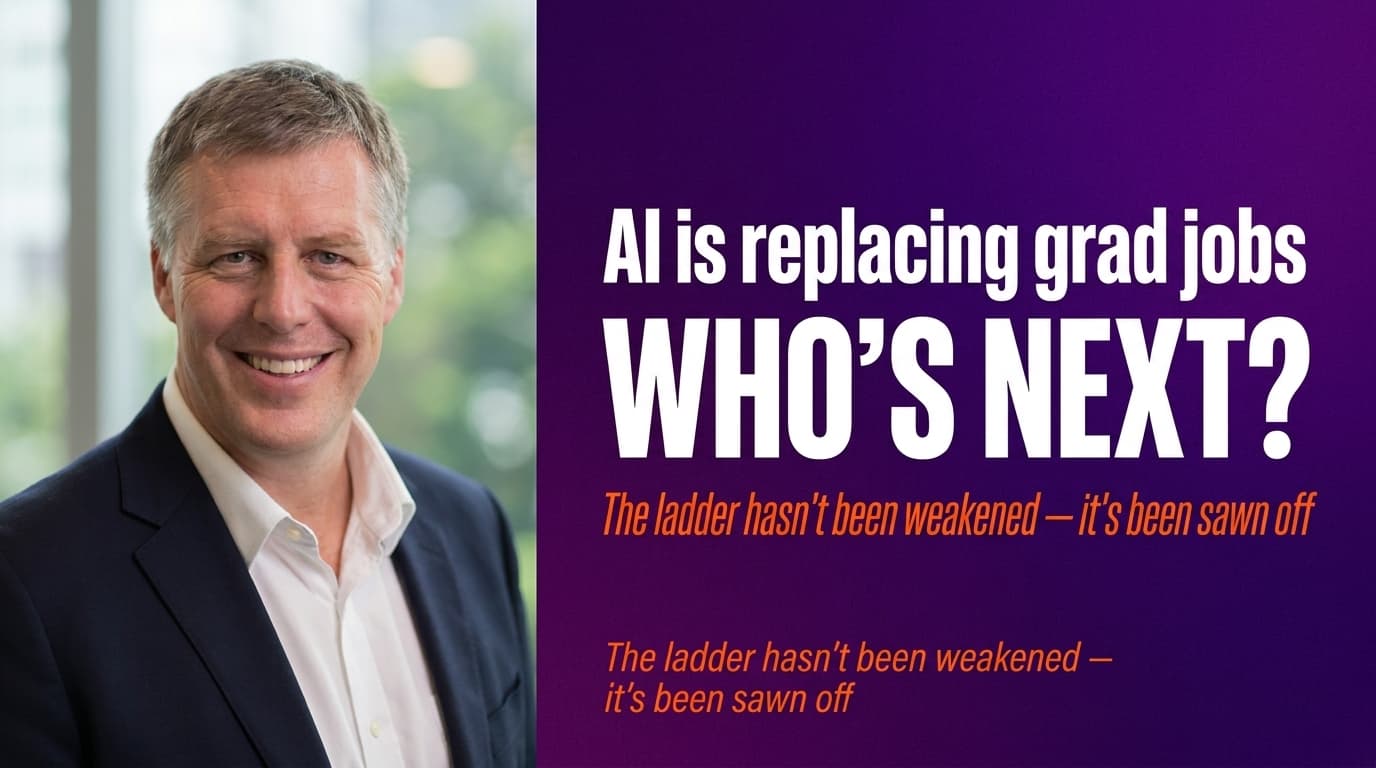
The entry-level job market is not going through a cyclical downturn. It is a structural collapse. Bill McDermott, CEO of ServiceNow, has stated publicly that AI agents could drive graduate unemployment into the mid-30s within two years. That is one in three graduates, carrying debt and a degree, unable to find work. The first rung of the corporate ladder has not been weakened. It has been sawn off completely.
The jobs historically used as professional entry points (paralegals, junior accountants, marketing assistants, entry-level coders) are precisely the roles AI is becoming most capable at performing. Work that once required five graduates a week can now be completed by one person with the right AI agent before their morning coffee goes cold.
Why has the traditional talent pipeline broken down?
For decades, the model was simple: hire graduates cheap, run them through the grunt work, and watch them develop into future leaders. It was a conveyor belt of talent: predictable, scalable, self-replenishing. That conveyor belt has ground to a halt.
Businesses now face a catch-22: either they do not hire graduates because AI is cheaper and more efficient, cutting off their future talent supply, or they do hire them, with no clear path to promotion, so the graduate is gone within a year. Either way, the social contract that underpinned the system (work hard, learn the ropes, and you will get ahead) has been torn up.
Experience is being decoupled from entry-level work, and that has terrifying implications for the future of your business.
This is not a blip. The concept of a "starter job" is becoming a relic. And the consequences will be felt at every level of the organisation, not just in HR.
What does the Singapore example tell us about the real skills gap?
Singapore has invested over a billion dollars in a national strategy to become a global AI hub, funding talent development, infrastructure, and research at scale. It is one of the most deliberate, forward-looking AI strategies of any government on earth.
And yet the senior director at AI Singapore came out with a stark warning: all that investment risks producing a nation of "AI users, " not "AI builders." Knowing how to write a prompt for ChatGPT is not the same as being able to think critically, architect systems, or direct AI to solve genuinely complex problems. If a government spending a billion dollars is struggling to bridge that gap, a business running a two-day offsite has no chance with the same approach.
The skills that mattered yesterday (recalling information, performing repetitive analysis, following a set process) are the exact capabilities being automated into oblivion. The new currency is critical thinking, creative problem-solving, and the ability to direct AI to create real value. That cannot be taught in a weekend workshop.
Is the C-suite actually at risk, or is this overstated?
Sam Altman, CEO of OpenAI, has been direct: the impact is not limited to interns and assistants. He predicts a future where even senior executives, including CEOs, will not be able to function effectively without significant AI assistance.
The threat to senior leadership is not that an AI takes their job title. It is that the skills which made them valuable (deep experiential knowledge, the ability to recall precedent, the capacity to analyse data) are increasingly performed faster and more accurately by AI. Twenty years of sector experience looks considerably less differentiating when an AI can synthesise information and model scenarios at a scale no human could match.
See where AI fits in your business. Free.
A 45-minute audit. We map the highest-value automations and what they're worth in time and money. No pitch, no pressure.
How is the corporate hierarchy actually changing?
The corporate ladder was built on one premise: experience equals value. The longer you had been in the game, the more you knew, and the more you were worth. That is why the senior partner in a law firm earned multiples of the junior associate.
That premise is now inverted. A 22-year-old who has mastered prompting tools like Claude or a purpose-built AI agent can outperform a 20-year veteran who is still working the old way. That junior employee can run in-depth market analysis, draft complex legal documents, write sophisticated code, and generate creative campaigns in a fraction of the time it takes the seasoned professional.
The people most open to change, most willing to learn, and most adept at collaborating with machines will be the new power brokers. Those most resistant, regardless of seniority or years served, will be left behind.
The new hierarchy is not based on what you know. It is based on what you can leverage.
What does this mean for your succession plan and training spend?
Your succession plan is probably obsolete. The rising stars you are developing for leadership: are you preparing them for the world that is, or the world that is coming? Are the skills you are building going to be valuable in two years, or worthless?
Most corporate training programmes are also a poor investment in their current form. A multi-day offsite teaching the latest industry regulations could be replaced by an AI agent that answers any question on the topic instantly and accurately. The shift required is from training for knowledge to training for leverage, teaching people how to think, how to question, and how to use AI to amplify their own capabilities.
What does AI-ready leadership actually look like in practice?
Concretely, it looks like this:
- The senior marketing director who built her career on gut instinct and creative flair becoming an expert in AI-driven market segmentation and predictive analytics
- The head of sales who prides himself on his little black book of contacts using AI to identify leads, personalise outreach, and predict churn
- The CFO who always relied on historical data using AI to model future financial scenarios and surface risks invisible to the human eye
At the graduate end, the answer is not a traditional apprenticeship, it is an inverted one. Pair graduates with senior leaders as AI mentors, not as subordinates. Their lack of entrenched ways of thinking is an advantage, not a liability. Use it. Let them be the ones constantly pushing the boundaries, experimenting with new tools, and challenging old assumptions.
Reskilling is required at every level, from the graduate intake right up to the boardroom. Continuous experimentation, not periodic training events. A culture where it is genuinely safe to say: "I do not know, but I am willing to find out."
What to do this week
- Audit your entry-level roles. For each junior role, ask: what percentage of the core tasks could an AI agent handle today? If the answer is above 50%, you have a structural problem, not a hiring pipeline problem.
- Review your succession plan. For each person in your development pipeline, identify which of their core skills will still be differentiating in two years. Reorient their development plan around leverage, not knowledge accumulation.
- Rename your training budget line. Stop calling it "training" and start calling it "reskilling." Every programme should answer one question: does this make our people better at directing AI?
- Create one AI mentor pairing. Identify a graduate or junior hire already experimenting with AI tools. Formally pair them with a senior leader for monthly sessions, and let the junior lead the conversation.
- Have the C-suite conversation. If your executive team has not explicitly discussed how AI will change each of their roles in the next 24 months, schedule that working session now. Not a keynote, a working session where each person identifies their three most AI-vulnerable responsibilities.
Where to from here
Book a free 60-minute AI audit, we'll explore exactly what workflows are worth augmenting with AI.
Live with passion & AI,
Brett
Want this installed in your business?
Bespoke AI implementation across your operations: strategy, build, rollout, and ongoing drift maintenance.
Frequently asked questions
How soon could AI cause graduate unemployment to rise significantly?
+
ServiceNow CEO Bill McDermott has warned that AI agents could drive graduate unemployment into the mid-30s within two years, meaning roughly one in three graduates may be unable to find work.
Which junior roles are most at risk from AI automation?
+
Paralegals, junior accountants, marketing assistants, and entry-level coders are among the most exposed. These are exactly the roles AI agents are becoming most capable at performing.
What is the difference between an AI user and an AI builder?
+
An AI user learns to operate existing tools. An AI builder can think critically, architect AI-driven systems, and direct the technology to solve complex problems. Singapore's AI Singapore agency has warned that even billion-dollar national programmes risk producing only users, not builders.
Is AI a genuine threat to C-suite executives, or just to junior employees?
+
According to OpenAI CEO Sam Altman, senior executives including CEOs will not be able to function effectively without significant AI assistance. The threat is not job replacement. It is that the skills that made executives valuable are increasingly performed faster and more accurately by AI.
How does AI invert the traditional corporate hierarchy?
+
The traditional hierarchy rewarded accumulated experience and knowledge. AI inverts this: a 22-year-old who masters AI tools like Claude can now outperform a 20-year veteran who has not adapted. Value shifts from what you know to what you can leverage.
What should businesses do with their graduate hiring programmes now?
+
The old model (graduates doing grunt work to learn the ropes) is broken. The recommended alternative is an inverted apprenticeship: pair graduates with senior leaders as AI mentors, treating their lack of entrenched habits as an advantage rather than a liability.
Why are most corporate training programmes now a poor investment?
+
Training built around knowledge transfer is being made redundant by AI that can answer questions instantly and accurately. Programmes need to shift toward capability development: teaching people how to think, question, and leverage AI tools effectively.

Brett is a four-time founder (Darra Tyres, Gladfish, EzyTrac, Anaboo) and the operator behind AIOS, Anaboo's AI Operating System. He writes from inside the build, installing AI in his own businesses first and reporting back what actually moves the numbers. Based between Singapore, the UK and Australia.