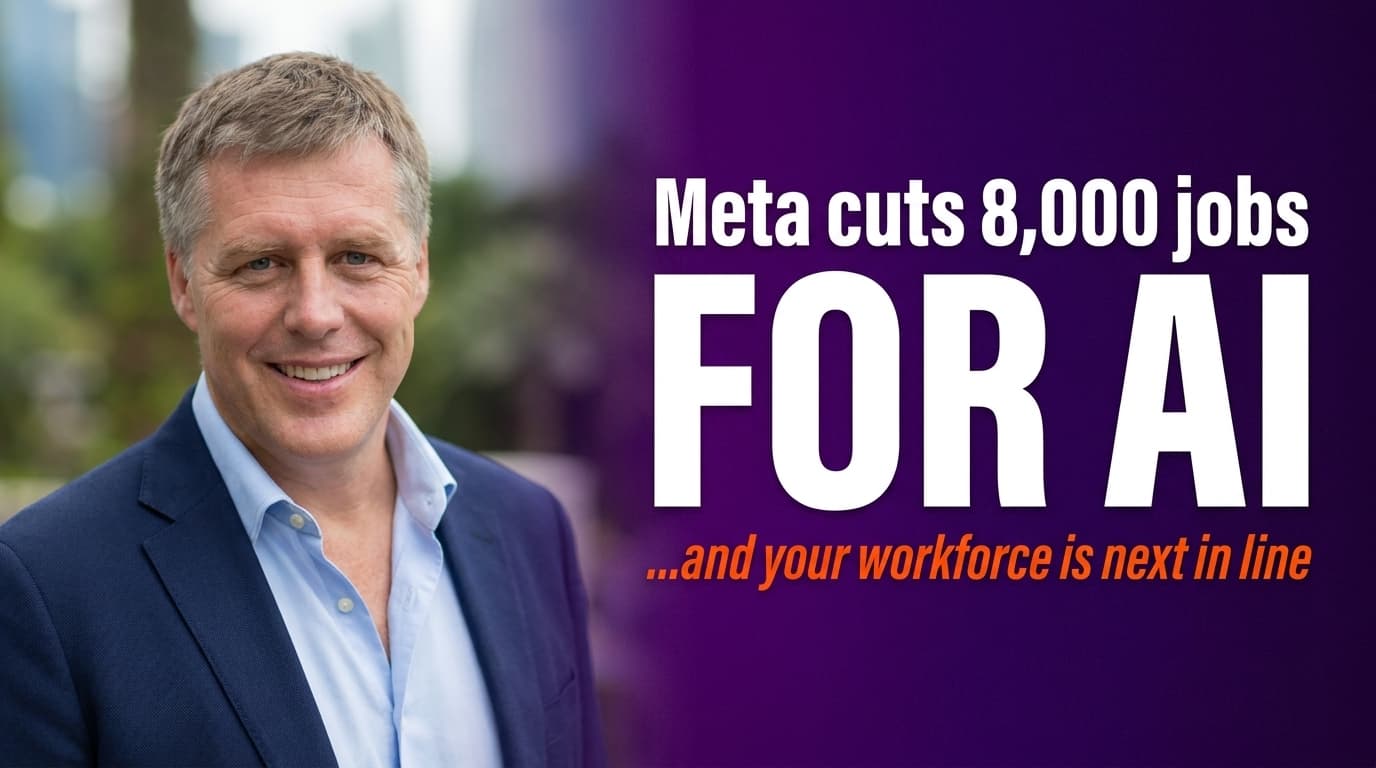
Meta cut 8,000 jobs for AI, here's what it means for your business
TL;DR
Meta is cutting 8,000 jobs, 10% of its global workforce, explicitly to redirect resources toward AI. Goldman Sachs estimates AI is already eliminating a net 16,000 jobs per month in the US alone, hitting entry-level workers hardest. The pipeline problem is real: cut the bottom rung of the career ladder and you starve yourself of the future leaders you will desperately need. The companies that restructure now, while they still have time, will be the ones that come out ahead.
Why Meta's 8,000 AI job cuts matter more than the headline
Meta is laying off approximately 10% of its global workforce, around 8,000 people, starting 20 May. This is not a response to a recession or a dip in advertising revenue. It is a deliberate, strategic restructuring explicitly designed to concentrate resources on artificial intelligence.
And Meta is not alone. Jack Dorsey cut 40% of the staff at Block, explicitly citing AI as the reason. OpenAI, the poster child for the AI revolution, is experiencing a significant executive exodus, with three senior leaders departing on the same day, its Sora video generation tool shutting down, and projected losses of $14 billion for 2026.
The tech giants are moving fast, and they are breaking their own workforces to do it.
Is AI creating more jobs than it destroys? The uncomfortable answer
The narrative is schizophrenic. AI will eliminate entire industries. AI will usher in a golden age of productivity. Both headlines appear in the same week.
Here is what the data actually shows. Goldman Sachs estimates AI is already cutting 16,000 jobs per month in the US alone, 25,000 substituted, with only 9,000 added back. The net loss is accelerating. The wage gap is widening by 3.3 percentage points for every standard deviation of AI exposure.
The jobs are disappearing, but the promised productivity gains aren't materialising. We are getting the worst of both worlds.
An NBER study of 6,000 executives found that despite all the noise about AI transforming the workforce, nearly 90% of firms report zero measurable impact on employment or productivity.
Why entry-level workers are being hit hardest
A study by Military.com and Forbes found that nearly 25% of executives expect AI to reduce their need for entry-level hires. That is not a rounding error. That is a structural shift in how companies think about talent.
Tasks like basic data entry, preliminary research, drafting routine emails, and writing simple code are now being handled by AI agents. The traditional path into the corporate world, the junior roles where young people learn the ropes, make mistakes, and gradually build their skills, is being automated out of existence.
Companies no longer want raw talent they have to train from scratch. They want candidates who already know how to prompt, how to manage AI agents, and how to integrate these tools into existing workflows.
But you cannot hire experienced mid-level managers if you have never trained any entry-level staff.
We are creating a massive pipeline problem. By eliminating the bottom rung of the career ladder, we are starving ourselves of the future leaders we will desperately need in five or ten years. IBM's Chief Human Resources Officer recognised this exact problem, announcing that the company would triple its number of young hires to avoid a dearth of middle managers down the line. Most companies are not IBM.
What the Australian and Singaporean data reveals
In Australia, a Pearson and AWS study across six countries found that 53% of employers are struggling to find AI-ready graduates. Universities are still training students for roles that are being automated before they even graduate.
In Singapore, the picture is equally complex. The country has achieved 99% digital government transactions and a 61% GenAI adoption rate, more than double the US rate of 28%. But only 3% of Singaporean financial institutions have achieved true AI leadership status. Adoption is broad but shallow. The tools are everywhere; the strategic thinking is not.
See where AI fits in your business. Free.
A 45-minute audit. We map the highest-value automations and what they're worth in time and money. No pitch, no pressure.
The developer gold rush nobody expected
According to the Eastern Herald, there has been a 60% year-over-year increase in global app releases, driven entirely by AI-powered coding tools that have dramatically lowered the barriers to entry.
You no longer need a four-year computer science degree to build functional software. With tools like GitHub Copilot and Anthropic's Claude, a single developer, or even a non-technical founder, can build, test, and deploy applications at a speed that was unimaginable just two years ago.
This is creating entirely new categories of work. But they are not the kind of jobs that replace the entry-level roles being lost. They require a different mindset, a different skill set, and a fundamentally different approach to problem-solving.
The three-person company and what it means for everyone else
A growing wave of AI-native founders are building what can only be called "three-person companies", lean, profitable businesses that use AI agents to do work that would previously have required a team of twenty or thirty. They are not raising venture capital. They are not hiring bloated workforces. They are building instantly profitable operations with minimal overhead.
This is brilliant for the founders. It is devastating for the traditional employment model.
If one person with the right AI tools can do the work of ten, what happens to the other nine?
The physical economy premium that AI cannot touch
While AI eliminates white-collar, screen-based jobs, demographic shifts are creating massive shortages in the physical economy. Nurses, teachers, electricians, plumbers, builders, all in short supply.
AI cannot fix a leaking pipe. It cannot hold the hand of a frightened patient. It cannot build a house.
We have a surplus of people who want to work in offices and a deficit of jobs for them. Meanwhile, we have a surplus of physical jobs and a deficit of people willing or able to do them. This structural misalignment is going to define the next decade of the global economy.
What OpenAI's own economist thinks, and why it doesn't comfort the 8,000
OpenAI's chief economist has acknowledged the disruption, though he argues the "AI job apocalypse" is overstated. His position: only 18% of jobs are at higher risk, and reorganisation is more likely than outright elimination.
Tell that to the 8,000 people at Meta who just lost their livelihoods. Or to the 40% of Block's workforce who were shown the door.
The disruption is real. The pace is faster than any model predicted. And most businesses are not ready for it.
What to do this week
1. Rethink your hiring strategy. If you are using AI to automate entry-level tasks, you need a new plan for training future leaders. Structured mentorship programmes, apprenticeships, and rotational roles can replace the learning that used to happen in junior positions. Do not simply stop hiring juniors and assume mid-level talent will appear in five years.
2. Upskill your existing team. Every person in your organisation, from the receptionist to the CEO, needs baseline technical fluency with AI. Not coding. Critical thinking about automated systems, managing AI agents, and validating their outputs.
3. Look for the new opportunities. The 60% surge in app development is a signal. The barriers to building digital products have collapsed. If you have an idea for a new internal tool or a customer-facing application, there has never been a better time to build it. You do not need a massive team of expensive developers anymore.
4. Prepare for the physical economy premium. As white-collar work gets commoditised by AI, the value of human-centric, physical work will rise sharply. If your business relies on physical labour, customer service, or face-to-face interaction, invest heavily in retention, culture, and employee wellbeing. Those are the capabilities AI cannot replicate.
The companies that start restructuring now, while they still have the luxury of time and choice, will be the ones that thrive. The ones that wait will be forced to restructure in a crisis, and that never ends well.
Where to from here
Book a free 60-minute AI audit, we'll explore exactly what workflows are worth augmenting with AI.
Live with passion & AI,
Brett
Need an AI operator inside your team?
Place a Chief AI Officer, an AI Officer, or embed an Anaboo Forward Deployed Engineer for 3–6 months.
Frequently asked questions
How many jobs did Meta cut for AI in 2026?
+
Meta announced it is laying off approximately 10% of its global workforce, around 8,000 people, starting 20 May 2026. The restructuring is explicitly designed to redirect resources toward artificial intelligence, not driven by any downturn in revenue.
How many jobs per month is AI eliminating in the US?
+
Goldman Sachs estimates AI is already cutting a net 16,000 jobs per month in the US, 25,000 roles substituted by AI with only 9,000 new roles added back. The wage gap is widening by 3.3 percentage points for every standard deviation of AI exposure.
Why are entry-level workers being hit hardest by AI job cuts?
+
Tasks like basic data entry, preliminary research, drafting routine emails, and writing simple code are now being handled by AI agents. A study by Military.com and Forbes found that nearly 25% of executives already expect AI to reduce their need for entry-level hires.
What is the AI talent pipeline problem businesses are creating?
+
By automating entry-level roles, companies are eliminating the training ground where future leaders develop. IBM's Chief Human Resources Officer recognised this, announcing the company would triple its young hires to avoid a future shortage of middle managers, but most companies are not thinking that far ahead.
What are 'three-person companies' in the context of AI?
+
Three-person companies are AI-native businesses where a tiny founding team uses AI agents to do the work that would previously have required twenty or thirty staff. They are profitable, lean, and require minimal hiring, which is great for founders but removes significant employment from the traditional labour market.
Does AI actually improve productivity? What does the data show?
+
An NBER study of 6,000 executives found that nearly 90% of firms report zero measurable impact on employment or productivity despite widespread AI adoption. Adoption is broad but shallow, the tools are everywhere, but the strategic thinking behind them is not.
What jobs can AI not replace?
+
AI cannot perform physical, human-centric work: fixing plumbing, nursing, teaching, building, or face-to-face service. As white-collar work gets commoditised, the economic premium on physical and interpersonal skills is set to rise significantly.

Brett is a four-time founder (Darra Tyres, Gladfish, EzyTrac, Anaboo) and the operator behind AIOS, Anaboo's AI Operating System. He writes from inside the build, installing AI in his own businesses first and reporting back what actually moves the numbers. Based between Singapore, the UK and Australia.