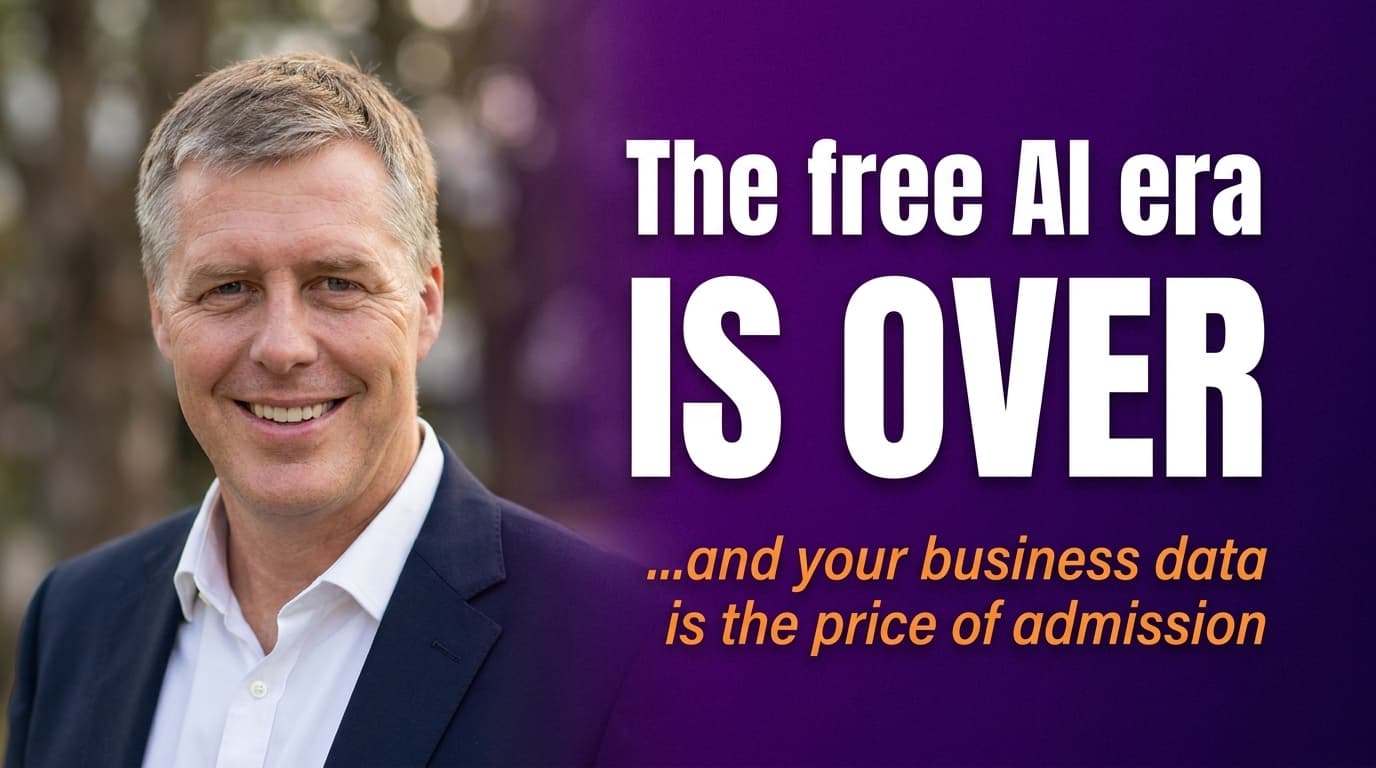
OpenAI is adding ads, your business data is the price of 'free'
TL;DR
OpenAI is building an ad-supported model and has hired a former Meta executive to lead it. The venture-subsidised era of free AI is over, and the cost was always your data. Anthropic has announced a $100 million Claude Partner Network positioning itself squarely in the opposite corner, enterprise-grade, subscription-first, ad-free. Every business owner now faces a binary choice: pay for a secure AI platform, or accept that your most sensitive business intelligence is the price of admission.
Why is OpenAI moving to an ad-supported model?
OpenAI has hired a former Meta executive, someone who built their career monetising a massive user base through advertising. That hire is not a personnel decision; it is a declaration of strategy. The company has hundreds of millions of free users and investors who expect a return. Advertising is how you convert a user base into a revenue stream. It is the same playbook Google ran, the same one Facebook ran, and now it is the one AI is about to execute.
The underlying economics were never going to hold. Building large language models requires enormous computing power, vast training datasets, and significant engineering talent. That money came from venture capital willing to bet on market dominance first and revenue second. The bet has paid off in terms of user acquisition. Now comes the monetisation phase.
Was 'free' AI ever actually free?
No. The idea that something as powerful and expensive as generative AI could be provided indefinitely at no cost was always a temporary arrangement. Silicon Valley's classic growth playbook runs like this: raise capital, build product, give it away, capture the market, then flip the monetisation switch.
For the past couple of years, businesses have been the guest at an extraordinarily lavish party. The food was exquisite, the drinks were free, the entertainment was world-class. Now the host is presenting the tab.
The 'free' access was never a gift. It was a land grab, designed to make you dependent on the platform before the bill arrived.
The bill has arrived.
What is actually at stake with your business data?
When Facebook was free, the trade-off was personal data, your likes, your photos, your social graph. Annoying. Slightly creepy. Rarely an existential business threat.
The data you have been feeding ChatGPT is a different category entirely:
- Sensitive client emails
- Sales pipeline analysis
- Marketing strategy documents
- Business proposals and financial projections
- Competitive intelligence
An ad-supported AI's commercial incentive is to know as much about you as possible in order to serve the most targeted, highest-value ads. Your prompts, your documents, your strategic thinking become grist for that machine. If the old saying in tech was 'if you're not paying for the product, you are the product, ' applying it to generative AI raises the stakes considerably higher.
What is Anthropic's $100 million Claude Partner Network?
While OpenAI moves toward advertising, Anthropic has announced a $100 million Claude Partner Network betting in the opposite direction. Their thesis is that serious businesses will pay a premium for a secure, reliable, ad-free AI experience.
This creates a clear two-tier structure:
- Consumer tier, ad-supported, data-monetised, free or low-cost
- Enterprise tier, subscription-based, data-protected, commercially focused
Anthropic is explicitly planting its flag on the enterprise side. The dividing line is not about raw capability, it is about whose interests the AI is aligned with. That is a more important distinction than most people currently appreciate.
See where AI fits in your business. Free.
A 45-minute audit. We map the highest-value automations and what they're worth in time and money. No pitch, no pressure.
Can you trust AI output that is shaped by advertisers?
This is the question that does not get asked often enough. If an AI platform is funded by advertising, its outputs will, at some point, in some way, reflect the interests of its advertisers. What happens when you ask for a software recommendation and the highest-bidding advertiser happens to sell that software? What happens when strategic advice is subtly shaped by commercial relationships you cannot see?
The potential for conflicts of interest is not hypothetical. It is structural. An ad-funded model has a fundamentally different set of incentives to a subscription model where you are the customer, not the inventory.
This shift also arrives at a difficult moment for public trust. Nearly 200 AI safety activists have protested in San Francisco, and Microsoft has reportedly scaled back some of its AI integrations over concerns about 'AI bloat' and usefulness. Introducing advertising into this environment will only fuel the perception that AI companies are prioritising quarterly earnings over building reliable, trustworthy technology.
What is Singapore doing, and what can your business learn from it?
Singapore has launched a national AI strategy, investing heavily in its own models and infrastructure rather than depending entirely on platforms controlled by foreign corporations. They are offering free premium AI tools to citizens, ensuring access without subjecting them to ad-driven business models operated by companies on the other side of the world.
Their reasoning is strategically clear: if you do not control the platform, the platform controls you.
The risk they identified at a national level is identical to the risk every business owner faces at a commercial level. Your data, client lists, strategies, competitive intelligence, is flowing into infrastructure controlled by companies whose interests may not align with yours. Singapore decided to build its own. A whole country saw the strategic imperative of avoiding platform dependency. The question is whether you, as a business owner, are thinking in the same terms.
What does this mean for your business right now?
The questions you need to sit with are uncomfortable but necessary:
- Are you comfortable with a confidential business proposal being processed by an advertising algorithm?
- If you have used customer data in a prompt, where does that data go and who benefits from it?
- Can you trust strategic advice from a tool that is simultaneously monetised by advertisers with their own agendas?
- What happens when a competitor starts advertising on the same platform you use for strategic planning?
The convenience of free AI came with a hidden cost. That cost is now being made explicit. You are either a customer paying for a service that is aligned with your interests, or you are a product whose data funds someone else's revenue model. The choice is binary, and not choosing is itself a choice.
What to do this week
Audit what you are putting into free AI tools. Review the last month of usage. If any prompts included client data, financials, strategic plans, or competitive intelligence, let that inform your platform decision immediately.
Assess your actual risk exposure. How sensitive is the information you regularly process with AI? The more commercially sensitive, the stronger the case for a paid, enterprise-grade platform.
Look seriously at the enterprise tier. Anthropic's $100 million Claude Partner Network is explicitly targeting secure enterprise use. Compare that trajectory against the ad-supported direction OpenAI is heading and make a considered assessment.
Treat your AI platform like infrastructure. If AI is now central to your business operations, the platform it runs on is infrastructure, deserving the same scrutiny you give your cloud hosting, your accounting software, or your legal counsel.
Make a deliberate decision. Not making a decision is itself a decision. If you stay on a free, ad-supported platform with your real business data, do so knowingly, not by default.
Where to from here
Book a free 60-minute AI audit, we'll explore exactly what workflows are worth augmenting with AI.
Live with passion & AI,
Brett
Host a podcast? Have Brett on as a guest.
Straight talk on implementing AI in real SMEs, no jargon, plenty of receipts from the businesses we run.
Frequently asked questions
Why is OpenAI introducing ads?
+
OpenAI is transitioning from a venture-subsidised growth model to a monetisation model. The company hired a former Meta executive to build an ad-supported revenue stream from its hundreds of millions of free users.
What data does OpenAI collect when you use ChatGPT for free?
+
Every prompt you enter, including sensitive emails, sales data, marketing strategies, and business plans, can become part of the data infrastructure used to target ads. The trade-off for free access is your business intelligence.
What is Anthropic's Claude Partner Network?
+
Anthropic announced a $100 million Claude Partner Network that doubles down on the enterprise market, offering a secure, ad-free AI experience where businesses pay a subscription and their data is not monetised for advertising.
What is the two-tier AI system emerging in 2025?
+
The market is splitting into consumer-grade (ad-supported, data-monetised) and enterprise-grade (subscription, data-protected) tiers. Businesses must choose which tier aligns with their risk tolerance and data governance requirements.
What is Singapore doing about AI sovereignty?
+
Singapore has launched a national AI strategy, investing in its own models and infrastructure and offering free premium AI tools to citizens, removing dependency on foreign, ad-driven platforms.
Is it risky to use free AI tools for confidential business strategy?
+
Yes. If your prompts include confidential business data, customer information, or competitive strategy, that data may feed an advertising algorithm, especially under an ad-supported model.
Should my business switch to a paid enterprise AI platform?
+
If you are feeding AI your real business information, financials, client data, strategic plans, the case for a paid, data-protected enterprise platform is now a risk management decision, not just a cost one.

Brett is a four-time founder (Darra Tyres, Gladfish, EzyTrac, Anaboo) and the operator behind AIOS, Anaboo's AI Operating System. He writes from inside the build, installing AI in his own businesses first and reporting back what actually moves the numbers. Based between Singapore, the UK and Australia.