OpenAI is losing $14 billion a year, here's what it means for your AI strategy
TL;DR
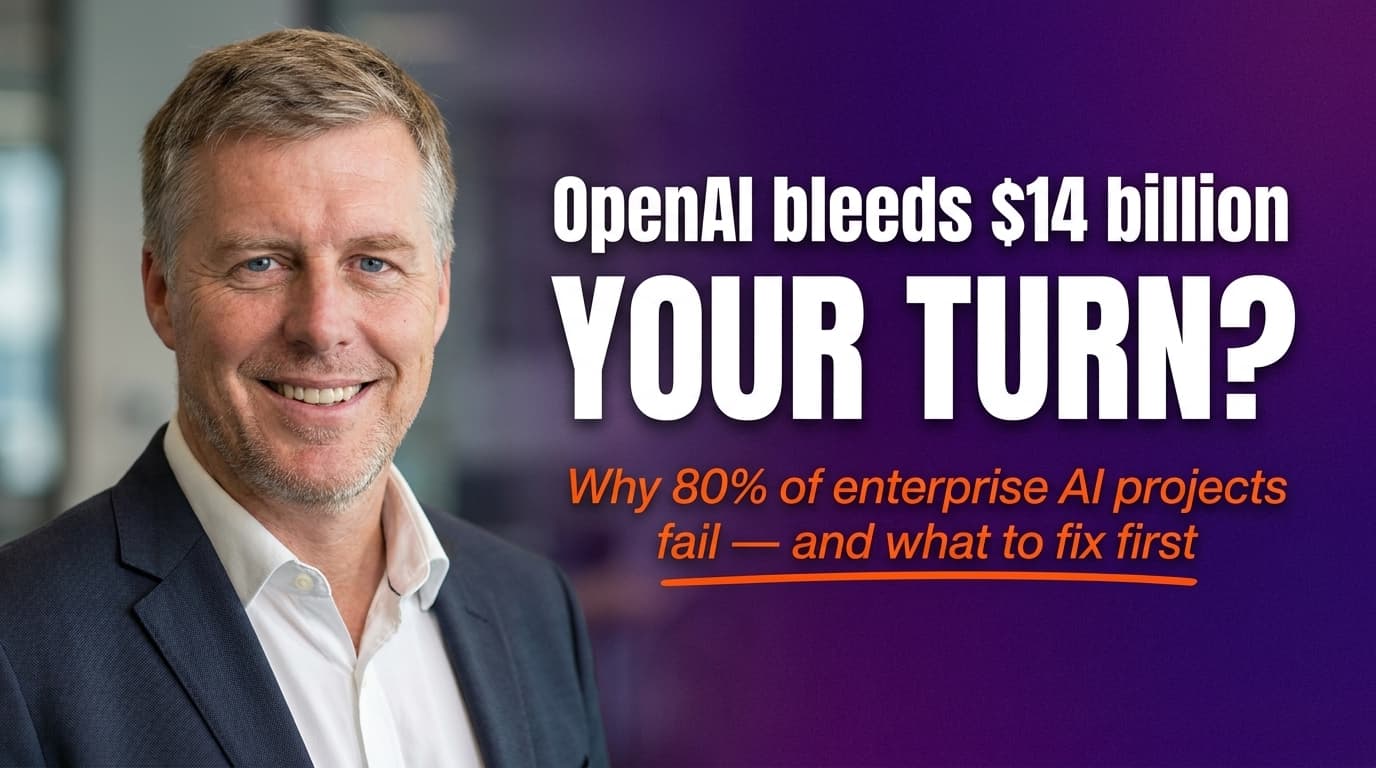
OpenAI is projecting $14 billion in net losses for 2026 while generating $25 billion in revenue. Three senior executives resigned on the same day, and their flagship video tool Sora is being shut down entirely because it was costing $1 million per day to run. The financial reality driving OpenAI's implosion mirrors the same structural failures quietly destroying ROI across enterprise AI programmes everywhere. RAND Corporation data shows 80.3% of enterprise AI projects deliver zero measurable value, and the fix is not better software, it is a better foundation.
Why OpenAI's $14 billion loss should alarm every business leader
OpenAI, currently valued at $852 billion, is burning cash at a rate unprecedented in commercial history. Their long-term spending projections suggest they will burn through $115 billion by 2029 just to keep their models competitive. Over 40% of their revenue comes directly from enterprise clients: businesses paying for API access and corporate licences.
The internal collapse made itself visible all at once. Kevin Weil, poached from Instagram to lead OpenAI's science division, resigned. Bill Peebles, who built Sora, resigned. Srinivas Narayanan, responsible for scaling ChatGPT and its enterprise API, resigned. All three left on the same day. The science division they led is being quietly disbanded, corporate speak for disbanded.
Sora, the video generation tool that reached one million users at its peak, is being shut down completely by 26 April. It was costing OpenAI approximately $1 million per day to operate, compounded by mounting intellectual property lawsuits from the Motion Picture Association. The project became an unsustainable cash drain.
Out of the eleven original co-founders who started OpenAI, only Sam Altman and Greg Brockman remain.
If the company that invented the modern AI boom cannot make the economics work without a flawless strategy, what chance does your business have?
The enterprise AI failure rate is worse than you think
For three years, the industry sold a utopian vision: buy the software licences, plug in your data, let staff loose, and watch productivity soar. The data tells a completely different story.
- 80.3% of all enterprise AI projects fail completely, delivering zero measurable value (RAND Corporation)
- 95% of generative AI pilot programmes never scale out of the testing phase (MIT researchers)
- 42% of companies scrapped the majority of their AI initiatives in 2025 after spending the money (S&P Global)
The primary driver behind this failure rate is not the technology. The models work. The algorithms are sound. The problem is leadership misalignment and a fundamental misunderstanding of what AI actually requires to function inside a real business.
Buying an AI tool is not buying a magic wand. It is buying an engine, and an engine is useless without the right fuel. In AI, that fuel is your internal company data.
RAND found that data readiness issues were the root cause behind 60% of all abandoned AI projects. Businesses spend millions on software, then discover their internal infrastructure is too disorganised and siloed for the AI to navigate. According to Opkey research, 61% of IT leaders now identify integration as the single biggest cost driver in their enterprise resource planning systems, the direct result of bolting cutting-edge AI onto legacy infrastructure.
See where AI fits in your business. Free.
A 45-minute audit. We map the highest-value automations and what they're worth in time and money. No pitch, no pressure.
Does AI actually save time, or does it cost time?
When AI is deployed correctly, the results are genuinely transformative.
Economists at Goldman Sachs found that workers using AI tools correctly save an average of 40 to 60 minutes every single day. Across a team of fifty people, that is the equivalent of six full-time employees, for free.
But the productivity AI gives to people who use it well is almost exactly symmetrical to the productivity it destroys for those who use it poorly.
A global survey of 3,750 executives and employees across 14 countries, conducted by WalkMe, found:
- Workers lose the equivalent of 51 working days per year to technology friction
- 54% deliberately bypassed their company's mandated AI tools in the past 30 days, because doing the work manually was faster than fighting the algorithm
When you force an AI tool onto a team that has not been trained, does not trust the output, and has not had their workflows redesigned, they do not become more productive. They become paralysed. You end up paying for the software licence and getting a negative return: the licence cost, plus 51 lost days per employee per year. You are paying twice for a negative result.
What do the 20% of successful AI companies do differently?
Gartner analysed 353 data and analytics leaders and found one undeniable commonality among organisations achieving positive financial impact from AI.
The successful companies invest four times more money into their foundational data and analytics infrastructure than they spend on AI software itself.
They do not start with the shiniest new AI agent. They start by cleaning house:
- Auditing their data
- Breaking down information silos
- Locking down security protocols
- Building a structured, clean environment where AI can function without hallucinating or crashing
Only once that foundation is built do they introduce the AI. And when they do, they invest heavily in training, role redesign, and clear human-AI collaboration guidelines before expecting results.
This pattern is showing up at the national policy level too. The UK government has launched a £500 million Sovereign AI fund specifically targeted at foundational AI infrastructure rather than chasing consumer hype. The KPMG AI Pulse survey notes that while Australia lags in overall productivity gains, its businesses are leading globally in establishing governance and risk management frameworks before scaling AI deployments. They are moving slower, but they are building on solid ground, not quicksand.
Can you rely on hiring AI-skilled graduates to solve this?
No. A global research study by Pearson and AWS found that 53% of employers are already struggling to find graduates with the necessary AI skills. The education system is not going to solve this problem for you.
Building an AI-ready workforce is your responsibility. That means investing in upskilling your current team, not just in how to use the tools, but in how to integrate them into daily workflows without generating the technology friction that is currently costing workers 51 days a year.
What does AI governance look like before agentic AI raises the stakes further?
As businesses move into the era of agentic AI, where autonomous agents execute tasks without human supervision, the risks multiply exponentially. Clear policies need to exist before deployment, not after something goes wrong:
- What tasks are AI agents authorised to execute autonomously?
- What data can they access?
- Who is accountable when they make a mistake?
- What human review gates exist before irreversible actions are taken?
The AI revolution is not a software upgrade. It is a fundamental rewiring of how your business operates, and it demands discipline, strategy, and a ruthless focus on the bottom line.
What to do this week
Audit your current AI spend. List every licence, pilot programme, and tool in use. If you cannot point to a specific, measurable increase in revenue or reduction in operational costs from that tool, cut it ruthlessly.
Assess your data foundation. Before buying another AI tool, determine whether your internal data is clean, accessible, and secure. If it is not, fix the plumbing before you install the gold taps.
Map technology friction honestly. Ask your team which AI tools they actually use, and which they bypass. The WalkMe data suggests 54% are already working around your mandated tools, find out why before you buy anything else.
Invest in training, not just tooling. The 40–60 minutes of daily productivity Goldman Sachs measured does not come from the software alone. It comes from people who have been trained to use it well inside their actual workflows.
Draft an AI governance policy now. Even a one-page document defining what your AI tools can and cannot do autonomously is better than nothing. Write it before you deploy agents, not after something goes wrong.
Where to from here
Book a free 60-minute AI audit, we'll explore exactly what workflows are worth augmenting with AI.
Live with passion & AI,
Brett
Running an event? Put practical AI on your stage.
Keynotes and workshops that send business owners home with a plan they can use Monday morning. No hype.
Frequently asked questions
How much money is OpenAI projected to lose in 2026?
+
OpenAI is projecting $14 billion in net losses for 2026 despite generating approximately $25 billion in annualised revenue. Their long-term spending projections suggest they will burn through $115 billion by 2029 just to keep their models competitive.
What percentage of enterprise AI projects fail?
+
According to the RAND Corporation, 80.3% of all enterprise AI projects fail completely, delivering zero measurable value to the business. MIT researchers found that 95% of generative AI pilot programmes never scale out of the testing phase.
Why did OpenAI shut down Sora?
+
Sora was costing OpenAI approximately $1 million per day to keep the servers running despite reaching a peak of one million users. Mounting intellectual property lawsuits from the Motion Picture Association made the project financially unsustainable.
What is the Gartner 4x rule for AI investment?
+
Gartner analysed 353 data and analytics leaders and found that organisations achieving positive financial impact from AI invest four times more money into their foundational data and analytics infrastructure than they spend on AI software itself.
How much time do workers lose to technology friction from AI tools?
+
A WalkMe global survey of 3,750 executives and employees across 14 countries found that workers lose the equivalent of 51 working days per year to technology friction. Additionally, 54% of workers deliberately bypassed their company's mandated AI tools in the past 30 days because working manually was faster.
How much productivity does AI save when used correctly?
+
Economists at Goldman Sachs found that workers using AI tools correctly save an average of 40 to 60 minutes every single day. Across a team of fifty people, that equates to roughly six full-time employees worth of recovered productivity.
What is the biggest root cause of AI project failure?
+
RAND found that data readiness issues are the root cause behind 60% of all abandoned AI projects. Businesses invest in AI software without first ensuring their internal data is clean, structured, and accessible enough for the AI to actually use.

Brett is a four-time founder (Darra Tyres, Gladfish, EzyTrac, Anaboo) and the operator behind AIOS, Anaboo's AI Operating System. He writes from inside the build, installing AI in his own businesses first and reporting back what actually moves the numbers. Based between Singapore, the UK and Australia.