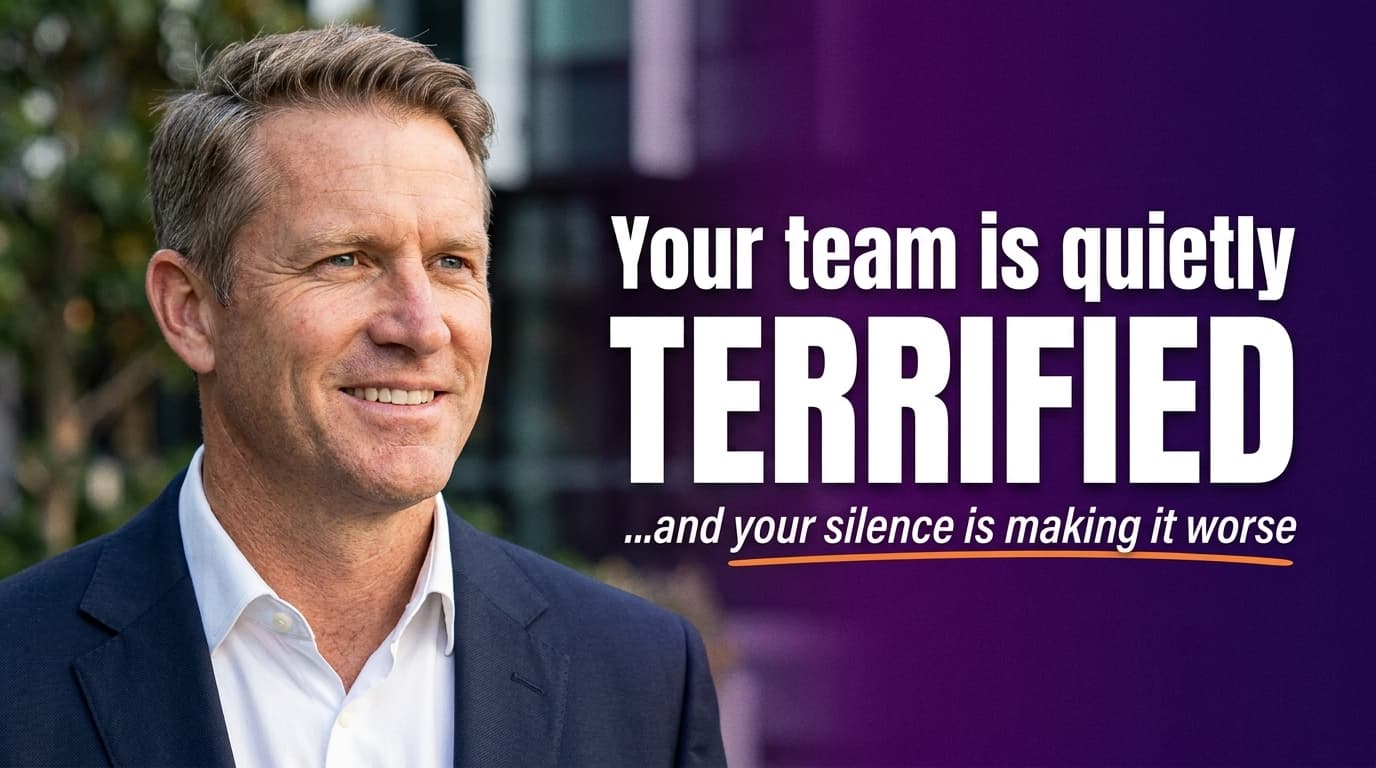
Your team is more scared of AI than you think, and it's costing you
TL;DR
Your team is not enthusiastically embracing AI. 41% are genuinely anxious about their futures, and only 25% of HR leaders even recognise it as a problem. Haphazard AI adoption without training or strategy is creating a two-speed workforce that hollows out the middle of your organisation. The talent walking out the door today is not being replaced by machines; it is being poached by competitors who are actually leading. Treat AI as a people problem, not a tech problem, and start now.
Why your AI adoption numbers are lying to you
You see your team using AI tools. Productivity looks up. You tell yourself you have cracked it. What you are actually seeing is panic dressed up as progress, employees desperately trying to stay relevant in a world that feels like it is moving faster than they can keep up.
The numbers tell a different story:
- 41% of employees are genuinely anxious about AI's impact on their jobs in the next five years
- Only 25% of HR leaders think this anxiety is a significant problem
- 70% of staff are already using generative AI in some form
- Only 19% have received any formal training on it
That is not a gap. That is a chasm. You are fundamentally misreading the room.
You have got the vast majority of your workforce fumbling in the dark with a technology that has the power to transform your entire industry, with absolutely no guidance from you. This is not a missed opportunity; it is a ticking time bomb of anxiety, misuse, and resentment.
What happens when untrained, anxious staff use AI unsupervised?
Think carefully about what happens when an untrained, anxious employee starts feeding your confidential customer data or your three-year product strategy into a public AI model. You are creating a shadow workforce, learning on the fly, making mistakes you cannot see, and growing more disconnected from your company's actual strategy every single day.
This is not hypothetical. It is happening right now in organisations that mistake activity for progress.
The exit interview story that should keep you up at night
A CEO, doing everything he thought was right, celebrated his team's AI adoption. Productivity was up. The boring stuff was getting automated. Two weeks later, his head of product, a decade-long veteran, handed in his notice.
The exit interview was brutal:
"I don't see a future for myself here. I see the company buying tools, but I don't see it investing in me. I don't know what my career looks like in two years, and no one seems to be able to tell me."
This is not an isolated story. Your best people are not leaving because they hate AI. They are leaving because you have given them no signal that you have a plan for them within it.
How AI is accidentally building a two-speed workforce inside your business
Haphazard AI adoption does not just create anxiety. It restructures your organisation in ways you may not even notice until it is too late.
Research from the Dallas Fed identifies two distinct effects:
Effect 1: AI automates the entry-level rung of the ladder. Routine tasks based on what economists call "codified knowledge" (the stuff you can write down in a manual) are the first to go. This is precisely where junior staff have always cut their teeth, learning the fundamentals of the business, the industry, the market. By automating that rung, you kick it out from under them.
Effect 2: AI supercharges your senior people. Experienced workers with "tacit knowledge" (the wisdom and intuition built from years in the trenches) are getting a productivity and wage boost. AI tools amplify their ability to analyse, strategise, and execute.
The problem: you cannot hire for tacit knowledge. It has to be grown. By cutting off the pipeline of junior talent, you create a massive bottleneck: a handful of highly paid senior leaders at the top, a revolving door of junior staff at the bottom who leave after 18 months because they see no path forward, and nothing in the middle.
Fast forward five years: your senior team is the same group you have today, only five years older and five years more burnt out.
Your institutional knowledge evaporates. You are not a team anymore; you are a collection of freelancers who happen to share an office.
See where AI fits in your business. Free.
A 45-minute audit. We map the highest-value automations and what they're worth in time and money. No pitch, no pressure.
What Singapore is getting right that most boardrooms are not
If you think this is purely a cultural anxiety problem, look at what Singapore is doing at a policy level.
Members of Parliament in Singapore are standing up and demanding accountability for the nation's significant investment in AI. They are not getting dazzled by tech demos. They are asking for cold, hard proof, specifically:
- Measurable wage increases for workers
- The creation of net new jobs, not just efficiency gains
They understand a fundamental truth that most business leaders miss: AI is only a success if it uplifts the workforce, not just the bottom line.
Think of it in ROI terms you already understand. You would never sign off on a seven-figure software deal without a detailed return-on-investment plan: metrics, KPIs, projected revenue impact. So why are you throwing your entire company culture into upheaval with AI without demanding the same level of accountability from yourself?
Singapore is treating AI not as a toy but as a powerful tool that must be wielded with purpose and a deep sense of responsibility. That is a masterclass in responsible innovation, and it is a lesson you ignore at your peril.
Are these warning signs showing up in your team right now?
You are probably reading this thinking, "My team's fine. They're smart. They're adapting."
Look harder. Here are the signals that a team has gone into survival mode:
- Team meetings are getting quieter. People are less willing to speak up or challenge ideas.
- Volunteers are disappearing. Nobody is putting their hand up for the tough new project.
- Bare minimum output. Not laziness. Fear. They are keeping their heads down, avoiding unnecessary risk, and planning their exit.
- LinkedIn activity is up. Your most forward-thinking employee is not just adapting to AI. They are adapting to the reality that you do not have a plan. They are learning skills for their next job because you have given them no confidence in their future with your company.
You are not losing the war for talent against machines. You are losing it against other leaders who are actually leading.
The rival company down the road is providing training, creating clear career paths in the age of AI, and having honest conversations about the challenges and opportunities ahead. That is who you are competing against. Not a robot.
Why treating AI as a tech problem is the wrong diagnosis
Your team does not need another pizza day or a new coffee machine. They need:
- A plan: a clear, communicated strategy for how AI fits into your business and their roles within it
- To be seen: genuine acknowledgement from leadership that this transition is hard and that their fears are legitimate
- Investment: formal training, not just access to tools
- A future: visible career paths that make sense in the age of AI
You are so focused on automating the simple stuff that you are forgetting the simple stuff is where your future leaders are born. You are not just creating a two-speed workforce; you are creating a dead end for ambition and a breeding ground for resentment.
What to do this week
- Run an anonymous pulse survey. One question: "How confident are you that our AI strategy includes a clear future for your role?" The results will surprise you.
- Audit your training provision. If your AI training figure is anywhere near that 19% industry average, you have an immediate problem to solve, not a future one.
- Have one honest conversation. Pick your most valuable team member and ask them directly what the AI transition means for their career at your company. Listen without defensiveness.
- Map your talent pipeline. Identify the entry-level roles that AI is already changing. Ask yourself: where will your next generation of senior leaders come from if those foundational roles disappear?
- Set workforce accountability metrics. Before your next AI tool purchase, define what success looks like in terms of team outcomes, not just efficiency gains. Wages, career progression, development opportunities. Demand the same ROI discipline you would apply to any other major capital investment.
Where to from here
Book a free 60-minute AI audit and we'll explore exactly what workflows are worth augmenting with AI.
Live with passion & AI,
Brett
Host a podcast? Have Brett on as a guest.
Straight talk on implementing AI in real SMEs, no jargon, plenty of receipts from the businesses we run.
Frequently asked questions
What percentage of employees are anxious about AI's impact on their jobs?
+
Survey data cited in this article shows 41% of employees are genuinely anxious about AI's impact on their jobs over the next five years, worried about skills becoming obsolete and being left behind.
How many employees have received formal AI training at work?
+
Despite 70% of staff already using generative AI in some form, only 19% have received any formal training on it, leaving the vast majority learning on the fly with no organisational guidance.
What is a two-speed workforce and how does AI create one?
+
A two-speed workforce emerges when AI automates entry-level tasks (codified knowledge), stripping junior staff of the foundational learning experiences that build expertise, while simultaneously supercharging senior workers whose tacit knowledge makes them harder to replace. Research from the Dallas Fed identifies this divide.
Why are talented employees leaving because of AI uncertainty?
+
Employees aren't leaving because they oppose AI. They're leaving because leadership has no visible plan for their futures within it. Without clear career paths and honest conversations, top performers take their development into their own hands and seek employers who will invest in them.
How is Singapore holding businesses accountable for AI outcomes?
+
Members of Parliament in Singapore are demanding measurable outcomes from AI investment (specifically wage increases and the creation of net new jobs), treating AI as a workforce uplift tool rather than a cost-cutting mechanism.
What are the warning signs that your team is scared of AI?
+
Watch for quieter team meetings, fewer people volunteering for difficult projects, and staff doing just the bare minimum. These are signs a team has entered survival mode. It is not laziness, it is fear.
What should leaders actually do to address AI anxiety in the workplace?
+
Leaders need to provide formal AI training, create clear career paths in the age of AI, and have honest conversations about both challenges and opportunities, treating AI as a people problem first and a technology problem second.

Brett is a four-time founder (Darra Tyres, Gladfish, EzyTrac, Anaboo) and the operator behind AIOS, Anaboo's AI Operating System. He writes from inside the build, installing AI in his own businesses first and reporting back what actually moves the numbers. Based between Singapore, the UK and Australia.