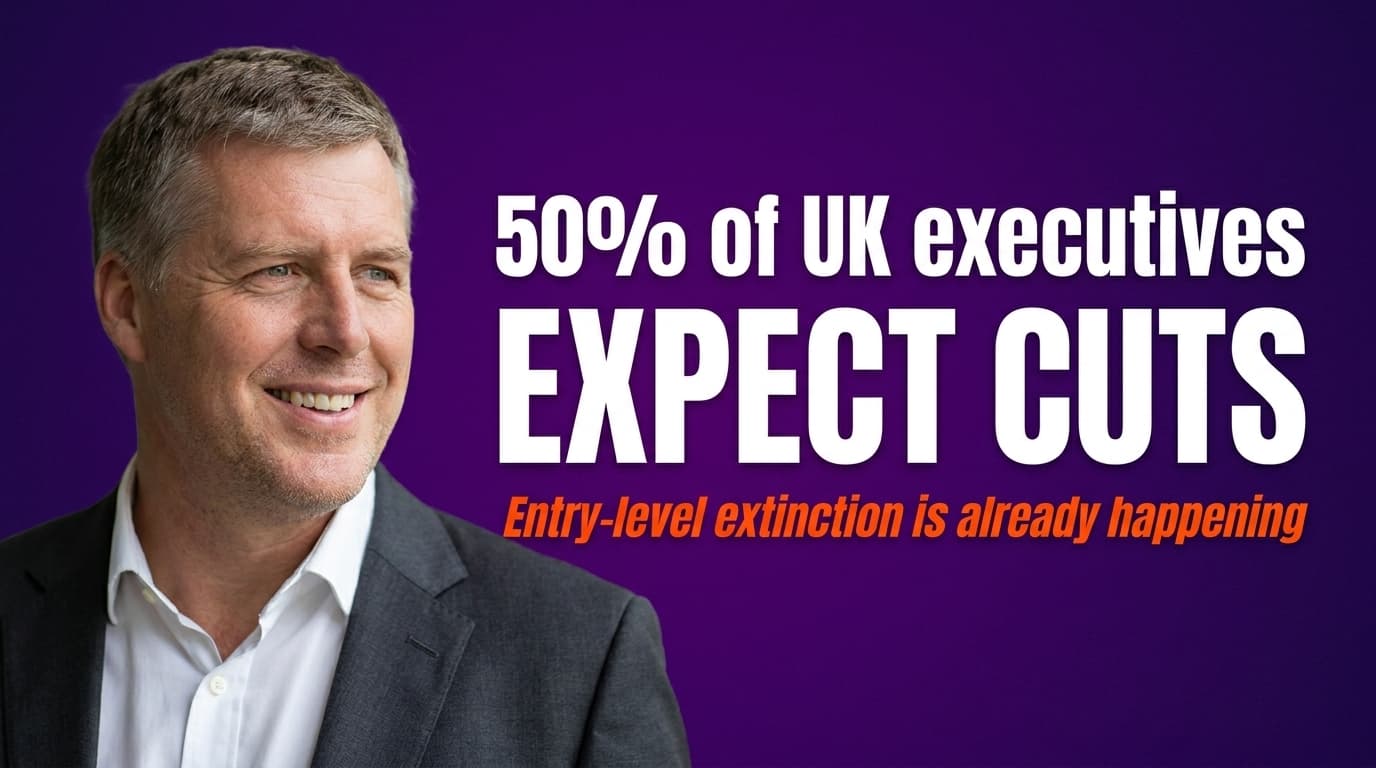
Half of UK executives expect AI to cut more jobs than it creates
TL;DR
Half of UK executives now expect AI to permanently eliminate more jobs than it creates over the next decade, up from roughly a third two years ago, according to a major new Accenture survey. The cuts are already materialising, over 78,000 tech layoffs in Q1 2026 alone, with nearly 48% attributed directly to AI and automation. The most serious risk is structural: entry-level roles are disappearing before anyone has worked out how to replace the talent pipeline built on them. The businesses that act now have a genuine window to build something stronger than what existed before.
What did the Accenture survey actually find?
A major new Accenture survey found that 50% of UK business leaders now expect AI to permanently eliminate more jobs than it creates over the next decade. Two years ago, when generative AI first exploded into public consciousness, that number sat at around a third. The shift in executive sentiment is not theoretical, these are the people making headcount decisions today, not forecasting abstractions from a conference stage.
What is the AI Solow Paradox and why does it matter?
Companies are aggressively cutting headcount to fund AI investments, while the promised productivity gains have not yet arrived for the vast majority of them.
Economists are calling it the "AI Solow Paradox." In Q1 2026 alone, over 78,000 tech workers were laid off globally, with nearly 48% of those cuts attributed directly to AI and automation. Meta cut 8,000 jobs. Oracle cut 30,000. These are not struggling companies, they are restructuring their entire operational models around AI.
And yet a landmark NBER study of 6,000 CEOs across the US, UK, Germany, and Australia found that nearly 90% of firms report no measurable impact on employment or productivity over the last three years. Executives are cutting with conviction before the productivity gains have materialised, because they already know which jobs the technology replaces.
Which roles are being cut first?
Data from Bloomberg, Boston Consulting Group, and the Accenture survey all point to the same target: entry-level positions in finance, administration, and customer service. BCG estimates approximately 15% of all US jobs face outright elimination within the next two to three years. The people most exposed are junior employees, interns, and recent graduates.
- Meta: 8,000 jobs cut
- Oracle: 30,000 jobs cut
- Verizon: 13,000 positions cut
- Jack Dorsey's Block: 40% of workforce cut
These are not distressed companies. These are profitable businesses rebuilding their operational models from the ground up.
Why is the entry-level extinction a structural crisis?
For decades, the corporate pyramid relied on a broad base of junior staff performing routine, repetitive tasks. That was not just how companies got basic work done, it was how they trained future leaders. You learned the business by doing the grunt work. You learned to write a contract by drafting fifty bad ones and having a senior partner mark them up. You learned financial modelling by spending two years wrestling with spreadsheets until your eyes bled.
Today, an AI agent drafts that contract in six seconds. It builds that financial model in under a minute. The economic incentive to hire a 22-year-old graduate at $65,000 a year to do work an algorithm handles for $40 a month is rapidly approaching zero.
A Pearson and AWS study found that 53% of employers across six countries are already struggling to find AI-ready graduates. The skills universities are teaching are no longer the skills businesses need at scale. If your primary value to an employer is your ability to summarise information, write basic code, or process data, your value has just been commoditised.
This creates a direct pipeline problem. If you stop hiring entry-level staff today because AI is cheaper, where do your mid-level managers come from in five years? How do you develop strategic thinkers, relationship builders, and complex problem solvers if you have removed the training ground where those skills are forged? It is like ripping out the foundations of a building to save on concrete and then wondering why the roof collapses.
See where AI fits in your business. Free.
A 45-minute audit. We map the highest-value automations and what they're worth in time and money. No pitch, no pressure.
How are executives handling the communication challenge?
Two approaches stand out and the contrast is instructive.
Verizon CEO Dan Schulman cut 13,000 positions and was blunt about why. He launched a $20 million career-transition fund to retrain displaced workers in cloud computing and cybersecurity. "Being authentic, being realistic, telling the truth as best you can, is the most essential thing, " he said. Schulman understood that pretending AI is not coming for jobs destroys trust faster than the layoffs themselves.
Jack Dorsey at Block cut 40% of his workforce, publicly cited AI with zero euphemisms, and predicted that competitors across the entire fintech industry would follow. Whether you agree with his methods or not, the transparency was striking.
The contrast matters more than you might think. A ManpowerGroup study found that 64% of employees are now staying with their current employer out of fear, not engagement, "job hugging, " clinging to roles they know are vulnerable because the alternative feels even more terrifying. That is not a productive workforce. A paralysed workforce does not innovate.
What is Singapore doing that Australia is not?
Singapore is acting decisively. Through their ONE Pass scheme, they have already attracted over 8,000 top-tier global professionals since 2023, recently updating it to recognise stock-based compensation for startups, making it easier for AI-native companies to import exactly the specific, high-level talent they need. Singapore is not trying to protect obsolete jobs. It is aggressively importing the people who know how to build the new ones.
Australia, meanwhile, is caught in a holding pattern. We have some of the strongest responsible AI governance frameworks in the world, but we are lagging significantly on productivity and execution. We are very good at discussing the ethical implications of AI. We are struggling to integrate it into workflows in ways that actually move the needle. While Australia debates the ethics, the global tech giants are reshaping the economic landscape we operate in.
What skills actually matter in an AI-driven economy?
For a century, the corporate world rewarded people who could process information quickly, follow established procedures accurately, and produce consistent, reliable output. Those are precisely the skills AI does better than humans.
The employees who will thrive in the next decade are the ones who can do what AI cannot:
- Build genuine relationships and maintain trust under pressure
- Navigate ambiguity where there is no established procedure
- Exercise ethical judgement in situations algorithms cannot frame
- Connect ideas across domains that an algorithm would never think to link
The ability to write a flawless email or format a perfect spreadsheet is no longer a competitive advantage. You need people who can ask the right questions, verify complex outputs, and operate at the intersection of human judgement and automated systems.
The companies that will win the next decade are not the ones with the biggest AI budgets. They are the ones that understand the human side of this transition, that invest in their people as aggressively as they invest in their technology, and that build cultures where AI is a tool for elevation, not a threat to be managed quietly.
What to do this week
1. Audit your org chart for exposure. Identify where a significant portion of your payroll is dedicated to routine data processing, basic administration, or initial customer triage. Those roles are going to be automated. It is not a question of if, but when. Plan that transition now, not when your competitors have already slashed their operating costs by 30%.
2. Redesign how you build expertise. If the entry-level grunt work disappears, expertise has to be built differently. Design intentional training programs focused on complex negotiation, strategic empathy, cross-functional problem solving, and AI orchestration. Teach junior staff to manage and audit AI systems, not compete with them.
3. Have an honest conversation with your team. Your employees are reading the same headlines you are. They know that 78,000 tech workers have been laid off. If you deploy a new AI tool and tell them it is "just to help them be more productive, " they will assume you are lying and preparing to fire them. Follow the Verizon model: be transparent about what is changing, explicit about which tasks are being automated, and clear about how you will support and retrain the people whose roles are affected.
4. Stop hiring for 2019. The skills that defined a strong hire five years ago have been commoditised. Start hiring for the reality of 2026: the ability to ask the right questions, think critically about AI outputs, exercise judgement where algorithms cannot, and build the relationships that no automation will replace. The transition is brutal, and it will get worse before it gets better, the businesses that make these decisions now are the ones that will still have a talent base worth leading in five years.
Where to from here
Book a free 60-minute AI audit, we'll explore exactly what workflows are worth augmenting with AI.
Live with passion & AI,
Brett
Host a podcast? Have Brett on as a guest.
Straight talk on implementing AI in real SMEs, no jargon, plenty of receipts from the businesses we run.
Frequently asked questions
What percentage of UK executives expect AI to cut jobs?
+
According to a major new Accenture survey, 50% of UK business leaders now expect AI to permanently eliminate more jobs than it creates over the next decade, up from roughly a third just two years ago.
How many tech workers were laid off due to AI in early 2026?
+
In Q1 2026 alone, over 78,000 tech workers were laid off globally, with nearly 48% of those cuts attributed directly to AI and automation. Meta announced cuts of 8,000 jobs and Oracle cut 30,000.
What is the AI Solow Paradox?
+
The AI Solow Paradox describes companies cutting headcount to fund AI investments while the promised productivity gains have not yet arrived. A landmark NBER study of 6,000 CEOs across the US, UK, Germany, and Australia found nearly 90% of firms report no measurable impact on employment or productivity over the last three years.
What percentage of US jobs could AI eliminate in the near term?
+
Boston Consulting Group estimates approximately 15% of all US jobs face outright elimination within the next two to three years, with entry-level roles in finance, administration, and customer service most at risk.
What is job hugging and how widespread is it?
+
Job hugging refers to employees staying with their current employer out of fear rather than genuine engagement. A ManpowerGroup study found that 64% of employees are doing exactly this, clinging to roles they know are vulnerable because the alternative feels worse.
Why is the entry-level talent pipeline under threat from AI?
+
AI can now draft a contract in six seconds and build a financial model in under a minute, tasks previously performed by junior staff. This removes the training ground where companies have historically developed their future leaders and strategic thinkers.
How is Singapore responding to the AI-driven talent crisis?
+
Singapore's ONE Pass scheme has attracted over 8,000 top-tier global professionals since 2023, recently updated to recognise stock-based compensation for startups. Rather than protecting obsolete roles, Singapore is actively importing talent capable of building new ones.

Brett is a four-time founder (Darra Tyres, Gladfish, EzyTrac, Anaboo) and the operator behind AIOS, Anaboo's AI Operating System. He writes from inside the build, installing AI in his own businesses first and reporting back what actually moves the numbers. Based between Singapore, the UK and Australia.