AI data fragmentation is why your departments can never agree
TL;DR
When each department builds AI on top of its own data export, you end up with multiple competing versions of the same business. Finance says one thing, sales says another, operations says a third. No AI tool will reconcile them for you, because the disagreement is in the data, not the model. The fix happens before you touch the AI.
The numbers have always disagreed, AI just made it louder
Most businesses have been running on fragmented data for years. The CRM holds one version of customer activity. The accounting system holds another. The operations platform, the support desk, the spreadsheet someone in finance built four years ago and never quite retired, each one is a slightly different picture of the same company.
Before AI, the disagreement was manageable. Numbers were compared in a monthly meeting, someone would shrug and say the systems do not talk to each other, and everyone moved on. The cost was a few hours of confusion and some imprecise decisions.
AI changes the cost structure. When a team uses an AI tool, that tool reasons from whatever data it has been given. If sales feeds it a CRM export, it reasons from the CRM's version of reality. If finance feeds it an accounting export, it reasons from a different version. Both tools are working correctly. Both are producing answers that cannot be reconciled.
What running your own AI actually means
When a department runs its own AI, what that usually means in practice is: a team has connected an AI tool to a data source they control. That data source is either a live integration into one system, or more commonly, a file export they prepared at a point in time.
That second option is the quiet disaster. A data export is a photograph. It captures one moment. The business keeps moving. Three days after that export was taken, deals have closed, invoices have been raised, customers have churned. The AI is still reasoning from the photograph.
Now imagine three departments doing this simultaneously, each with their own photograph taken at a different time, from a different angle, using a different camera. When the AI tools produce their outputs, every output reflects a different moment in a different subsystem. The outputs are not wrong, exactly. They are just incompatible.
You do not have an AI problem. You have a data architecture problem that AI has made impossible to ignore.
The definition problem hiding inside your own terminology
Even before you get to the export timing issue, there is a more fundamental one: departments do not agree on what words mean.
Take revenue. To the sales team, it might mean the value of deals signed this month. To finance, it means cash received or invoiced amounts recognised under your accounting policy. To the CEO's dashboard, it might be a blend of both, depending on what the report template was built to show.
None of these is wrong. They are different, valid, and useful definitions depending on the question being asked. The problem is that when separate AI tools are trained or prompted on each department's data, the word revenue in each tool's outputs means something different. And nobody told the AI that.
The same thing happens with customer, lead, project, active account, and almost every other noun a business runs on. Each department has quietly adopted its own working definition, usually without realising it, often because their system enforced it.
See where AI fits in your business. Free.
A 45-minute audit. We map the highest-value automations and what they're worth in time and money. No pitch, no pressure.
The meeting where four teams bring four different answers
Picture a quarterly review. The sales director's AI summary shows pipeline conversion is improving. The finance AI shows that average deal value has dropped. The operations AI flags that delivery times are lengthening. The marketing AI reports that lead quality is at a high.
All four outputs came from AI tools working correctly on the data available to them. None of the teams is lying or incompetent. But the four pictures do not form a coherent whole, and the leadership team cannot use them to make a single confident decision.
This meeting used to happen without AI, and it was frustrating. With AI, it is worse, because everyone now arrives with a confident, well-formatted, AI-generated summary that feels authoritative. The confidence level in the room has gone up. The accuracy of the combined picture has not.
Connecting systems is not the same as aligning them
The standard response from most technology vendors is integration. Connect your CRM to your finance system. Pipe everything into a data warehouse. Run a single BI dashboard. This advice is correct in principle. It is also harder than it sounds and does not, by itself, solve the definition problem.
Two systems can be connected and still disagree. If the CRM and the accounting platform define customer differently, a pipeline that joins them will produce a joined dataset with the same definitional conflict baked in. Your AI tool will now reason from a larger, joined, still-inconsistent dataset.
The work that actually fixes the problem is semantic alignment: agreeing, explicitly, on what each key term means across the business, and ensuring that definition is enforced at the point of entry into each system. That is not an AI project. It is a data governance project. AI can augment the process of finding inconsistencies, flagging outliers, and surfacing definitional drift. But it cannot decide, on behalf of your business, that revenue should mean one thing and one thing only.
Why AI tools cannot reconcile data on your behalf
There is a persistent belief that a sufficiently capable AI can sort out messy data. Feed it everything, let it figure out the contradictions. This belief is wrong, and the reason matters.
An AI model reasons from the information it is given. If that information contains two conflicting figures for the same metric, the AI has no way to know which is correct. It might average them, pick one, flag the discrepancy, or ignore it, depending on how it was set up. In none of those cases has it resolved the underlying problem. It has just chosen a response to the problem.
The authority to decide which version of a metric is correct belongs to your business, not your AI tool. That decision requires context: why the systems differ, which one reflects the policy you actually want to enforce, and what the downstream consequences of each choice are. An AI can surface the question. Only your business can answer it.
What a shared operating layer changes
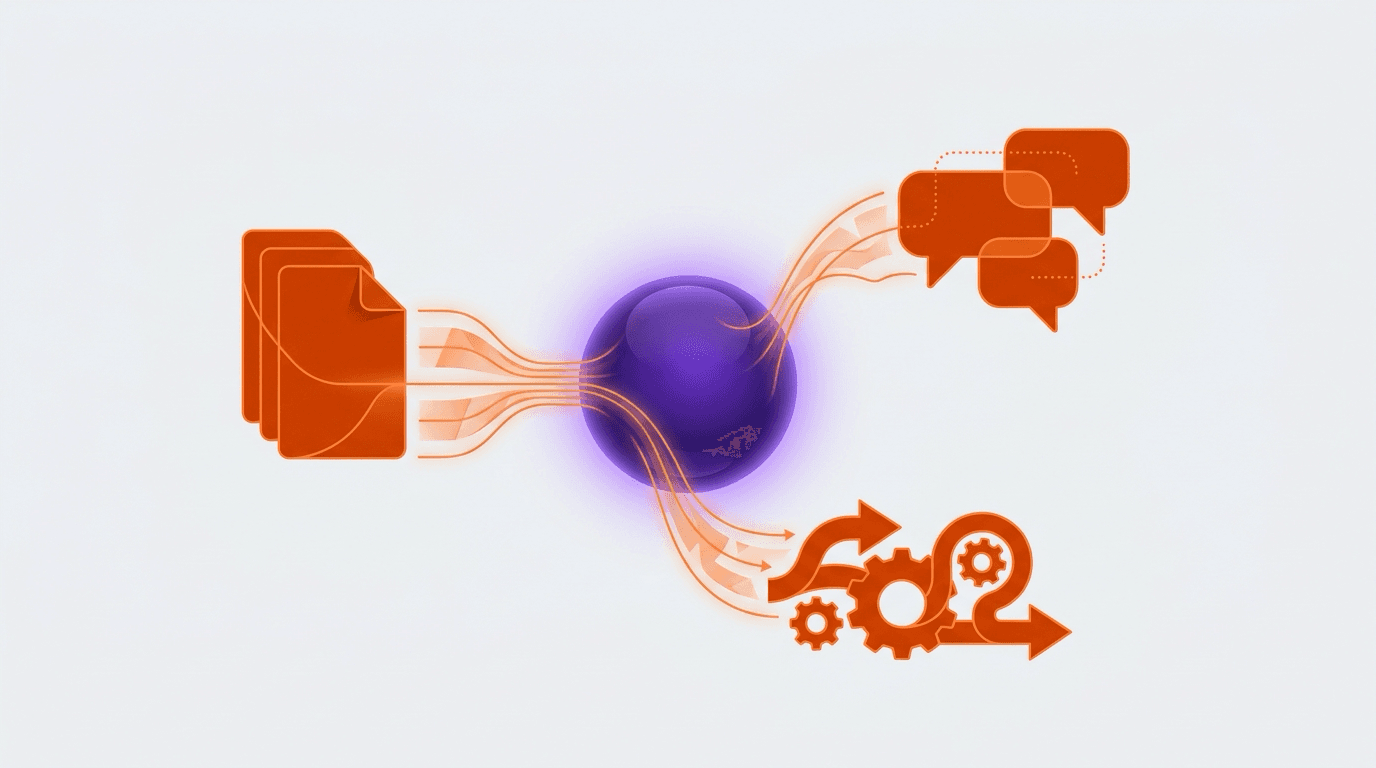
The businesses that get consistent AI outputs across departments share one characteristic: they work from a single operating layer. One system of record for customers. One definition of each key metric, written down and enforced. One data pipeline that every AI tool reads from, rather than each team's own export.
This is what AIOS is built around. Not a collection of AI tools bolted onto separate departmental systems, but a single layer that every function can augment from. When sales and finance are both looking at the same underlying data, with the same definitions applied, the AI outputs are comparable. The quarterly review becomes a question of interpretation, not a dispute about whose numbers are right.
Getting there requires deliberate choices about which system of record to trust for each data type, and explicit conversations about definitions. Those conversations are not glamorous. They are some of the most valuable work a leadership team can do before deploying AI at scale.
What to do this week
- Pick one metric your business uses frequently, revenue or active customers being good starting points, and ask three different teams what it means. Document where the definitions diverge.
- List every data export or snapshot that a team is currently feeding into an AI tool. Note the date each export was taken and how often it is refreshed.
- Identify the one AI output your leadership team trusts least. Trace it back to its data source and find out when that source was last validated against your system of record.
- Commit to one data definition in writing. Choose the metric that causes the most confusion, agree on a single definition, write it down, and share it across teams. That single decision will improve every AI output that depends on it.
- Before adding another AI tool to any department, ask: what data will it read from, and is that the same data every other AI tool in the business reads from?
Where to from here
Book a free AI audit and we'll show you what's worth augmenting first in your business, and what isn't.
Live with passion & AI,
Brett
Host a podcast? Have Brett on as a guest.
Straight talk on implementing AI in real SMEs, no jargon, plenty of receipts from the businesses we run.
Frequently asked questions
What causes AI data fragmentation across departments?
+
Each department typically connects its AI tools to its own system or data export. Because these systems capture different things at different times with different definitions, the AI outputs reflect those differences rather than a unified business reality.
Can AI fix data fragmentation automatically?
+
No. AI tools reason from the data they are given. If that data contains conflicts or inconsistencies, the AI will produce outputs that reflect those conflicts. Deciding which version of a metric is correct requires a business decision, not an AI one.
What is the most common cause of different numbers between departments?
+
Definitional drift. Words like revenue, customer, and active account tend to mean different things to different teams, often because the systems they use enforce different interpretations. The disagreement exists before any AI tool is involved.
Does connecting systems with integrations solve the problem?
+
Connecting systems is necessary but not sufficient. Two integrated systems can still disagree if they use different definitions for the same terms. Semantic alignment, agreeing on what each key term means across the business, has to happen first.
How does AIOS address department-level data fragmentation?
+
AIOS provides a single operating layer that all functions work from. Rather than each team connecting AI tools to their own data exports, every AI output draws from the same underlying data with the same definitions applied consistently.
What is the first step to fixing AI data fragmentation?
+
Pick one metric your business uses regularly and ask three different teams what it means. Where the definitions diverge is where your fragmentation problem lives. Starting there is more useful than starting with the technology.
Is data fragmentation a new problem created by AI?
+
No. Data fragmentation existed long before AI. AI makes it more visible and more costly because AI tools produce confident-sounding outputs that amplify the underlying inconsistency rather than obscuring it in manual calculations.

Brett is a four-time founder (Darra Tyres, Gladfish, EzyTrac, Anaboo) and the operator behind AIOS, Anaboo's AI Operating System. He writes from inside the build, installing AI in his own businesses first and reporting back what actually moves the numbers. Based between Singapore, the UK and Australia.