AI layoffs myth: why tech companies blame AI and the real skills gap crisis
TL;DR
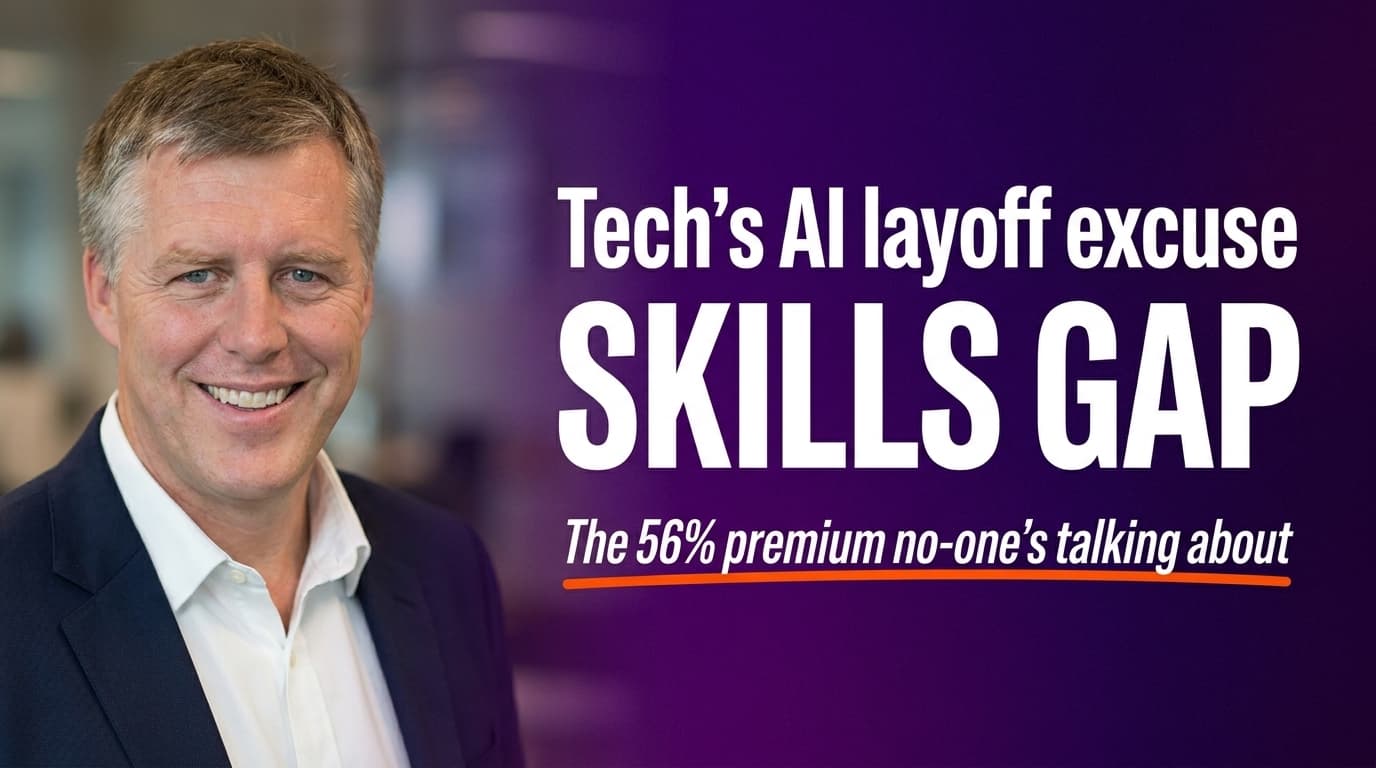
Tech companies blaming AI for layoffs are mostly running cover for pandemic over-hiring and a cash flow reckoning. Goldman Sachs puts real AI-driven job displacement at just 2.5%. The actual crisis is a widening skills gap, PwC data shows workers with AI skills command a 56% wage premium over their peers. This is not job destruction; it is a structural shift in who gets paid.
Are tech companies really cutting jobs because of AI?
No. The real driver is a financial correction, not a technological one. During the pandemic, tech companies hired at an unsustainable pace, fuelled by cheap capital and the assumption that the digital boom would last forever. It did not. When inflation rose and interest rates bit, investors stopped rewarding growth at any cost and demanded a clear path to profitability. The result: CFOs walking into boardrooms with burn-rate spreadsheets, not robot deployment plans.
Framing it as AI-driven is a PR strategy. It sounds forward-thinking and inevitable, a force of nature, not a leadership failure. It is much easier to say "the future made us do it" than to admit a forecasting mistake. When companies like Atlassian and Block announce layoffs, the narrative about AI-driven efficiencies and automated workflows lands better than the real one: we over-hired, the boom ended, and the payroll is now a liability.
What do the real numbers say about AI job displacement?
The data is nowhere near as alarming as the headlines suggest. Goldman Sachs puts the number of jobs genuinely at risk of full displacement from AI at just 2.5%. Two point five percent. The University of Sydney reached similar conclusions, noting that current layoffs are concentrated in the very companies that grew at unsustainable rates, not in industries being hollowed out by automation.
- Goldman Sachs: 2.5% of jobs at risk of full displacement from AI
- University of Sydney: layoffs are concentrated in pandemic-era over-hirers, not automation victims
- The real driver: burn rate management and a return-to-profitability mandate from investors
The story being sold to the public does not match the story in the financials. When a CEO blames AI for layoffs, the right question is what is really happening behind the scenes. The truth is usually found in the accounts, not in the code.
What is the 56% AI wage premium, and why does it matter?
This is the part of the story that gets buried. While the public debate fixates on job losses, a PwC report found that workers with AI skills command a 56% wage premium over peers with similar experience. In the same company, two people with near-identical backgrounds can have a 56% difference in their pay packet, simply because one understands how to leverage AI.
This is not about being a coder or an engineer. It is about understanding how to apply AI to decision-making, customer strategy, and workflow efficiency. Workers who can build, manage, and strategise with AI are becoming disproportionately valuable. That is not job destruction; it is wealth creation concentrated in a specific, learnable skill set.
In the same company, two people with similar experience can have a 56% difference in their pay packet, simply because one of them understands how to leverage AI.
Wages in industries heavily exposed to AI are also rising at twice the rate of other sectors. The market is already pricing in the skills gap. The question is which side of it your people are on.
See where AI fits in your business. Free.
A 45-minute audit. We map the highest-value automations and what they're worth in time and money. No pitch, no pressure.
Is there a genuine transition cost?
Yes, and it would be dishonest to pretend otherwise. US Federal Reserve Governor Lisa Cook warned of "job displacement before job creation." That sequence matters. The high-value AI roles are appearing, but the roles being disrupted come first. It is not a clean one-for-one swap where a displaced worker steps into a new position the following Monday.
For people caught in the middle, mid-career professionals whose roles are being automated faster than retraining can occur, this is a period of real hardship. A logistics professional with 20 years of experience finding that AI now automates 80% of their daily tasks is not facing a robot; they are facing a skills gap with a mortgage and dependants behind them. Economists talk about "frictional unemployment" and "labour market fluidity." For the people living through it, it is a period of immense stress and anxiety.
Acknowledging this is not defeatist. It is honest. Structural economic shifts are never smooth rides, and this one is no different.
Why are AI-skilled workers becoming so valuable so fast?
Because the companies investing in AI are not looking at it as a headcount-reduction tool, they are looking at it as a revenue multiplier. The people who can turn AI from an experiment into a profit engine are in short supply. That scarcity is what drives the premium.
The pattern is consistent:
- Workers who retrain and adopt AI tools see accelerating wage growth
- Workers who treat AI as a passing fad find their roles incrementally automated until those roles restructure entirely
- The gap between the two groups widens each year
This is a structural shift in where economic value is created. The businesses and workers who understand that early have a significant and compounding advantage over those who are waiting for certainty.
What does this mean for your business?
The wrong question is: "Do I need to cut staff because of AI?" The right question is: "How do I find, afford, and retain the people with AI skills to make my business more valuable?"
That 56% wage premium is a warning shot. Businesses are entering a bidding war for talent they did not know they needed eighteen months ago. Meanwhile, competitors are not using AI to trim headcount, they are using it to generate revenue that was impossible before. They are hunting for people who can turn AI from a cost centre into a profit engine.
Every dollar spent on low-skill, repetitive tasks is a dollar not spent on innovation. Every employee stuck doing manual data entry is an employee not thinking about growth. Companies that do not engage with this shift will be slower, less efficient, and unable to attract the talent they need. They will be building in the old economy while their competitors build the new one.
The challenge for business leaders is not managing decline. It is building a team that can thrive, through retraining existing staff, identifying internal champions early, creating a culture of continuous learning, and being honest about which skills the business will actually need in three years.
What to do this week
- Audit your skills gap. List your top 10 recurring tasks. Which could be partially automated with existing AI tools? Who on your team is closest to being able to lead that transition?
- Find your internal champion. Look for one person already leaning into AI tools in your business. Invest in them visibly, it signals to the rest of the team what is now valued.
- Stop using AI as a budget excuse. If you are restructuring, be honest about why. Blaming AI when the real cause is financial mismanagement erodes trust and makes future change harder.
- Share the PwC wage data with your leadership team. The 56% premium is a current market signal, not a forecast. It is happening now.
- Start a retraining conversation. Not a formal programme, just a conversation. Ask your team: what is one thing AI could take off your plate, and what would you do with that time?
Where to from here
Book a free 60-minute AI audit, we'll explore exactly what workflows are worth augmenting with AI.
Live with passion & AI,
Brett
Host a podcast? Have Brett on as a guest.
Straight talk on implementing AI in real SMEs, no jargon, plenty of receipts from the businesses we run.
Frequently asked questions
Are AI really causing the current wave of tech layoffs?
+
No. Goldman Sachs puts the number of jobs genuinely at risk of full AI displacement at just 2.5%. The University of Sydney found that recent layoffs are concentrated in companies that over-hired during the pandemic, this is a financial correction, not an AI takeover.
What is the AI skills wage premium according to PwC?
+
A PwC report found that workers with AI skills command a 56% wage premium over peers with similar experience. Two people with near-identical backgrounds in the same company can have a 56% difference in their pay packet simply because one understands how to leverage AI.
What did Goldman Sachs say about AI job displacement?
+
Goldman Sachs estimated that only 2.5% of jobs are at real risk of full displacement from AI, far removed from the apocalyptic scenarios dominating mainstream headlines.
What did US Federal Reserve Governor Lisa Cook say about AI and jobs?
+
Federal Reserve Governor Lisa Cook warned of 'job displacement before job creation', acknowledging that disruption of existing roles will precede the emergence of new AI-era positions, making the current transition period genuinely difficult for many workers.
Why are tech companies like Atlassian and Block framing layoffs as AI-driven?
+
Blaming AI is a PR strategy that frames financially motivated restructuring as an inevitable technological shift. It sounds forward-thinking rather than like a forecasting failure, and taps into genuine public anxiety about automation to deflect accountability.
How fast are wages rising in AI-exposed industries?
+
Wages in industries heavily exposed to AI are rising at twice the rate of other sectors. Workers who adopt AI skills see accelerating pay growth, while those who do not find their roles incrementally restructured until they no longer resemble the original position.
What should business leaders do about the AI skills gap?
+
The right question is not whether to cut staff because of AI, but how to find, retain, and develop people with AI skills. Retraining existing employees, identifying internal AI champions, and building a culture of continuous learning are the practical starting points.

Brett is a four-time founder (Darra Tyres, Gladfish, EzyTrac, Anaboo) and the operator behind AIOS, Anaboo's AI Operating System. He writes from inside the build, installing AI in his own businesses first and reporting back what actually moves the numbers. Based between Singapore, the UK and Australia.