AI scams cost the UK £9.4 billion, your business is next
TL;DR
AI-powered fraud has drained £9.4 billion from the UK economy across more than 444,000 cases. Nearly half of all crime in England and Wales is now fraud. Only 36% of adults believe they can spot an AI-generated scam, which means your team almost certainly cannot either. Your existing cybersecurity was built for a different era. It will not protect you from attacks designed to exploit psychology, not systems.
What is the actual scale of AI fraud in the UK?
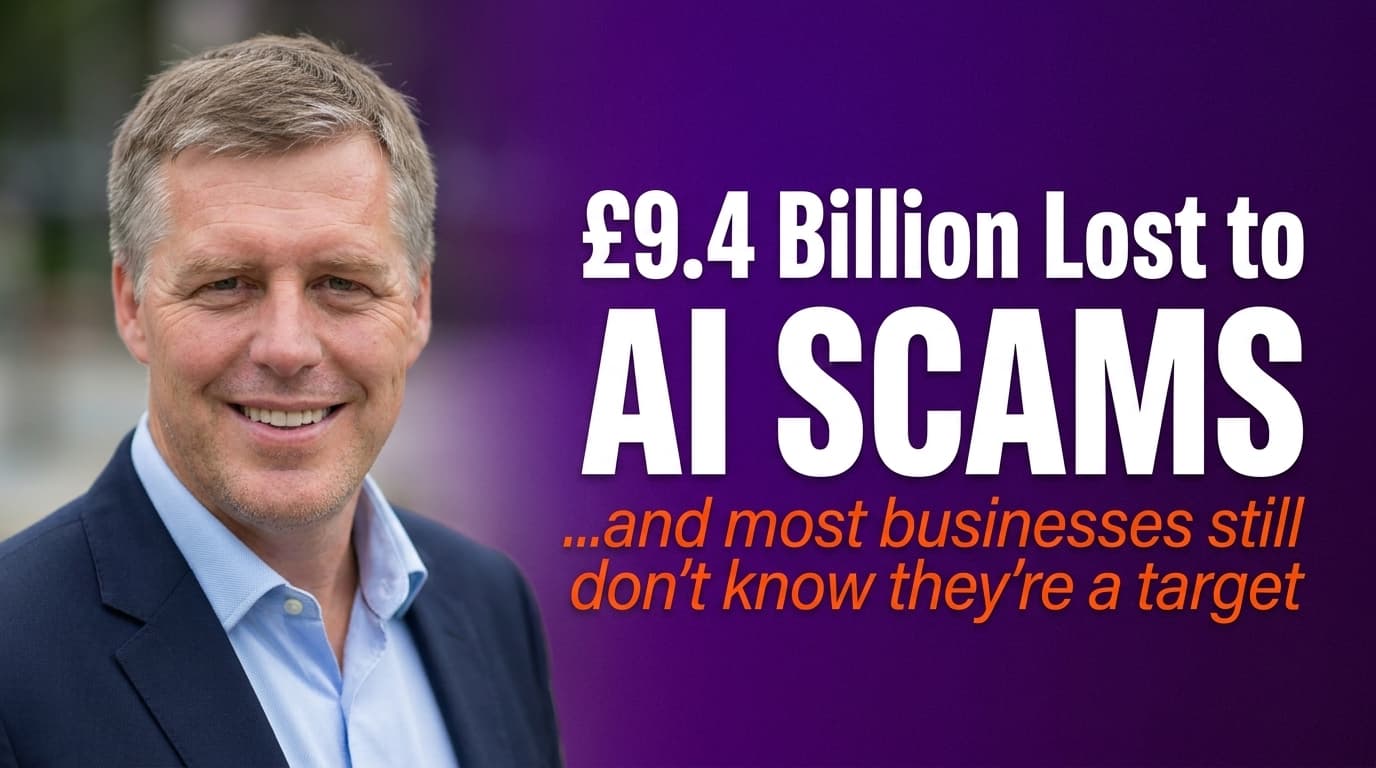
£9.4 billion. That is not a forecast or a hypothetical warning. That is the amount of cold, hard cash drained from the UK economy by AI-driven scams, across more than 444,000 individual cases. We have reached the point where nearly half of all crime in England and Wales is now fraud. This is not a niche problem affecting a handful of unlucky individuals. It is a mainstream economic disaster.
- £9.4 billion stolen from the UK economy by AI-powered fraud
- 444,000+ individual fraud cases recorded
- ~50% of all crime in England and Wales is now fraud
Those numbers represent the current state of play, not a projection.
How is AI fraud different from old-school phishing?
Forget the clumsy, poorly-worded emails from a supposed Nigerian prince. Those were detectable. What we are dealing with now is qualitatively different.
Today's AI-powered attacks are:
- Hyper-personalised, crafted using data scraped from your website, LinkedIn, and public communications
- Voice-cloned, criminals replicate a senior executive's voice to authorise fraudulent payments by phone
- Pattern-aware, AI analyses your company's existing communication history to send perfectly timed, perfectly worded requests
A business owner I spoke to runs a successful logistics company. He received an invoice that looked exactly like one from a regular supplier, correct logo, correct job number, correct formatting. The only change was the bank account number. A junior accounts person paid it. £50,000 gone.
He told me the worst part was not the money. It was the realisation that his processes, his team, and his own due diligence had been so easily bypassed.
He had built his business on relationships and trust, and a machine had just weaponised that against him.
This is not about tricking the gullible. It is about overwhelming the diligent.
Is the threat limited to financial fraud?
No. Fake invoices and fraudulent bank transfers are just the entry point. The deeper threat is the weaponisation of information and the systematic destruction of your brand's reputation.
In the UAE, authorities arrested ten people for spreading AI-generated fake videos. The stated goal was to sow panic and destabilise society. It is a clear demonstration that the same technology that fakes an invoice can also fake a CEO's announcement, a product recall, or a damning investigative report.
I watched a promising tech startup nearly lose a major funding round after a competitor seeded deepfaked audio clips, seemingly the founder admitting to faking performance metrics, across anonymous forums and social media accounts. The investors got cold feet. The deal stalled. By the time the startup had disproved the claims, the opportunity was gone. They spent months fighting a ghost, trying to prove a negative.
We are not just fighting to protect our bank accounts. We are fighting to protect the very concept of truth in our communications.
This is corporate warfare, not hacking servers, but hacking minds.
What does AI disinformation actually do to a business?
Consider what a single credible piece of disinformation can achieve:
- Manipulate stock prices or investor sentiment
- Torpedo a partnership on the eve of signing
- Turn a loyal customer base against you overnight
- Stall a funding round indefinitely
You spend years, sometimes decades, crafting a reputation for quality, reliability, and service. A single, well-crafted deepfake can unravel all of that in an afternoon. Your brand narrative is your most valuable asset, and in a world where seeing is no longer believing, it is also your most exposed.
See where AI fits in your business. Free.
A 45-minute audit. We map the highest-value automations and what they're worth in time and money. No pitch, no pressure.
Why is trust the real casualty?
Only 36% of adults feel confident they can spot an AI-generated scam. Nearly two-thirds of your customers, employees, and partners are navigating a digital world they can no longer read with certainty.
When trust evaporates, commerce follows. Customers who cannot verify whether an email came from you will stop clicking, stop engaging, and eventually stop buying. The cost of AI fraud is not only the money that gets stolen, it is the vast, unquantifiable loss of business that comes from a market paralysed by suspicion.
An e-commerce operator selling high-end bespoke furniture had her customer database breached. The attackers did not steal money directly. Instead, they launched a targeted phishing campaign using her own brand voice, her logos, and her pricing structure, a fake 50% discount on her new collection. A handful of her best clients fell for it. The financial loss was real, but the deeper wound was the collapse of trust. Her most loyal customers, previously her biggest advocates, are now suspicious and feel betrayed. Her sales have dropped, not because of the competition, but because the trust underpinning her entire business model has been compromised.
That is the slow, silent death of a sales pipeline.
Is traditional cybersecurity enough to stop these attacks?
No. Not even close.
Traditional cybersecurity was built for a different category of threat, one aimed at systems. These attacks are aimed at psychology. Your firewall cannot stop an employee from paying a fraudulent invoice that looks completely genuine. Your anti-virus cannot stop a customer from handing over details to a phishing site that perfectly mirrors your own brand.
The weakest link in your security chain is not your software. It is your people, and that is precisely where AI-powered attacks are directed.
Think about these vectors:
- An email from "the CEO" with an urgent, slightly unusual request
- A supplier updating their bank details with a convincing new account number
- A call from "your bank" where the person on the other end recites your recent transaction history
Each of those is a human decision, not a system vulnerability. No legacy software will close that gap.
What does an effective defence actually look like?
Three layers. Not one.
1. Advanced AI detection tools You need tooling that can identify the subtle, near-invisible signatures of machine-generated fakes, in email content, audio, video, and document formatting. Standard spam filters will not catch them.
2. Continuous, realistic employee training Not the annual tick-box compliance exercise. Immersive, live simulations that replicate the actual attacks your team will face. Repetition builds instinct. Instinct is the only thing that catches a near-perfect fake in real time.
3. Secure, authenticated customer channels Your customers need to know exactly how to verify that any communication claiming to be from you is genuine. Build those verification mechanisms proactively, before you need them in a crisis.
The old playbook is broken. Incremental upgrades to broken infrastructure will not save you.
What to do this week
- Brief your team today. Walk them through a real example, the £50,000 invoice scam, the voice clone call, the deepfaked audio clip. Make it concrete. Do they understand that these attacks target psychology, not systems?
- Audit your payment verification process. Any change to supplier bank details or any payment above a defined threshold should require a callback to a pre-verified number, never a number supplied in the email requesting the change.
- Map your trusted communication channels. Document every legitimate channel you use to contact customers. Send that list to your customers directly so they know what is real and what to be suspicious of.
- Review your AI detection tooling. Are your email filters AI-aware? Can they detect spoofed domains, cloned writing styles, and deepfaked attachments? If the answer is uncertain, that is your answer.
- Run one simulated phishing attack against your own team. The result will tell you more about your actual vulnerability than any audit report ever will.
Where to from here
Book a free 60-minute AI audit, we'll explore exactly what workflows are worth augmenting with AI.
Live with passion & AI,
Brett
Want this installed in your business?
Bespoke AI implementation across your operations: strategy, build, rollout, and ongoing drift maintenance.
Frequently asked questions
How much have AI scams cost the UK economy?
+
AI-driven scams drained £9.4 billion from the UK economy across more than 444,000 individual cases. We have now reached the point where nearly half of all crime in England and Wales is fraud.
What is voice cloning fraud and how does it target businesses?
+
Voice cloning fraud uses AI to replicate a senior executive's voice and then phones employees to authorise fraudulent payments over the phone. The replicated voice is virtually indistinguishable from the real person.
How does AI-powered business email compromise work?
+
AI analyses a company's existing communication patterns and crafts perfectly timed, perfectly worded emails that mimic suppliers, colleagues, or leadership. The goal is usually a fraudulent payment or a data handover.
What percentage of adults can spot an AI-generated scam?
+
Only 36% of adults feel confident they can identify an AI-generated scam. That means nearly two-thirds of your customers, employees, and partners cannot reliably distinguish real communications from fake ones.
Can deepfakes be used to damage a business's reputation?
+
Yes. Deepfaked audio or video of a founder or executive can kill funding rounds, torpedo partnerships, and erode customer trust rapidly. In the UAE, ten people were arrested for spreading AI-generated fake videos specifically designed to destabilise public trust.
Why doesn't standard cybersecurity protect against AI fraud?
+
Traditional cybersecurity targets systems, not psychology. AI scams are designed to exploit human trust, a fake invoice that looks genuine, a spoofed call from your bank that recites your real transaction history. A firewall cannot stop a trained employee from paying a convincing fraudulent invoice.
What three things should a business do to defend against AI fraud?
+
First, deploy advanced AI detection tools capable of spotting machine-generated fakes. Second, run continuous, realistic employee training with live simulations rather than annual tick-box exercises. Third, build secure, authenticated communication channels so customers know exactly how to verify anything claiming to come from you.

Brett is a four-time founder (Darra Tyres, Gladfish, EzyTrac, Anaboo) and the operator behind AIOS, Anaboo's AI Operating System. He writes from inside the build, installing AI in his own businesses first and reporting back what actually moves the numbers. Based between Singapore, the UK and Australia.