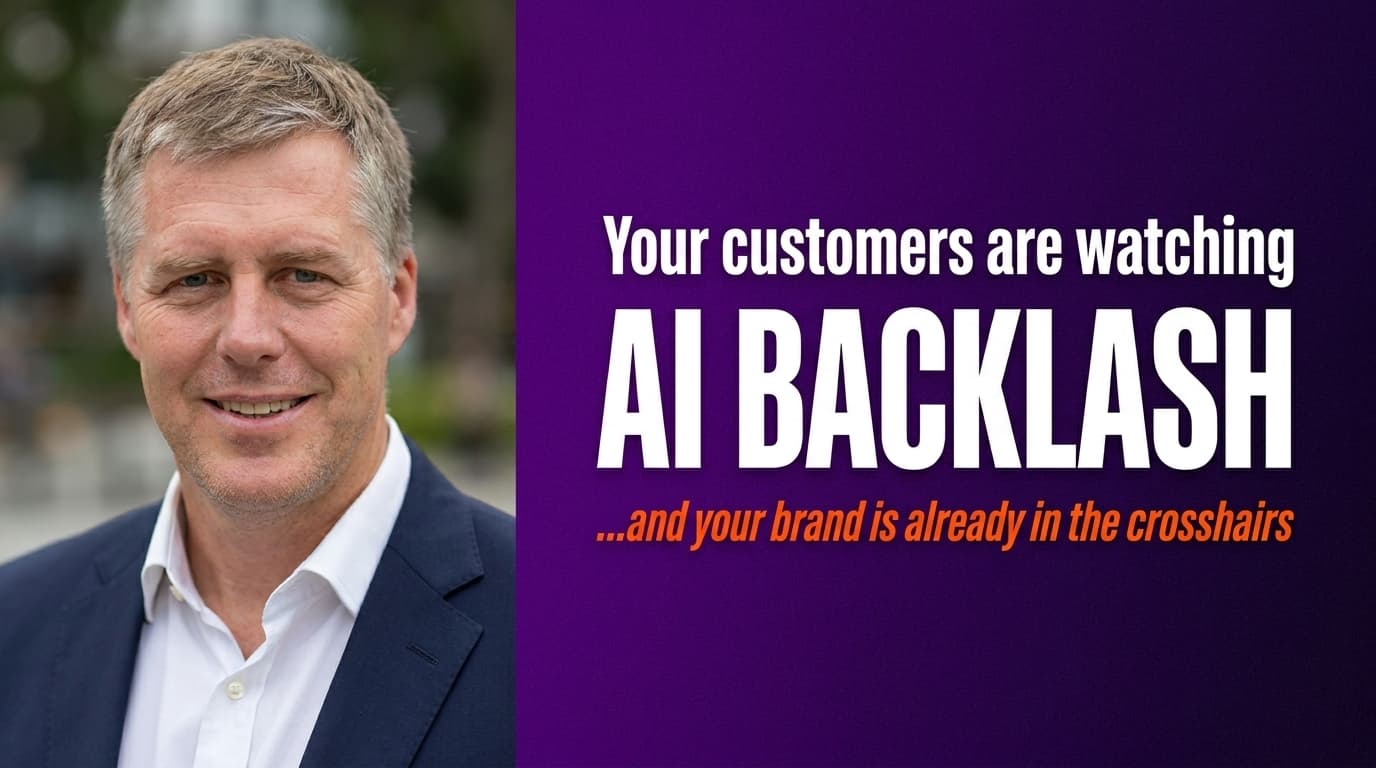
Your customers are turning against AI, are you ready for the backlash?
TL;DR
Customers are not warming to AI, they are growing suspicious of it. Three forces are driving the backlash: the staggering environmental cost of data centres, the tidal wave of hollow AI-generated content flooding every channel, and the creeping use of AI for workplace and customer surveillance. Businesses that ignore this shift are not being innovative. They are building a brand liability.
Why is the AI backlash accelerating right now?
You have been sold the story that AI is the future. Efficiency. Productivity. Cost-cutting. The holy trinity of modern enterprise. But while you have been busy integrating the next shiny tool, the ground has been shifting. Your customers, the very people you are trying to serve, are starting to see AI not as a helpful assistant, but as a threat.
This is not a fringe movement. It is mainstream, it is growing, and it is coming for your brand.
The backlash is not irrational. It is the accumulation of three legitimate grievances that businesses have been remarkably slow to acknowledge.
What is the real environmental cost of AI?
Progress for the sake of progress is no longer a defensible position.
Every AI query spins up a chain of processors in a massive, air-conditioned warehouse somewhere, guzzling electricity at a rate that rivals entire cities. We have been conveniently ignoring this dirty secret behind the AI revolution.
It is not just energy. Data centres generate colossal heat and need billions of gallons of water annually for cooling, often in areas already struggling with water scarcity. The image is stark: while communities are asked to conserve water, a silent, humming facility down the road is drinking them dry.
This is no longer abstract:
- UK Members of Parliament have warned that Britain's AI ambitions are on a collision course with its climate targets
- Local councils from Edinburgh to New Jersey are rejecting proposals for new data centres on environmental grounds
- Regulators and communities are no longer willing to separate the question of capability from the question of consequence
The question has shifted from "Can we do this?" to "Should we?"
Your customers are more environmentally conscious than ever. If they see you championing AI without acknowledging its environmental toll, they will see you as disingenuous at best, and actively harmful at worst. As resources become scarcer and regulations tighten, businesses that have built their models on unsustainable infrastructure will find themselves at a dead end.
What is AI 'slop' and why is it killing your brand?
You slop, you flop.
Remember when the internet was a place of genuine discovery? Now it is increasingly a digital landfill, choked with low-quality, soulless, AI-generated content. Your customers are sick of it.
The promise was that AI would free us from the drudgery of content creation. The reality is that it has created a race to the bottom. Marketers have seized on AI to churn out blog posts, social media updates, and entire websites at the click of a button. But here is what they forgot: your customers are not idiots. They can spot a fake. They can feel the emptiness in the words, the absence of genuine insight, the lack of a human soul behind the screen.
Every piece of slop you publish is a small withdrawal from your brand's trust account. And once that account is empty, it is incredibly difficult to refill.
Filling your channels with generic AI-generated content sends a clear message: you do not value your audience's time or their intelligence. You are more interested in gaming the algorithm than having a real conversation. That is how trust erodes, not in one dramatic moment, but in a thousand hollow interactions.
This extends beyond the written word. It is the uncanny valley of AI-generated images, the robotic monotone of AI-powered customer service, the soulless automation of interactions that should feel human. People are craving authenticity. They are desperate for real connection in an increasingly artificial world.
The businesses that thrive will be the ones that use technology to enhance human connection, not the ones that use it as a substitute.
See where AI fits in your business. Free.
A 45-minute audit. We map the highest-value automations and what they're worth in time and money. No pitch, no pressure.
Is AI surveillance destroying trust with your employees and customers?
There is a darker dimension beyond environmental concerns and content quality: the creeping fear of a surveillance state.
In the workplace, AI is being deployed to track every keystroke, monitor every conversation, and analyse every minute of an employee's day. The justification is always productivity, efficiency, performance. The reality is that it creates a culture of fear and mistrust. Employees who feel constantly watched do not become more productive. They become more stressed, more resentful, and more likely to leave. You are treating them like cogs in a machine, and they are responding in kind.
The same suspicion is spilling into the customer experience. When your customers interact with your business, are they being helped, or monitored? Are their conversations being recorded and analysed for your benefit rather than theirs? Are their online behaviours being tracked and profiled not to provide a better service, but to sell them more? These are the questions running through their minds. And the more they hear about AI's surveillance capabilities, the more suspicious they become.
Trust is the bedrock of any successful business relationship. When you use AI to monitor customers, you are sending a clear message that you do not trust them. And if you do not trust them, why should they trust you?
The reputational risk is immense. A single story about your company using AI in a way perceived as intrusive or manipulative can undo years of brand-building. In the age of social media, that story spreads fast, and you are left to deal with the ashes.
The conversation around AI and privacy is only going to get louder. The businesses that put their customers' privacy and trust first are the ones that will build the kind of loyalty no amount of data can buy.
How does this apply to your business specifically?
You might be thinking: we are just a small business using AI to answer queries faster. The lure of efficiency is real. But step back and ask the hard questions.
When you adopted that AI tool, did you think about how customers would perceive it? Did you consider that the human interaction you are replacing might be exactly what your customers value most about your business? That friendly exchange with a real person, the sense of being heard and understood, is not a trivial thing. It is the lifeblood of customer loyalty.
Are you transparent about your use of AI? If it is buried in the small print of your terms and conditions, you have built a ticking time bomb. The moment customers discover they have been talking to a machine when they believed they were talking to a person, you have lost them. The sense of betrayal is real, and it is not something you easily recover from.
This is no longer a technology issue. It is a brand management issue. It is about the story you are telling. Are you the innovative, forward-thinking company using technology to build a better future? Or are you the operation willing to sacrifice genuine human connection for a few extra quid?
Because that is increasingly how customers are framing it. The backlash against AI is not just about the technology itself, it is about the values it represents. And if your values are not aligned with your customers' values, you are in for a rough ride.
What to do this week
- Audit every AI customer touchpoint. List every place where AI interacts with customers on your behalf. For each one, ask: does this genuinely improve their experience, or does it replace something they actually valued?
- Test your transparency. If a customer asked right now "Am I talking to a human or an AI?", could you answer honestly and proudly? If not, fix it before someone else exposes it.
- Review your content output critically. If you are using AI to generate content at scale, read the last ten pieces as a customer would. Would a real human write this? Would your best client share it? If not, pull it.
- Develop a position on environmental impact. You do not need to solve the climate crisis. But you do need a stated position. Acknowledging the trade-offs signals honesty, silence signals complicity.
- Define your data limits in writing. Specify clearly what employee and customer data your AI tools are allowed to collect, and what they are not. Then communicate those limits to the people they affect.
The businesses that survive the AI backlash will not be the ones that deployed it most aggressively. They will be the ones that deployed it most wisely.
Where to from here
Book a free 60-minute AI audit, we'll explore exactly what workflows are worth augmenting with AI.
Live with passion & AI,
Brett
Running an event? Put practical AI on your stage.
Keynotes and workshops that send business owners home with a plan they can use Monday morning. No hype.
Frequently asked questions
Why are customers becoming suspicious of AI?
+
Customers are responding to three compounding issues: the environmental cost of AI data centres, the tidal wave of hollow AI-generated content flooding the internet, and the use of AI for surveillance in customer interactions and workplaces.
What is AI 'slop' and why does it damage brand trust?
+
AI slop is the wave of generic, soulless content produced at scale using AI tools. Customers can detect inauthenticity quickly, and publishing it signals that you value algorithm gaming over genuine communication, each piece erodes brand trust.
How significant is the environmental cost of AI data centres?
+
AI data centres consume energy at a scale that rivals entire cities and require billions of gallons of water annually for cooling, often in water-scarce areas. UK Members of Parliament have warned that Britain's AI ambitions are on a collision course with its climate targets.
Are local governments actually pushing back on AI data centres?
+
Yes. Local councils from Edinburgh to New Jersey have rejected proposals for new data centres, citing unsustainable energy and water consumption as reasons they cannot afford the environmental price tag.
What are the risks of using AI to monitor employees or customers?
+
Workplace AI surveillance creates cultures of fear, raises stress levels, and increases staff turnover. Monitoring customers without transparent consent destroys trust, a single story about intrusive AI use can undo years of brand-building.
What should businesses do before replacing human interactions with AI?
+
Ask whether the human interaction being replaced is what customers actually value most. Be transparent about AI use, customers who discover they were talking to a machine without knowing feel genuinely betrayed and rarely return.
How can a business use AI without alienating customers?
+
Use technology to enhance human connection rather than replace it, be fully transparent about where AI is deployed, and treat customer privacy as a competitive advantage rather than a compliance burden.

Brett is a four-time founder (Darra Tyres, Gladfish, EzyTrac, Anaboo) and the operator behind AIOS, Anaboo's AI Operating System. He writes from inside the build, installing AI in his own businesses first and reporting back what actually moves the numbers. Based between Singapore, the UK and Australia.